


Master plan business development process powerpoint slide background




Try Before you Buy Download Free Sample Product
 Impress Your
 Audience
 100%
100% Editable
 Save Hours
 of Time


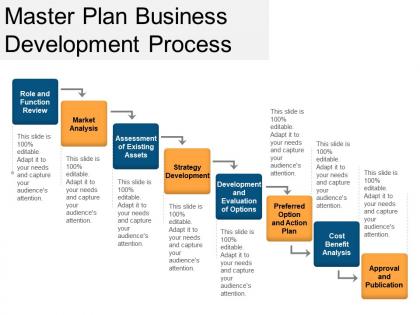
Encourage your teammates and audience through our, master plan business development process PowerPoint slide background. Use this design for business development related strategies We have shown key factors responsible for the working of various segments of a working system. Staircase vision is shown her and arrow symbols to direct the information flow. Stages included here are, role and function review, market analysis, assessment of existing assets, strategy development, development and evaluation of options, preferred optional and action plan, cost-benefit analysis, approval, and publication. Text area corresponding to each stage can be used to describe your business planning, views on the current market and actions needed to be taken in order to achieve desired goals. Develop your strategic planning and use this master pan PPT for the creation of long-term value for an organization from customers, markets, and relationships. Get started with all new experiences with our engaging master plan business development process PowerPoint slide background and forget about disappointments. Click on the download button and just get started. Our Master Plan Business Development Process Powerpoint Slide Background are enthusiastically encouraging. You will feel extra energetic.
People who downloaded this PowerPoint presentation also viewed the following :
Master plan business development process powerpoint slide background with all 5 slides:
Live life large with our Master Plan Business Development Process Powerpoint Slide Background. Give a boost to your growth factor.


FAQs for Master plan business development process
Honestly, business development is like 70% just being good with people - you're basically building friendships that turn into deals. Communication skills are absolutely crucial since you'll constantly be pitching and negotiating stuff. Strategic thinking matters too because you need to spot opportunities before your competitors do. Oh, and don't underestimate how much number-crunching you'll actually do - reading market trends, tracking your sales pipeline, all that fun stuff. I'd say figure out which area feels shakiest for you right now and work on that first. The relationship side is probably the hardest to fake if you're not naturally social.
Honestly, small businesses have a huge advantage - you can move fast while big companies are stuck in endless meetings. Build real relationships with customers (something corporations totally suck at). I've watched tiny shops destroy their competition just by answering emails in an hour vs. days. Your size lets you pivot when markets shift, test crazy ideas, and give personalized service that feels actual human. Oh, and niche markets? That's where you shine. Pick one thing you can do way faster or better than whoever's dominating your space right now.
Dude, market research is like your GPS for business stuff. Without it, you're just guessing where the money is. It shows you who actually wants your product, what problems they're dealing with, and how much competition you're up against. I swear, half the startups I know crashed because they skipped this part - thought they already knew everything. Primary research fills in the details, but start with the basic online stuff first to get your bearings. It's boring but saves you from building something nobody wants.
Honestly, data analytics is like having a crystal ball for your business. You can actually see which leads are worth chasing and predict deals that'll close. Way better than the old spray-and-pray approach we're all guilty of. It shows you what messaging hits different with each customer type, plus you can spot trends your competitors are missing. The real game-changer? You'll know what's genuinely working instead of guessing. I'd start simple though - maybe track lead conversion rates first and see what patterns jump out. Once you get hooked on the insights, you can expand from there.
Honestly, the hardest parts are gonna be finding leads, dealing with forever-long sales cycles, and stakeholders who flip-flop constantly (seriously, why do they do that?). Build real relationships instead of just pitching all the time - networking and referrals crush cold emails every time. Keep prospects interested during those dragged-out cycles by checking in with actual useful stuff, not just "following up." Oh, and write everything down when dealing with wishy-washy decision makers. Trust me on that one. Start tracking your numbers now so you can see what's actually working before everything falls apart.
Honestly, partnerships are the smartest way to grow without blowing your budget. You tap into their customers and expertise while they get something from you too. Think of it like trading strengths - they've got what you're missing, you fill their gaps. Perfect for breaking into new markets or covering stuff you can't handle solo. I always tell people to avoid partnering with direct competitors though, that gets messy fast. Map out what you need first, then hunt for companies hitting the same audience but selling different things. Way less risky than going it alone.
Honestly, just focus on actually getting to know people instead of treating them like business cards to collect. Listen way more than you talk - ask about their real challenges and see how you can help them out first. Hit up industry events regularly, and keep the conversations going on LinkedIn between meetups. Always follow up within 48 hours with something useful, like an article or connection that relates to what you guys talked about. The networking events themselves are kinda awkward anyway, but the real magic happens when you stay consistent over time. It's all about maintaining those relationships so when opportunities pop up, you're already top of mind.
Track your leading stuff first - pipeline growth, meetings booked, partnership convos. That's what drives future results. Then watch the lagging metrics: actual revenue, closed deals, new market wins, customer acquisition costs. Honestly, I used to get obsessed with vanity numbers that looked impressive but didn't matter. Pick maybe 3-4 key things for a monthly dashboard instead of drowning yourself in spreadsheets. Consistency matters way more than perfection here. Stick with the same metrics long enough to actually see patterns, otherwise you're just guessing.
Dude, business development is totally different now with all this tech stuff. AI helps you find prospects way faster than cold calling random people. You can automate your follow-ups too - honestly saves so much time. CRMs let you keep track of everyone without losing leads in spreadsheet hell (been there). Social media's huge for reaching people you'd never get to otherwise. Sometimes I feel like there's too many tools though? Pick maybe 2-3 that actually fix your problems. Don't get caught up trying every new app that comes out.
Your customers are basically handing you a business blueprint for free. Track their feedback systematically - don't just collect random comments and hope for the best. Use it to spot new product opportunities and figure out which features matter most. Honestly, they'll suggest stuff you'd never think of internally (sometimes the most obvious gaps are invisible when you're too close to your business). Look for patterns to find new customer segments. Oh, and feedback shows you market gaps competitors are totally missing. Set up a simple system to capture and analyze everything regularly. It's your roadmap for what to build next.
Dude, you HAVE to get the cultural stuff right or you'll totally crash and burn. I've watched companies fail spectacularly because they didn't bother learning basic customs - like that cringe moment when someone used the wrong hand gesture in their pitch. Research their business etiquette first, then tweak everything from your sales pitch to product features. Different places want different things. Hire local consultants if you can swing it. They'll save you from looking like an idiot and help you actually connect with people instead of just talking at them.
Sales teams close deals with what you've already got - they're chasing those revenue targets. Business development is different though. They're out there building partnerships, finding new markets, creating opportunities that didn't exist before. Honestly, you can't really pick one over the other. Sales keeps money coming in right now (which, let's be real, pays the bills). Biz dev sets you up for bigger growth down the road. The trick is getting both teams to actually work together instead of doing their own thing in separate silos.
Dude, seriously - stories are game changers for presentations. People's brains just work better with narratives than boring data slides. I've watched presenters completely flip their results just by switching from feature lists to actual customer stories. Your prospects will actually pay attention instead of scrolling Instagram under the table. Plus stories build trust, which honestly matters more than specs half the time. Next presentation, try opening with "So we had this client who was dealing with..." instead of jumping straight into your product demo. Works way better than you'd think.
Honestly, everything's going super targeted now - companies are ditching the spam approach for actual data-driven outreach. AI automation is everywhere for lead scoring and personalization (seriously, if you're not testing these tools yet, you're behind). Remote selling obviously isn't going anywhere, but it's way more polished than those awkward Zoom calls from 2020. Partnership deals are the new hotness too. Everyone wants strategic alliances instead of doing everything solo. The spray-and-pray days are pretty much dead, which is probably for the best anyway.
Honestly, most people just chase whatever fire needs putting out that day - total mistake. What works is making sure your quick wins actually connect to bigger picture stuff. Like, go after those high-value clients who might become real partners down the road, you know? I always set aside maybe 20% of my time for longer-term projects, even when everything's chaotic. You've gotta plant seeds while you're harvesting. Track metrics for both so you can tell when you're getting too tunnel-visioned on immediate stuff. The systems that scale later? Start building those now.
-
Content of slide is easy to understand and edit.
-
Innovative and attractive designs.