


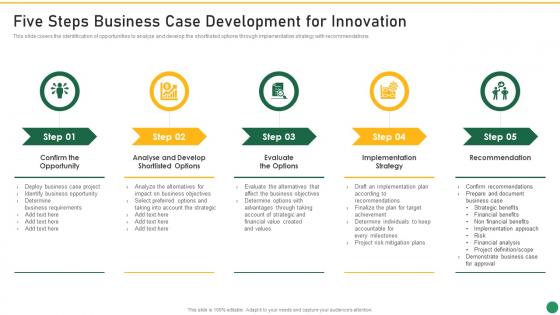
Five Steps Business Case Development For Innovation Set 1 Innovation Product Development




Try Before you Buy Download Free Sample Product
 Impress Your
 Audience
 100%
100% Editable
 Save Hours
 of Time


This slide covers the identification of opportunities to analyze and develop the shortlisted options through implementation strategy with recommendations
People who downloaded this PowerPoint presentation also viewed the following :
Five Steps Business Case Development For Innovation Set 1 Innovation Product Development with all 6 slides:
Use our Five Steps Business Case Development For Innovation Set 1 Innovation Product Development to effectively help you save your valuable time. They are readymade to fit into any presentation structure.






FAQs for Five Steps Business Case Development For Innovation Set 1
The key stages in innovation product development include idea generation, concept development, feasibility analysis, prototype creation, market testing, and commercialization. These stages streamline product launches by validating market demand, reducing development risks, and optimizing resource allocation, with many organizations finding that structured processes accelerate time-to-market while enhancing competitive advantage.
User feedback influences product development by identifying pain points, validating feature concepts, guiding design iterations, and prioritizing development roadmaps based on actual user needs. Through continuous feedback loops, companies streamline their development cycles, reduce costly revisions, and enhance market fit, with many tech organizations finding that systematic user input accelerates time-to-market while delivering more competitive products.
Design thinking plays a pivotal role in product innovation by centering development around user needs, iterative prototyping, and cross-functional collaboration throughout the entire process. This human-centered approach enables organizations to identify unmet market opportunities, reduce development risks through rapid testing, and create solutions that resonate with target audiences, ultimately delivering more successful product launches and stronger competitive positioning.
Organizations foster innovation culture by encouraging experimentation, providing dedicated time for creative projects, implementing open communication channels, establishing cross-functional collaboration spaces, and celebrating both successes and intelligent failures. These approaches streamline idea generation and development, with many companies finding that regular innovation workshops, hackathons, and recognition programs ultimately deliver enhanced employee engagement and competitive advantage.
Key metrics for evaluating new product success include revenue growth, market share capture, customer acquisition costs, user engagement rates, and customer lifetime value. These indicators work together to provide comprehensive performance insights, with many organizations finding that combining financial metrics with user satisfaction scores and retention rates delivers the most strategic advantage for scaling products across competitive markets.
Market trends significantly impact innovation strategy by shaping product development priorities, resource allocation decisions, and competitive positioning approaches. Companies leverage trend analysis to identify emerging opportunities, anticipate customer needs, and align their innovation pipelines accordingly, with many organizations finding that proactive trend monitoring enables faster market entry, reduces development risks, and ultimately delivers sustainable competitive advantage.
Common product development pitfalls include insufficient market research, feature creep, poor stakeholder communication, inadequate testing phases, and misaligned timelines with budget constraints. These challenges often derail projects by creating scope confusion, delayed launches, and products that miss target audiences, with many development teams finding that early validation and structured feedback loops ultimately deliver more focused solutions and competitive market positioning.
Cross-functional collaboration enhances product innovation by combining diverse expertise, accelerating decision-making, and reducing development cycles through integrated planning. Teams spanning engineering, marketing, design, and operations streamline communication, identify market opportunities faster, and deliver more comprehensive solutions, with many organizations finding that collaborative approaches ultimately reduce time-to-market while improving product-market fit.
Product development tools include design thinking platforms, rapid prototyping software, collaborative project management systems, customer feedback analytics, and agile development frameworks. These technologies streamline innovation by accelerating iteration cycles, enhancing cross-functional collaboration, and integrating real-time market insights, with many organizations finding that strategic tool combinations reduce development timelines while improving product-market fit.
Competitive analysis informs innovation by revealing market gaps, identifying emerging trends, and highlighting successful strategies that can be adapted or improved upon. Through systematic competitor research, organizations can benchmark their capabilities, anticipate market shifts, and develop differentiated solutions, while avoiding costly mistakes others have made, ultimately accelerating time-to-market and enhancing competitive positioning.
Prototyping enables rapid testing, validation, and refinement of product concepts before full-scale production, significantly reducing development costs, minimizing risks, and accelerating time-to-market. Through iterative prototyping, organizations can gather user feedback, identify design flaws, and optimize functionality early in the process, ultimately delivering more market-ready products while streamlining resource allocation and enhancing competitive positioning.
Intellectual property considerations significantly influence innovation strategies by determining research directions, partnership structures, competitive positioning, and market entry timing. Organizations must balance patent protection with open innovation approaches, often finding that strategic IP management enables faster product development, stronger market differentiation, and enhanced licensing opportunities while minimizing infringement risks.
Successful disruptive innovation case studies include Netflix revolutionizing entertainment through streaming, Uber transforming transportation with ride-sharing, Airbnb disrupting hospitality via home-sharing, Tesla electrifying automotive markets, and Amazon Web Services reshaping cloud computing. These innovations streamlined traditional industries by eliminating intermediaries, reducing costs, and enhancing accessibility, with many organizations finding that early adoption delivers significant competitive advantages.
Firms balance risk and creativity through structured innovation processes, diversified product portfolios, staged development approaches, cross-functional collaboration, and market validation techniques. By implementing design thinking methodologies, creating innovation labs, and establishing clear go/no-go criteria at each development phase, organizations can pursue breakthrough innovations while managing exposure, ultimately delivering competitive advantages and sustainable growth.
Emerging trends in sustainable product development include circular design principles, bio-based materials, carbon-neutral manufacturing, lifecycle assessment integration, and regenerative design approaches. These methodologies streamline environmental impact while enhancing market competitiveness, with companies in automotive, packaging, and consumer electronics finding that sustainable innovation ultimately delivers cost savings, regulatory compliance, and stronger customer loyalty in an increasingly eco-conscious marketplace.
-
“Detailed and great to save your time.”
-
Wonderful ideas and visuals. I'm really pleased with the templates, which are unique and up to date.