Prototyping And Testing Design Thinking Process Set 1 Innovation Product Development

Rating:
80%
Prototyping And Testing Design Thinking Process Set 1 Innovation Product Development
Slide 1 of 6

or

Favourites Favourites

Try Before you Buy Download Free Sample Product

Audience Impress Your
Audience
Editable 100%
Editable
Time Save Hours
of Time
The Biggest Sale is ending soon in
0
0
:
0
0
:
0
0
Rating:
80%
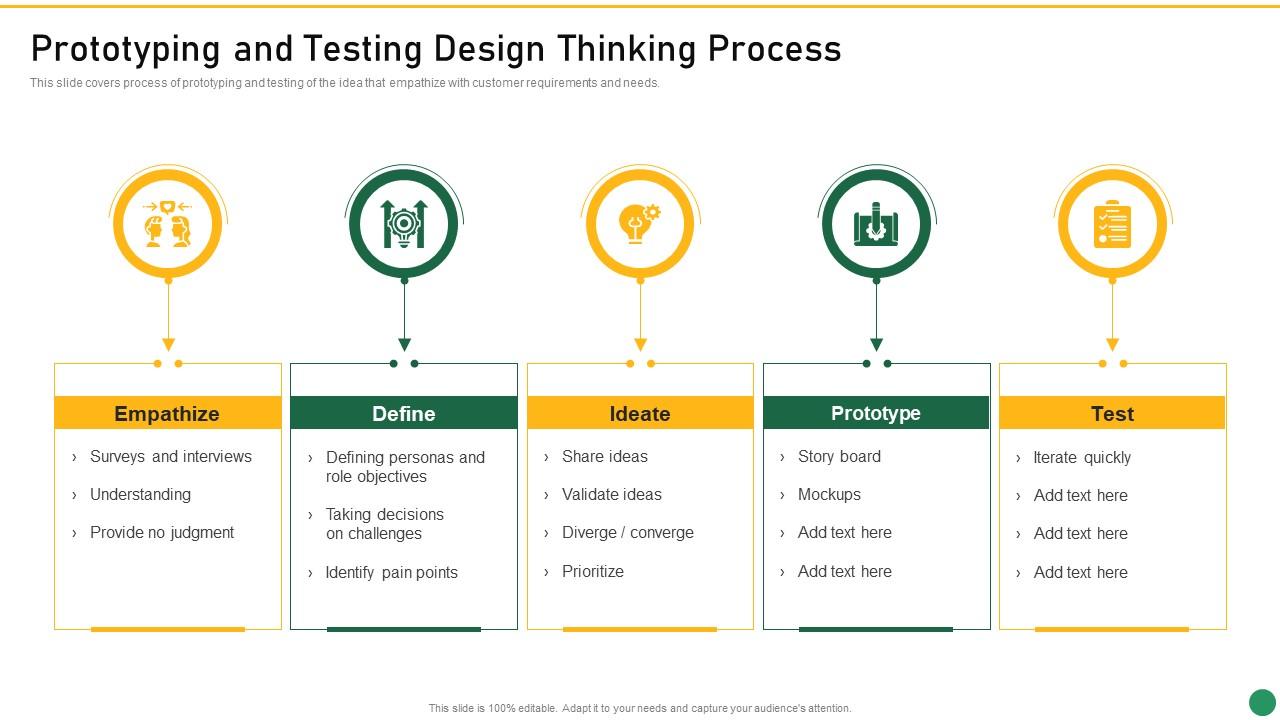
This slide covers process of prototyping and testing of the idea that empathize with customer requirements and needs. Introducing Prototyping And Testing Design Thinking Process Set 1 Innovation Product Development to increase your presentation threshold. Encompassed with five stages, this template is a great option to educate and entice your audience. Dispence information on Surveys And Interviews, Understanding, Provide No Judgment, Defining Personas And Role Objectives, Taking Decisions On Challenges, using this template. Grab it now to reap its full benefits.
FAQs for Prototyping And Testing Design Thinking Process Set 1

Prototyping delivers early user feedback, reduces development costs, accelerates time-to-market, minimizes design risks, and enhances stakeholder communication throughout product development. These approaches streamline decision-making by identifying usability issues, validating market demand, and refining functionality before full-scale production, with many organizations finding that strategic prototyping ultimately delivers competitive advantage and significantly higher product success rates.

Prototyping enhances communication by creating tangible, visual representations that eliminate ambiguity, align expectations, and facilitate clearer feedback exchanges among diverse team members. Through interactive models and mockups, teams can identify potential issues earlier, streamline decision-making processes, and ensure stakeholders understand project vision, ultimately reducing costly miscommunications and accelerating development timelines.

Prototypes include paper prototypes, digital wireframes, interactive mockups, functional prototypes, and high-fidelity demos, each serving distinct validation purposes throughout development cycles. Paper prototypes work effectively for early concept testing, while interactive mockups excel in user experience validation, and functional prototypes prove invaluable for technical feasibility assessment, with many organizations finding that strategic prototype selection accelerates product development timelines significantly.

Prototyping mitigates project risks by identifying design flaws early, validating user requirements, and testing technical feasibility before full development. Through iterative testing and feedback, organizations streamline resource allocation, minimize costly revisions, and enhance stakeholder alignment, with many companies finding that early prototyping reduces development costs by up to 60%.

High-fidelity prototyping tools include Figma, Adobe XD, Sketch, InVision, and Axure RP, each offering advanced design capabilities, interactive elements, and collaboration features. These platforms streamline the design process by enabling real-time collaboration, component libraries, and seamless handoffs to development teams, with many organizations finding that strategic tool selection significantly accelerates product development cycles.

User feedback during prototyping identifies usability issues, validates design assumptions, and reveals user preferences through direct interaction with early product versions. This iterative input enables development teams to refine features, streamline interfaces, and optimize functionality before final production, ultimately reducing development costs and accelerating time-to-market while ensuring market-ready solutions.

Common prototyping pitfalls include over-engineering early versions, skipping user feedback loops, perfectionism that delays testing, unclear objectives, and inadequate stakeholder communication. These mistakes significantly slow development cycles and increase costs, with many organizations finding that focusing on rapid iteration, clear success metrics, and early user validation ultimately delivers more successful products and competitive market positioning.

Rapid prototyping accelerates innovation by enabling faster concept validation, reducing development costs, facilitating early user feedback, and minimizing time-to-market cycles. Through iterative testing and refinement, organizations across industries like automotive, healthcare, and consumer electronics can identify design flaws early, ultimately delivering better products while maintaining competitive advantage in increasingly fast-paced markets.

Hardware prototyping involves physical materials, manufacturing constraints, and iterative testing of tangible components, while software prototyping focuses on user interfaces, functionality workflows, and rapid digital iterations. Hardware projects require specialized tools, longer development cycles, and consideration of physical limitations, whereas software prototypes enable faster testing, easier modifications, and immediate user feedback, ultimately delivering different approaches to validation and refinement.

Prototyping serves as a cornerstone of agile development, enabling rapid iteration, early stakeholder feedback, continuous refinement, and risk mitigation throughout development cycles. These iterative prototypes streamline communication between development teams and clients, accelerate decision-making processes, and minimize costly late-stage revisions, with many software companies finding that strategic prototyping ultimately delivers faster time-to-market and enhanced user experiences.

Incorporating user testing into prototyping improves final outcomes by identifying usability issues early, validating design assumptions, reducing development costs, and ensuring product-market fit before full-scale implementation. Through iterative feedback loops, organizations across sectors like healthcare, fintech, and e-commerce streamline their development cycles, minimize costly revisions, and ultimately deliver solutions that better meet user needs and drive higher adoption rates.

Teams should consider user engagement metrics, task completion rates, time-to-completion, error frequency, and stakeholder feedback scores when evaluating prototype success. These measurements enable organizations to assess usability, functionality, and market viability early in development, with many product teams finding that comprehensive metric analysis streamlines iterations, reduces costly revisions, and ultimately accelerates successful product launches.

Prototyping integrates into remote teams through cloud-based design platforms, virtual collaboration tools, real-time feedback systems, and digital handoff processes. These technologies streamline development by enabling simultaneous editing, instant stakeholder reviews, and seamless version control, with many distributed organizations finding that structured prototyping workflows ultimately deliver faster iterations and stronger team alignment.

Successful products through iterative prototyping include the iPhone, which evolved from multiple hardware and software iterations, Tesla vehicles that continuously improve through over-the-air updates, and Airbnb's platform that transformed from simple room-sharing to comprehensive travel experiences. These innovations demonstrate how iterative development enables companies to refine user experiences, enhance functionality, and adapt to market feedback, ultimately delivering products that achieve sustained competitive advantage and market leadership.

Prototyping aids team alignment by creating tangible representations that clarify abstract concepts, facilitate collaborative feedback, and establish shared understanding of project objectives. Through interactive mockups and visual models, development teams, stakeholders, and designers can identify misalignments early, streamline communication, and ensure everyone works toward unified goals, ultimately reducing costly revisions and accelerating project delivery.

Ratings and Reviews

80% of 100
Review Form
Write a review
Most Relevant Reviews
  1. 80%

    by Jack Johnson

    Fantastic and innovative graphics with useful content. The templates are the best and latest in the industry.
  2. 80%

    by Darell Vargas

    SlideTeam is the way to go when you are in a time crunch. Their templates have saved me many times in the past three months.

2 Item(s)

per page: