


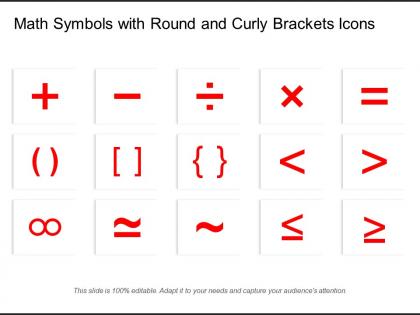
Math symbols with round and curly brackets icons




Try Before you Buy Download Free Sample Product
 Impress Your
 Audience
 100%
100% Editable
 Save Hours
 of Time


Folks become grateful for their good fortune due to our Math Symbols With Round And Curly Brackets Icons. Enable them to improve their finances.
People who downloaded this PowerPoint presentation also viewed the following :
Math symbols with round and curly brackets icons with all 5 slides:
Display economic efficiency with our Math Symbols With Round And Curly Brackets Icons. They help cut down on extra expenditure.

FAQs for Math symbols with round and
So you'll definitely need the basics first - +, -, ×, ÷ and = for sure. Parentheses too for grouping stuff. Then there's < and > for inequalities, fractions like a/b, and exponents (x²). Oh, and that square root symbol √ that looks like a weird checkmark. Variables are usually x, y, z, though mathematicians get fancy with Greek letters sometimes - honestly kind of pretentious if you ask me. You'll see π for pi, ∞ for infinity, and sets written like {1,2,3} with curly brackets. Master these and you won't feel totally lost reading math anymore.
Math notation evolved from ridiculously wordy to sleek over thousands of years. Babylonians literally wrote out "the unknown quantity" instead of "x" - can you imagine? Arabic mathematicians changed everything around 800 CE by introducing algebra symbols. Europeans didn't add + and - until the 1400s, which seems so late. The equals sign wasn't even invented until 1557! That one always blows my mind. If you want to dig deeper, Florian Cajori's "A History of Mathematical Notations" is actually a fun read despite how dry it sounds.
Math notation is basically shorthand that saves your brain from overload. Like instead of saying "the sum of all integers from 1 to n" you just slap down that Σ symbol and you're done. Super efficient. What's cool is it works across languages too - a mathematician in Japan reads the same symbols as someone in Brazil. Forces you to be precise with your thinking since messy notation = messy logic (learned that the hard way). Plus you can cram these complex relationships into tight spaces that would otherwise eat up half a page. Next time you're doing a proof, you'll probably notice how the symbols help you follow along way better.
Honestly, standardization saves so much headache. Picture trying to read physics papers when they use completely different symbols for derivatives than what you learned in calc - nightmare fuel. When everyone sticks to the same notation, you can actually jump between disciplines without needing a decoder ring. Yeah, there are still weird field-specific things that'll mess you up (looking at you, engineering constants), but at least the basics stay consistent. My take? If you're writing anything cross-disciplinary, just use the most common conventions. It's not worth being creative with notation if nobody can follow your work.
Yeah, each math area basically has its own language that developed over time. Algebra's pretty straightforward with x, y, z variables written out horizontally. But then calculus throws these crazy symbols at you - ∫ for integrals, d/dx for derivatives. I swear it looked like ancient Egyptian when I first saw it! Geometry does its own thing with angle notations, and stats is obsessed with Greek letters (σ, μ, all that). Each field just created notation that made their work easier. My advice? Don't stress about memorizing everything upfront - just pick up symbols as you go.
Bad notation is honestly the worst - it completely kills your momentum when solving problems. Like when you can't tell if x means multiply or it's a variable. Handwritten stuff that looks like ancient Egyptian doesn't help either! Inconsistent symbols across different problems make you second-guess everything. Spacing gets messy and suddenly your order of operations is wrong because the parentheses are unclear. Then you're stuck figuring out what units you're even working with or what the variables actually represent. It's such a time waster. Just make sure your notation actually makes sense when you write it down.
Math notation's actually pretty random when you think about it. Leibniz invented the integral sign (∫) and d/dx for derivatives, but Newton just used dots for time stuff. The equals sign didn't even exist until some guy named Robert Recorde made it up in the 1500s - like, people did math for centuries without =! Arabic numerals came from Islamic mathematicians, obviously. Plus and minus signs? German merchants invented those. Hindu-Brahmi numbers gave us decimals. You should totally look up how different cultures wrote zero - it's crazy how they figured out ways to make math actually workable instead of impossibly messy.
Honestly, it's wild how much easier math notation has gotten. You can type equations in LaTeX and they render instantly online - no more struggling with those ancient equation editors. MathJax lets websites display gorgeous formulas, and there are apps now that convert your handwriting to digital text (though I still grab pen and paper half the time anyway). The best part? You don't need to be some typesetting wizard anymore to make professional-looking documents. Real-time collaboration is huge too. Definitely learn basic LaTeX syntax if you haven't - it's basically the universal language for math stuff now.
Ugh, the worst part is definitely cognitive overload. Kids are trying to decode weird new symbols AND understand the actual math at the same time - it's brutal. Plus different textbooks use notation slightly differently, which drives everyone crazy. I swear some authors just want to be special. Memory's another nightmare since these symbols are so abstract and random-looking. What helps: give them reference sheets they can actually use, and introduce symbols slowly instead of throwing everything at them. Short sentences work better for this stuff. Don't overwhelm them right off the bat.
Honestly, visuals just make math way less intimidating. Your brain can actually grasp what's happening when you see a graph next to an equation instead of just staring at random symbols. It's like having translation help! Plus everyone learns differently - some people are total visual learners who'd be lost without diagrams or those little fraction blocks. The trick is actually connecting the pictures to the math symbols though. Don't just throw charts around randomly. Show kids how that curve on the graph relates to the x² in the equation. Makes everything click together way better.
They're basically cousins, honestly - both express logic and operations with different syntax. Variables, functions, operators, even loops (just iterative operations) mirror math concepts you already know. MATLAB and R are literally math you can execute, which is pretty cool. Programming languages just need to be 100% unambiguous since computers are dumb and need everything spelled out. Math notation? Way more flexible and context-dependent. When learning new languages, hunt for those mathematical concepts first. Makes picking up the syntax so much easier once you spot the patterns.
Yeah, it's annoying but not terrible. Biggest pain is decimal stuff - like Europeans using commas where we use periods. Function notation varies too, plus different symbols for the same operations. I've literally spent 10 minutes at the start of Zoom calls just figuring out what someone's notation means lol. Most published math follows pretty standard conventions though. My advice? Hash out notation rules right away when you start collaborating. Maybe keep a shared doc if you're using regional symbols - saves headaches later. The math world has gotten better about this over time, honestly.
Start slow with notation - connect it to stuff they already get. I've watched teachers just throw symbols at kids with zero context, which is basically educational malpractice. Begin with concrete examples, then work toward the abstract stuff. Always explain why we use certain symbols (like, there's actually reasons). Have them read notation out loud, not just scribble it down. Let them translate between different ways of writing the same thing. Here's what really works though - let them invent their own notation first, then show the "official" version. They'll actually understand the why behind it. Give them space to argue about notation choices too.
Okay so proofs are super strict about notation - like, every single symbol has to be defined perfectly, and you're constantly using those logical operators (∀, ∃, ⟹) to make everything bulletproof. Applied math? Way more chill, thankfully. You can use shortcuts and approximations without justifying every step. Like in proofs you'd spend forever on epsilon-delta stuff, but applied work lets you just say "as x approaches..." and jump to the actual calculation. I guess the mindset's different too - proof readers are basically hunting for logical holes, while applied math people just want to get your method and see results. Makes the writing totally different.
Honestly, the worst trap is assuming math notation is the same everywhere - it's not! European papers use different symbols than American ones. Engineering vs pure math? Totally different conventions. Like, sometimes there's no "rule" for why we use *i* instead of *j* for imaginary units, it's just what people do. Don't even get me started on subscripts and superscripts - they mean different things depending on context. My advice? Always hunt down the definitions section first when you're reading something new. Saves so much confusion.
-
Understandable and informative presentation.
-
Very unique and reliable designs.