


0514 stomach anatomy medical images for powerpoint




Try Before you Buy Download Free Sample Product
 Impress Your
 Audience
 100%
100% Editable
 Save Hours
 of Time


Our 0514 Stomach Anatomy Medical Images For PowerPoint allow you to gad about. They leave you free for other activities.
People who downloaded this PowerPoint presentation also viewed the following :
Content of this Powerpoint Presentation
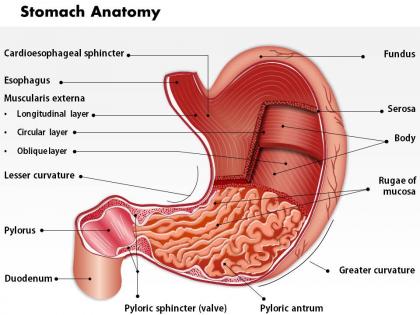
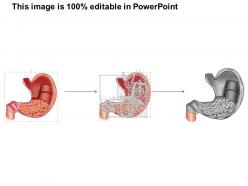
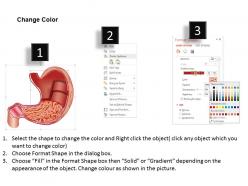
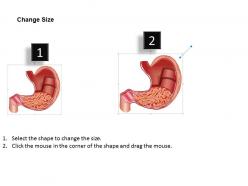
Stomach anatomy is all about studying the internal composition of the abdomen. It is the place where food digestion takes place. It is the backbone of the human anatomy because whatever we consume is going to affect our overall health. It resides in the upper gut, a J-shaped biological structure surrounded by the duodenum and esophagus. It comprises four crucial parts; these are cardia, where the esophagus associates. The second one is the fundus, where eaten food and secretes gastric juices are stored; the body is accountable for mixing food with digestive enzymes. The last one is pylorus, which regulates food passage into the small intestine. Stomach anatomy eases the digestive process effectively.
Explore the intricate network of the stomach's inner workings with the stomach human anatomy PowerPoint slide. Click here to download and get started.
Understanding abdomen anatomy is similar to understanding business concepts. Stomach anatomy takes care of digestion and ensures good health. Likewise, knowing corporate fundamentals helps keep our business healthy. Furthermore, just like the stomach contains different parts that are required to work together for effective digestion, the corporation comprises several departments and functions that are associated with producing results. Additionally, by grasping stomach anatomy, an individual can appreciate the value of synergy and coordination, which are equally significant for corporate success. Business development requires a process to be followed by all team members; those who comprehend stomach anatomy are likely to make better business decisions as they have better knowledge to yield the desired results.
Click here to download our insightful guide on understanding and managing stomach ulcers, which explains symptoms, causes, and effective treatment options.
Use our stomach anatomy PPT designs to craft effective presentations. They help you communicate business, education, or other relevant information professionally. These PowerPoint slides also enable you to engage your audience when you impart knowledge related to it. They convert your presentation from boring to extraordinary. Our PowerPoint layouts enable you to showcase your expertise in medical education or even corporate management.
Template 1: Stomach Anatomy
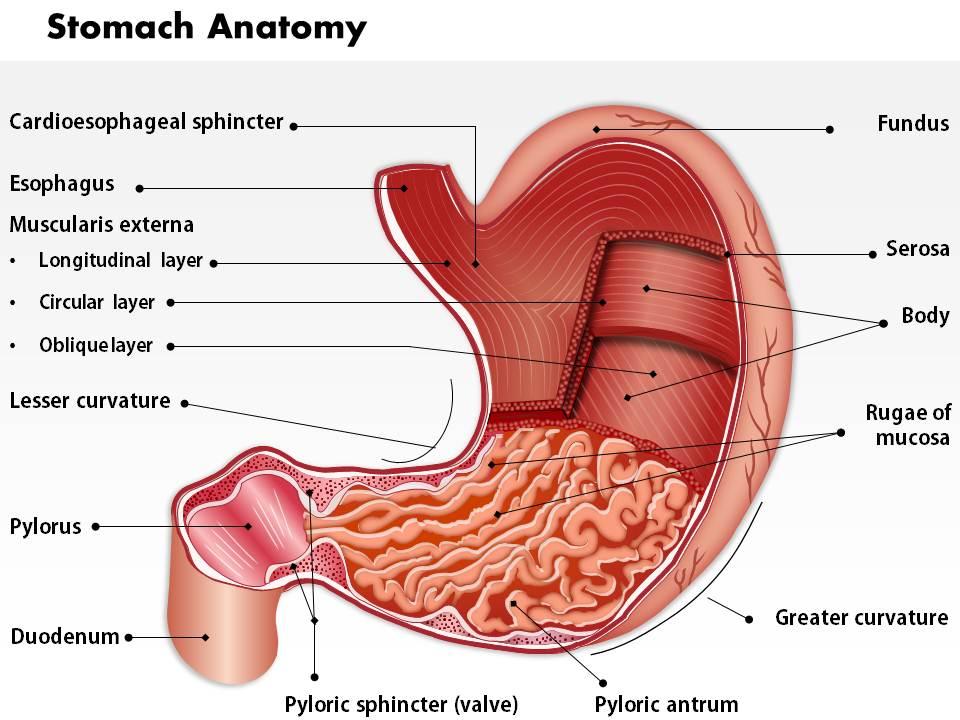
This PowerPoint template provides a complete overview of stomach anatomy. It elaborates on the internal structures. This presentation slide is beneficial to professionals such as gastroenterologists, anatomists, medical educators, and surgeons. They will find this valuable resource for understanding the complex structures of the abdomen. Whether you are crafting a presentation for educational purposes, surgical needs, or patient medical history, this PPT layout will add value to you. Download and present the concepts effectively with this PowerPoint diagram.
Template 2: Stomach Anatomy – White Labels Removed
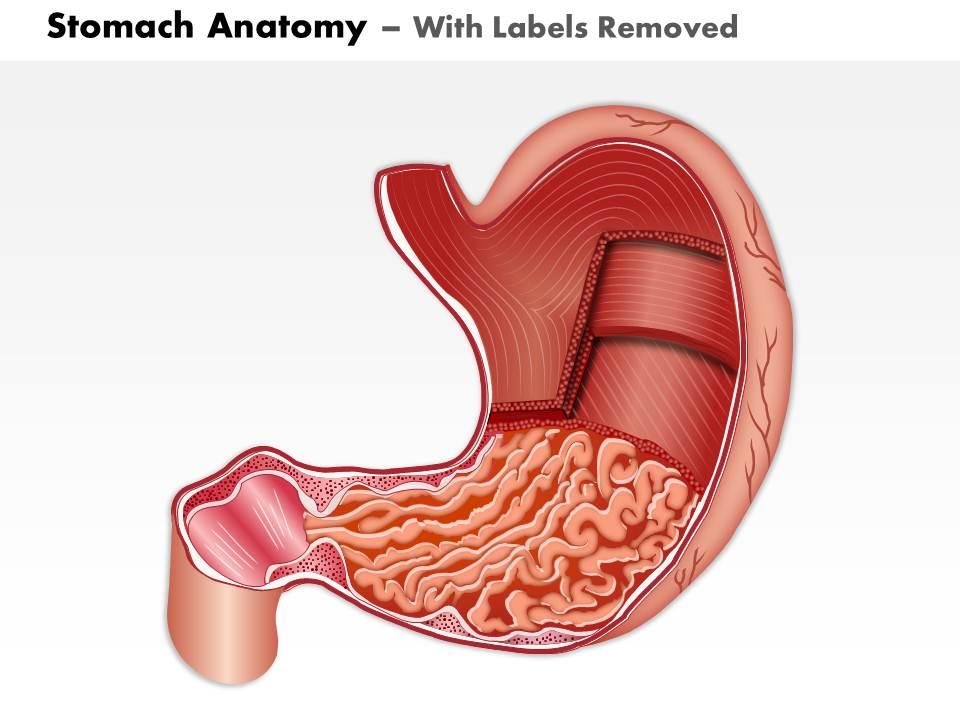
This presentation layout offers an insightful depiction of stomach anatomy without labels. It allows for interactive learning and engagement. This PowerPoint visual adds value to people working as medical illustrators, educators, researchers, and healthcare communicators. This PPT resource is invaluable for them when creating presentations, customizing education materials, and so on. Besides this, using this presentation design, they can also highlight vital functions of the stomach, which act as a temporary reservoir. Furthermore, the PowerPoint diagram also helps showcase the human digestive process. Download now.
Template 3: Stomach Anatomy – With Highlighted Part
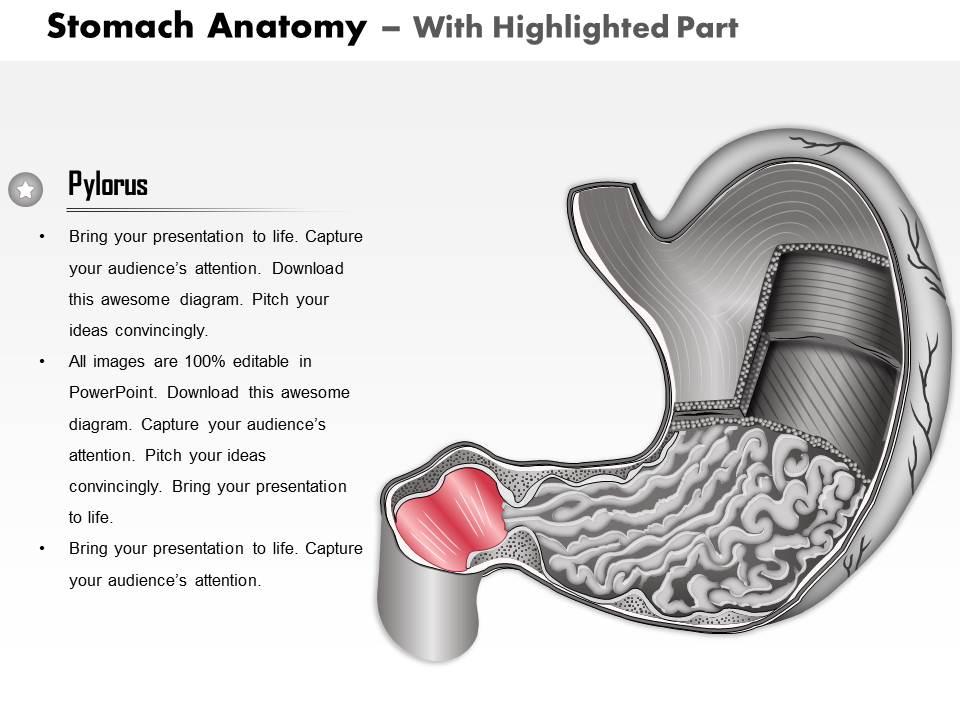
This PPT visual provides an illuminating overview of stomach anatomy. It focuses on the pivotal region - the pylorus. The presentation design helps you to portray the functionality of the pylorus in the stomach. The pylorus is critical for the right balance among the gut and the small intestine. It ensures the regulation of the movement of gastric juices and food. This PPT graphic is valuable for understanding and effective communication of gastrointestinal anatomy and physiology. The PowerPoint diagram gives the best value to professionals like gastroenterologists, medical educators, anatomists, and even surgeons. Download now and share it with your audience.
Template 4: Stomach Anatomy – With Highlighted Part (Duodenum)
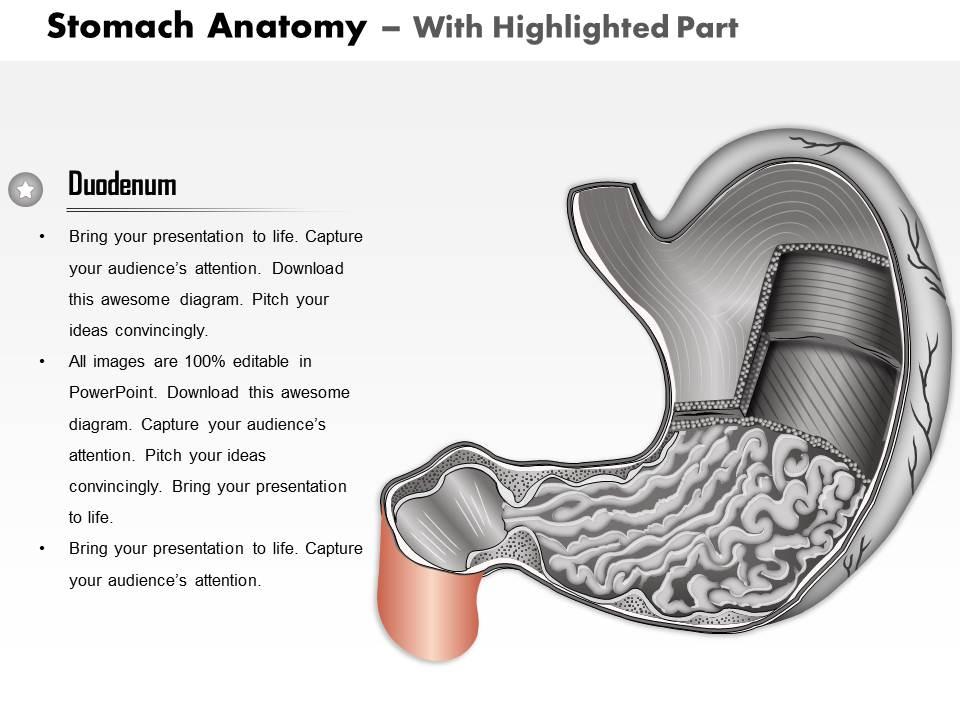
This PowerPoint diagram emphasizes the duodenum as the highlighted part. It resides at the start of the small intestine and participates actively in the digestion process. This presentation design helps you to show how it receives partially digested food from the abdomen and breaks it down with the help of bile and pancreatic enzymes. This PPT visual is beneficial for gastroenterologists, surgeons, medical educators, and anatomists. It enables them to share their knowledge and learning in the field of stomach anatomy with conviction. Furthermore, it also gives clarity to academic lectures when it is about imparting knowledge related to it to the students. Download now.
Discover the Depths: Stomach Secrets
An understanding of stomach anatomy is essential for many fields. It is significant for people working in the education, business, and medicine sectors. Our PowerPoint visuals provide you with an opportunity to create impactful presentations that can make an impression on your audience. Furthermore, these PPT slides are accessible with and without labels, which gives you the leverage to customize your design according to your business needs. Our presentation templates fulfill your purpose of educating your people, which can be your students or colleagues.
Download them now and be ready to show your prowess with precision.
0514 stomach anatomy medical images for powerpoint with all 9 slides:
Our 0514 Stomach Anatomy Medical Images For PowerPoint team have a good habit. They are always cross checking facts.


FAQs for 0514 stomach anatomy medical
So your stomach is basically like a food blender that also happens to be incredibly acidic - we're talking pH 1.5, which is wild. It stores what you eat and starts breaking down proteins using gastric acid and pepsin. Pretty gross but effective! The churning action mixes everything together while killing off most bacteria that hitched a ride with your meal. After all that, it slowly dumps this soupy mess into your small intestine where the real magic happens with nutrient absorption. Your stomach's more of a prep cook than the main chef, if that makes sense.
Your stomach's basically a muscular bag with thick walls that churn food around like a washing machine. It's got these folds called rugae that stretch when you eat (and boost surface area for digestion). The lining pumps out acid and enzymes that start breaking down proteins. That curved J-shape? Super smart design - food flows smoothly from your esophagus down to the small intestine. Oh and pro tip for studying: match each structure to its job. That's what professors love testing on. The whole thing's honestly pretty brilliant when you think about it.
So your stomach has four main parts that all do different things. The fundus at the top stores food and gas - like a holding tank. Then the body section does most of the mixing with gastric juices. Down at the bottom, the antrum grinds everything up into smaller bits (this part works pretty hard tbh). The pylorus is basically quality control - it decides what gets passed into your small intestine through this little valve called the pyloric sphincter. It's kind of like an assembly line but for digestion. Storage first, then mixing, grinding, and finally shipping out. This flow actually helps explain why certain GI problems happen in specific areas.
So your stomach has these three smooth muscle bands that work together to churn food around with gastric juices. Pretty wild mechanism honestly. They create these wave-like contractions that basically turn your stomach into a mixing bowl - you can sometimes feel it happening after you eat. Breaking down food isn't just chemical though, there's serious mechanical grinding going on too. The muscles push everything toward that pyloric sphincter while physically breaking apart food particles. When you're talking to patients about digestion, definitely mention both parts - the churning motion is just as important as the acid breakdown stuff.
So your stomach is basically like a chemical factory. It pumps out hydrochloric acid that kills bacteria and turns pepsinogen into pepsin - that's what breaks down proteins. There's also some gastric lipase for fats, plus mucus that keeps the acid from eating through your stomach wall (which is honestly pretty wild when you think about it). The acid helps you absorb iron, calcium, and B12 too. That's actually why taking too many antacids can screw with your nutrient levels - your body needs that acidic environment to work right.
So basically the pyloric sphincter is like a bouncer for your stomach - decides what gets through to your duodenum and when. It waits for the food to get acidic enough and properly mushy before opening up. Smart little muscle, right? Also stops bile from flowing backward into your stomach, which would suck. Normal emptying takes about 2-4 hours after you eat. Oh, and if someone's got gastroparesis or dumping syndrome? Yeah, that's usually this guy malfunctioning. Pretty wild how one tiny sphincter can mess up your whole digestive game.
Your stomach is basically a acid bath - we're talking pH 1.5-2, which is insane when you think about it. That acid does two main things: breaks down proteins and kills nasty bacteria in your food. Special cells called parietal cells pump out hydrochloric acid that activates pepsin, your protein-digesting enzyme. Pretty crazy stuff happening in there! The acid also helps you absorb iron, calcium, and B12. Without enough stomach acid, you'd have trouble digesting protein and get sick way more often from food. Honestly, if you're popping antacids all the time, maybe think twice about shutting down that acid production.
So your stomach has these endocrine cells that are like chemical messengers for digestion. G cells release gastrin when food shows up, telling your stomach to make more acid. Then D cells put out somatostatin to slow things down when needed - pretty cool how that works. There's also ghrelin making you hungry and leptin telling you when you're full (though I swear my leptin's broken half the time). These cells coordinate your stomach acid, enzymes, and how fast food moves through. It's wild how much chemistry happens just from eating a sandwich.
So the big three you'll encounter are peptic ulcers, gastritis, and GERD. Ulcers are basically painful sores that develop in your stomach lining - usually thanks to H. pylori bacteria or too many NSAIDs. GERD is when stomach acid decides to take a little trip back up into your esophagus (not fun). Then there's gastritis, which is just your entire stomach lining getting pissed off and inflamed. They all mess with that protective mucus barrier your stomach relies on. When patients come in complaining about persistent stomach pain, nausea, or that classic burning feeling, these three are definitely where I'd start looking first.
So your stomach is basically the middle guy in digestion. Food drops down from your esophagus, gets all churned up with acid, then heads to your small intestine where the real nutrient absorption magic happens. What's cool is your stomach actually sends hormone signals to your pancreas and gallbladder - telling them when to dump in enzymes and bile. It's surprisingly coordinated when everything's working. Oh, and if you're having gut issues, just know that problems in one spot usually mess with the whole system. Everything's connected, you know?
Oh man, aging stomachs are weird! The walls get thinner and less stretchy, so they can't expand and contract like before. Acid production drops too. Food literally just sits there longer because gastric emptying slows way down - kinda gross when you think about it. Blood flow decreases, which screws with healing and general function. That's why older folks get more reflux and their meds don't absorb as well. Plus digestion becomes this whole slow ordeal. Really explains a lot about those GI complaints you see!
Look, what you eat totally messes with your stomach's acid production and how fast things move through there. Spicy or super acidic stuff irritates your stomach lining and makes it pump out way too much acid. Fat slows everything down - like, your stomach just sits there struggling to empty. Processed junk is honestly the worst because it's got zero fiber and weird additives that screw up digestion. I learned this the hard way after too many late-night pizza binges. But fiber-rich foods actually help things move along properly, and probiotics keep your gut bugs happy. Try eating at regular times too - your stomach loves routine. Cut the processed crap first, then add more real food.
So basically your stomach has this crazy good defense system - it pumps out thick, alkaline mucus that neutralizes the acid before it can burn through your stomach wall. Plus there's bicarbonate ions for extra protection. What's wild is your stomach lining completely replaces itself every 3-5 days, which honestly seems exhausting lol. Tight cell junctions seal everything up too. Ulcers happen when this whole system fails. If your stomach's been acting up for a while though, you should probably get it checked out - could mean something's not working right.
Your vagus nerve is like your stomach's main controller. It kicks off acid production and gets digestive enzymes flowing. Even just smelling good food? That's your vagus nerve prepping everything before you take a bite. It also manages that pyloric sphincter - basically the gatekeeper deciding when food moves to your small intestine. The whole system's pretty interconnected, honestly. Oh, and if you're dealing with gastroparesis patients or motility problems, definitely look into vagal function. Nerve damage there can throw off the entire digestive rhythm.
So for stomach imaging, you've got CT enterography, MR enterography, and endoscopic ultrasound - way better than regular X-rays. CT and MRI show wall thickness, inflammation, masses, all that stuff. Endoscopic ultrasound gets you super close to see the actual gastric wall layers. The image quality now is honestly insane compared to like 2014. Oh, and there's gastric emptying scintigraphy if you need to check how well it's actually functioning. For tricky cases, I'd def chat with radiology first about which one gives you what you're looking for.
-
Top Quality presentations that are easily editable.
-
Good research work and creative work done on every template.