


Mission And Vision Statement Cosmetic And Beauty Products Company Profile




Try Before you Buy Download Free Sample Product
 Impress Your
 Audience
 100%
100% Editable
 Save Hours
 of Time


This slide focuses on companys mission and vision statement which describes the desired future position of company by defining purpose, goals, expertise, etc.
People who downloaded this PowerPoint presentation also viewed the following :
Content of this Powerpoint Presentation
Mission and Vision statements are central to the existence of businesses. Whether clearly articulated across a multi-billion US dollar business or just an unstated assumption in a bootstrapped small company, mission and vision statements help everybody understand and connect better with the business.
Brands really value mission and vision statements. Find a cosmetic brand reaping the benefits.
For instance, consider this statement: To become the first choice for cosmetic care products aiming to break into new markets within and beyond the US. As you can see, this is the vision statement of a cosmetics firm that we feature in the template below as well.
The implication, then, is to ensure that the central purpose of the business is communicated and that it guides all stakeholders, especially the staff, when they need inspiration.
A cosmetic company overview that can really make for a wow experience can be found with a click here.
At SlideTeam, we have curated many content-ready mission and vision PPT templates, providing a ready-made solution to your woes regarding a perfect mission and vision statement. These templates are 100% editable and customizable.
Let’s explore!
Template 1 Mission and Vision of Cosmetics Beauty Products PPT
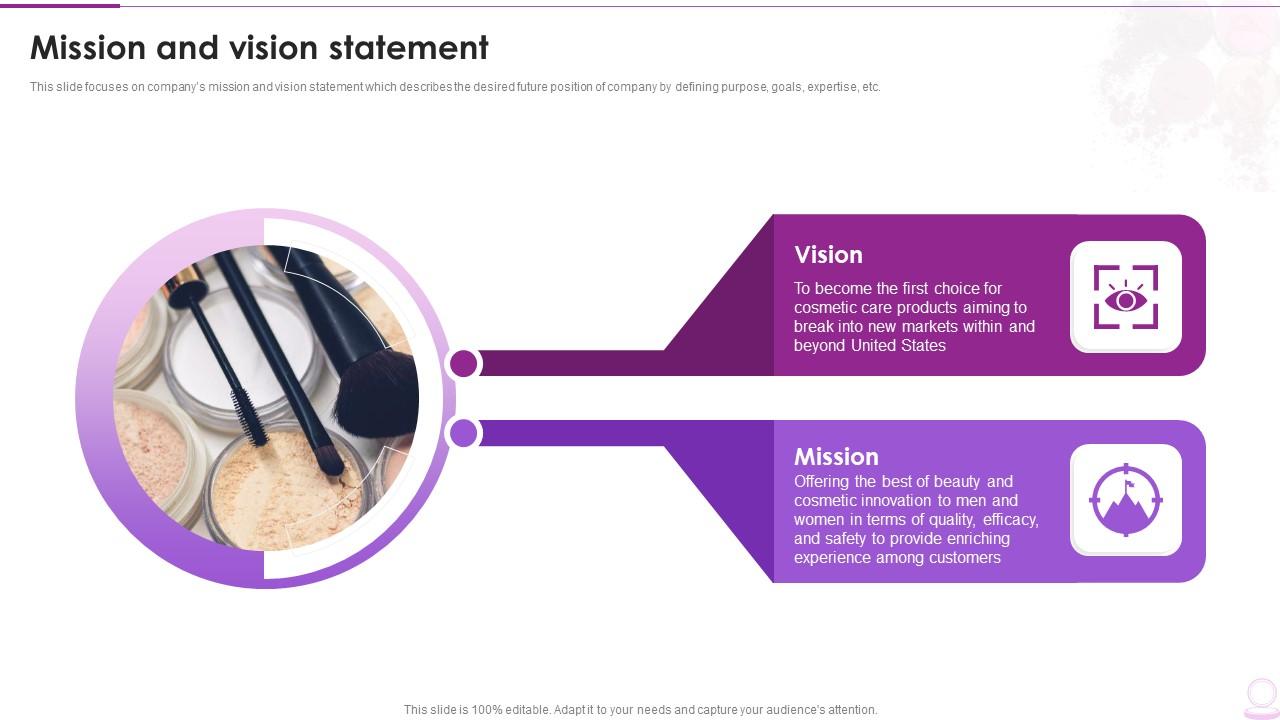
This mission and Vision PPT Template is a primer on how to define your future state and state with conviction the actions that will take you there. Use this slide to streamline and refine your critical vision and mission statements to perfectly capture why the business exists and where it will be 10 years from now. The focus of the PPT Layout is on the company’s mission and vision statement, which describes the desired future position of the company by defining purpose, goals, expertise, etc. The sample taken for this purpose is a cosmetics firm. The wonderfully designed design depicts both the Vision and mission as the arms of a beautiful cosmetics brush.
The wonderfully done icon of an Open Eye acts as the accompaniment for Vision, fitting the bill perfectly. The mission is represented by the flag at the peak of a mountain, depicting the horizons that the business will conquer. The slide, thus, depicts the ultimate target for the business in the form of a mission. Download this template now to make such an inspirational presentation an indispensable part of your library.
LIFE-FORCE OF BUSINESS
Without a mission and Vision, it becomes virtually impossible to survive and function. Without Vision, even day-to-day tasks flounder as no one knows where these will lead. Without a mission, employees and even middle-level management can, in some cases, be demotivated. To set things right, then, a mission and vision template displayed proudly and presented with great aplomb across business verticals is the real deal.
PS Templates on values that support a cosmetic company’s Vision can be found here.
Mission And Vision Statement Cosmetic And Beauty Products Company Profile with all 6 slides:
Use our Mission And Vision Statement Cosmetic And Beauty Products Company Profile to effectively help you save your valuable time. They are readymade to fit into any presentation structure.





FAQs for Mission And Vision Statement Cosmetic And Beauty
Okay so basically your mission is what you're doing *right now* - like why your company even exists and what you actually do day-to-day. Vision is more like "here's where we want to be in 5-10 years" - the big dream stuff. Mission statements are way more practical and concrete. Vision gets pretty aspirational, sometimes borderline cheesy honestly, but that's fine. Your mission helps you make decisions today, while vision is what drives your long-term planning. Oh and definitely write your mission first - it's so much easier to figure out where you're going once you nail down what you're currently all about.
Your mission statement is basically your company's personality on paper. It shows employees, customers, and everyone else what you're actually about. When people read it, they should instantly get why you exist and what makes you tick. Honestly, most companies screw this up with generic corporate speak that means nothing. But if you nail it? Your team feels connected to something bigger, and outsiders remember you because they can tell you apart from the competition. Just make sure it reflects your real values - not whatever sounds impressive in a boardroom.
Look, you need three main things: where you're going long-term, what winning actually looks like, and why anyone should care beyond just profits. I'm talking 5-10 years out here, not some quarterly target nonsense. Make it vivid enough that people can picture it, but don't box yourself in too much. Honestly, if your leadership can't memorize it, you've probably made it too complicated. Draft a few versions first. Test them with your team - you'll know pretty quickly which one gets people fired up versus the ones that make their eyes glaze over.
Look, most companies write these once and never touch them again - huge mistake. I'd say check yours every 3-5 years, but honestly? Do it sooner if you're going through major stuff like pivots or big growth spurts. Your market changes, customers evolve, priorities shift. If your mission statement feels like it was written by someone else's company, that's your sign. I actually recommend doing quick annual gut-checks first. Does this still feel like us? Then dive deeper when something's really off.
Honestly, good mission and vision statements are game-changers for team morale. People work way harder when they get the "why" behind what they're doing daily. I've watched this happen so many times - it's pretty cool actually. Your statements create shared values and give everyone purpose beyond just earning money. They also attract folks who genuinely fit your culture, which makes everything smoother. Oh, and don't just stick them on walls! Reference them in meetings regularly or they'll become useless decorations nobody cares about.
Yeah definitely! The "Purpose-Passion-Values" thing works really well - you just figure out why you exist, what gets you fired up, and what you actually believe in. Collins and Porras have this framework from "Built to Last" too. Honestly their book's kind of a slog but the ideas are good. They do core ideology plus where you want to end up. Oh and Sinek's "Start with Why" is solid for vision stuff. Here's what I'd do though - just pick whichever one clicks with your team and don't try mixing them all together.
Mission and vision statements are like your company's GPS - they filter every big decision you make. Honestly, I've watched so many businesses blow money chasing random opportunities that looked good on paper but made zero sense for what they actually do. Before jumping on anything, just ask yourself: does this fit our mission? Gets us closer to our vision? Really cuts through all the shiny object syndrome stuff. Plus it keeps everyone on the same page during those awkward quarterly meetings where someone's like "um, why did we start this project again?"
Definitely get your stakeholders involved early - employees, customers, investors, the whole crew. They'll catch blind spots you'd never see otherwise. I've watched way too many leadership teams lock themselves in a room and come out with something that sounds impressive but totally bombs with everyone else. Run some workshops or quick surveys to grab their input, then circle back with drafts before you call it done. Each group sees your company differently, which is exactly what you want. Map out who matters most and plan a few check-ins with them. Trust me, it's worth the extra effort upfront.
Don't just stick your mission and vision on the About page where nobody looks. Seriously, put them everywhere - email signatures, onboarding stuff, office walls, even those cheesy coffee mugs (they actually work though). During team meetings, explain what they mean in real situations. Show how daily choices tie back to these statements. The goal is getting people to memorize them and use them like decision filters. I've seen companies do desk placards too. Sounds corporate but whatever works, right? Make them living documents people can actually quote.
Oh man, the classic mistakes are brutal. Don't use those boring corporate buzzwords like "excellence" and "synergy" - literally every company says that stuff. Keep it short too, because honestly nobody's gonna remember some paragraph-long mission statement. Here's what really gets me though - so many companies write what they think sounds fancy instead of what's actually true about them. Big mistake. Get your team involved from the start so it reflects reality, not some fantasy version of your business. Test saying it out loud first. If it feels weird coming out of your mouth, scrap it and try again.
Write your values down first - seriously, don't just wing it. When you're working on the mission/vision stuff, keep asking "does this actually sound like us?" I've watched so many companies create these polished statements that have zero connection to reality. Try running your statements through real situations you deal with. Would you actually make decisions based on what you wrote? Also get people from different departments to look at it - they'll catch BS you missed. Someone should be able to read your mission and pretty much guess what your values are, you know?
Look at Tesla - their mission is "to accelerate the world's transition to sustainable energy." Super straightforward, right? Google wants "to organize the world's information and make it universally accessible and useful." Notice how both actually say what they're doing instead of throwing around vague "excellence" buzzwords. The best ones focus on impact over profit. Nike's "to bring inspiration and innovation to every athlete in the world" hits because it's emotional and big. When you're writing yours, think about the change you're making in people's lives - not just what product you're pushing. What problem are you actually solving?
Honestly, mission and vision statements are huge for startups. When everything's chaotic and you're changing direction weekly, they keep your team focused on what actually matters. You'll attract better people – employees, investors, customers who get what you're doing. I've seen too many founders waste months chasing random opportunities because they didn't have clear goals written down. Every tough decision becomes way easier when you can ask "does this fit our mission?" Put them somewhere you'll actually see them, not buried in some doc. Trust me, you'll reference them more than you think when the hard choices come up.
Honestly, adding visuals to your mission statement is a game-changer. People absorb images way faster than text - like 60,000 times faster, which sounds crazy but it's true. Try simple graphics or icons that show your values. Brand colors help create that emotional connection too. One company I know turned their whole mission into this cool visual roadmap that employees actually wanted to hang up. Way better than boring text blocks nobody reads. Just keep the visuals clean and relevant to what you're saying. Your team will remember it better and actually engage with it.
Honestly, start with employee surveys - see if people actually remember your mission or if it's just wall art. Track hiring decisions too. Are you really following those values? Customer feedback tells you tons about whether your brand matches what you're promising. Focus groups work great for spotting gaps between what you say versus what people experience. Leadership should reference these statements during planning sessions, not just at company retreats. I'd do quarterly check-ins because missions can get stale fast. Short version: measure if it's actually changing behavior or just taking up space.
-
I took a chance with SlideTeam. I never looked back. Great products and great service.
-
Really like the color and design of the presentation.