


Organizational Structure Cosmetic And Beauty Products Company Profile




Try Before you Buy Download Free Sample Product
 Impress Your
 Audience
 100%
100% Editable
 Save Hours
 of Time


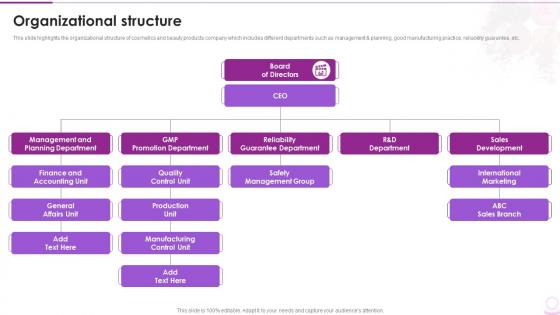
This slide highlights the organizational structure of cosmetics and beauty products company which includes different departments such as management and planning, good manufacturing practice, reliability guarantee, etc.
People who downloaded this PowerPoint presentation also viewed the following :
Organizational Structure Cosmetic And Beauty Products Company Profile with all 6 slides:
Use our Organizational Structure Cosmetic And Beauty Products Company Profile to effectively help you save your valuable time. They are readymade to fit into any presentation structure.





FAQs for Organizational Structure Cosmetic And Beauty
Look, you need clear hierarchy first - who reports to who and what everyone's actually responsible for. Communication channels matter too, plus making sure decisions get made at the right level. Don't overload managers with too many direct reports either. Honestly, the biggest mistake I see is when structures look pretty on paper but don't match what the company's actually trying to do. Map out who talks to who regularly and where decisions really happen. That'll tell you if your setup is working or just creating bottlenecks between departments.
Honestly, your org structure makes a huge difference in how motivated people actually feel at work. Clear reporting lines help everyone know what they're doing. But don't go crazy with rigid hierarchies - they just crush creativity and slow everything down. I've seen this happen so many times. Flatter structures usually work better because people feel like they actually own something. When you have too many layers, employees just feel totally disconnected from the people making decisions. Look at how your team operates day-to-day. Does your current setup help them get stuff done or just create more headaches?
So basically, flat structures have way fewer management layers - like employees straight to department heads to CEO. Hierarchical ones? Total pyramid with tons of middle managers, supervisors, team leads, the whole nine yards. Flat means decisions happen fast and people get more freedom to do their thing. But man, it gets messy when companies grow. Hierarchical gives you clear career ladders and everyone knows who's accountable, though everything moves at a snail's pace. Honestly depends on your size - startups can pull off flat, but bigger companies need structure or it's chaos.
Honestly, you gotta ditch the micromanaging thing first - remote work kills those old-school hierarchies anyway. Give your teams actual goals and let them figure out how to get there. Communication becomes super critical since you can't just pop by someone's desk anymore. Set up regular check-ins but also get good at async stuff - Slack, whatever works. Oh, and create some virtual hangout spaces because people still need that casual interaction. The whole thing is really about tracking results instead of babysitting, which... shouldn't that have been obvious from the start?
Honestly, your org structure can make or break innovation. Flat companies let ideas move way faster - fewer layers means less bureaucracy. I'm a huge fan of matrix structures too because they force different departments to actually talk to each other. Engineers chatting with marketing people? That's where the good stuff happens. But those heavy hierarchies? Total innovation killers. Nobody wants to get seventeen approvals just to test something small. You need structures that let teams fail quickly without everyone freaking out. Cross-functional collaboration is clutch. Take a look at how ideas currently move through your company and you'll probably spot the bottlenecks pretty fast.
Look, having a clear structure basically tells everyone who gets to decide what and when. No more hunting around for the "right person" or getting stuck in those endless approval chains. Information actually reaches decision-makers faster too since communication channels aren't all over the place. Teams end up making more consistent choices because there are actual processes to follow. Think of it like having GPS instead of just driving around aimlessly - way less frustrating. Try mapping out who currently makes decisions on your team. I bet you'll spot some weird gaps or overlaps slowing everything down.
Matrix structures are pretty sweet because you get functional expertise AND project focus at the same time. People develop way broader skills working across different teams. Resource sharing gets easier too. But dude, the politics can be brutal - power struggles between managers are basically guaranteed. Your employees will feel like they're being pulled in ten directions, and nobody knows who's actually calling the shots half the time. I've seen teams spend entire days in meetings just figuring out whose decision it is. Clear communication about decision ownership saves your sanity. Otherwise you're just creating expensive confusion.
Dude, culture totally shapes how your org should look. Asian companies? Super hierarchical - everyone knows their place in the chain. Scandinavian places are the opposite, all flat and collaborative. It's wild how different they are. Your team's background matters too - some cultures need that centralized control to feel secure, while others thrive with more freedom. I learned this the hard way at my last job honestly. Before you restructure anything, figure out what your people are comfortable with. Otherwise you're just creating friction where you don't need it.
Honestly, your leaders make or break any org structure you've got on paper. Fancy org charts mean nothing if your leadership team isn't actually modeling the right behaviors. They control whether info flows properly between levels, if teams work together or stay in their own bubbles, and how empowered people feel in their roles. Here's the thing though - leaders can't just announce changes and expect them to stick. They have to consistently back up structural shifts through what they actually do, not just what they say. Fix your leadership first, then worry about restructuring.
Start with the obvious stuff - are decisions getting stuck somewhere? That's your first clue. Employee turnover by department tells a story too. Honestly, just ask people how communication feels and if roles make sense. You'll get way more insight than fancy metrics. Quick survey or casual manager chats work great. Are teams actually talking to each other or totally siloed? And yeah, check if you're consistently hitting business goals. I mean, that's kinda the whole point, right? Look for friction before it becomes a real headache.
So your company's structure totally shapes how info gets around. Flat orgs are great - messages zip between people without getting stuck in management layers. Hierarchical ones though? Total bottleneck city. Everything gets filtered or sits on someone's desk forever. Matrix structures are kinda chaotic but honestly they're not bad for getting different teams talking. The trick is figuring out how your current setup actually works (not how it's supposed to work on paper) and then you can plan around those patterns instead of fighting them.
Honestly, just focus on where you're at right now, not where you think you'll be in two years. What's your team size? How do you make decisions today? Flat works awesome when it's 10 people around a pizza table, but man does it get chaotic once you hit 20+. You've gotta figure out your tolerance for bureaucracy vs. complete mayhem - there's no perfect middle ground. Pick something that fits your actual timeline. Start simple and layer on structure when things start breaking, not because some business book told you to.
Honestly, your org structure makes or breaks how fast you can help customers. Too many layers? Everything slows to a crawl and people get annoyed waiting. Flatter teams respond quicker, but then your front-line people might drown without backup support. Clear reporting helps so nothing gets lost in the shuffle - though I've seen that go sideways too. Cross-functional teams are pretty solid for messy problems. Just don't let your structure become the thing that creates more headaches than it solves, you know?
When everything's falling apart, you gotta flatten that hierarchy ASAP. Get rid of those approval layers - seriously, who has time for that bureaucratic nonsense? I'd start with cross-functional teams that can actually move fast. People get super confused about their roles during chaos, so nail down clearer responsibilities. You might end up merging departments or throwing together some temporary task forces too. The whole point is being agile instead of stuck in your old rigid ways. Oh, and find where decisions are getting stuck first - that's your biggest bottleneck to fix.
Honestly, tech is just demolishing those old corporate pyramids. Middle management is getting squeezed out because teams can talk directly now - why go through three people when Slack exists? Remote work obviously accelerated everything (though some companies are being weird about bringing people back). Your org chart probably looks like a hot mess compared to five years ago, but that's actually good. Teams can spin up for projects then disappear when they're done. The whole thing is way more fluid. My advice? Just roll with it and get decent collaboration tools. Fighting this shift is pointless.
-
SlideTeam is the way to go when you are in a time crunch. Their templates have saved me many times in the past three months.
-
Wonderful ideas and visuals. I'm really pleased with the templates, which are unique and up to date.