

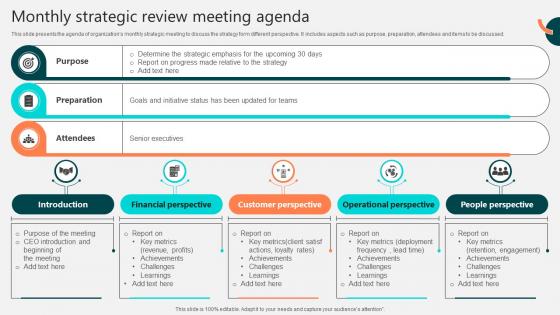
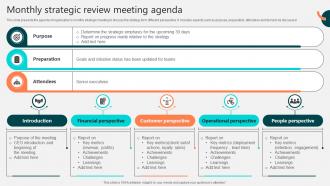
Monthly Strategic Review Meeting Agenda




Try Before you Buy Download Free Sample Product
 Impress Your
 Audience
 100%
100% Editable
 Save Hours
 of Time


This slide presents the agenda of organizations monthly strategic meeting to discuss the strategy form different perspective. It includes aspects such as purpose, preparation, attendees and items to be discussed.
People who downloaded this PowerPoint presentation also viewed the following :
Monthly Strategic Review Meeting Agenda with all 6 slides:
Use our Monthly Strategic Review Meeting Agenda to effectively help you save your valuable time. They are readymade to fit into any presentation structure.





FAQs for Monthly Strategic
Look at your market first - what competitors are doing, bigger trends, all that stuff. Then comes the hard part: being brutally honest about where you actually suck and where you're killing it. Nobody likes this step but it's everything. Get your stakeholders involved early, not just when you're done. Map out clear goals and timelines. Oh, and don't forget to actually allocate resources - I've seen so many plans fail because nobody thought about who's doing what. Build in review points from day one. Otherwise your whole strategy just becomes expensive wall art that nobody looks at.
Look, most companies do it yearly, but your industry matters a ton. Tech and healthcare? You're probably looking at every 3 months because stuff moves crazy fast. Stable industries can get away with 18-24 months no problem. Things that should make you pause and reassess: big market changes, new competitors showing up, leadership shake-ups, or when your current plan just isn't working. Oh, and honestly? Don't be too rigid about timing. Set your regular schedule but be ready to pivot when something major hits. The business world doesn't care about your calendar.
Honestly, getting stakeholder feedback is what separates good strategy from total disaster. You'll miss huge blind spots if you don't talk to customers, employees, partners - basically anyone who'll actually deal with your decisions. I learned this the hard way watching leadership teams convince themselves their brilliant plans would work... spoiler alert, they didn't. People outside your bubble see opportunities and problems you can't. Get their input early, not just at the end when you're basically asking them to rubber-stamp something. Oh, and make sure you're hearing from different types of people, not just the usual suspects who always agree with everything.
Look, first thing - grab your original goals and stack them against what actually happened. Revenue, customer numbers, whatever you were tracking from day one. Here's the annoying part though: some results won't show up for months, so don't panic if short-term numbers look weird. Get both the hard data AND feedback from your teams who did the actual work. They'll tell you why stuff failed or succeeded. Honestly, the "why" matters way more than just the numbers. Document it all in something simple so you can actually spot patterns later and not repeat the same mistakes.
Dude, get some real-time dashboards set up - way better than drowning in spreadsheets every quarter. AI tools are actually decent at spotting trends you'd miss otherwise, saves tons of time. Your team can drop insights whenever using collaboration platforms, which honestly makes scheduling so much easier. Oh and scenario planning software lets you test different strategies super fast. Just don't go overboard picking tools that don't play nice with what you're already using. Nothing worse than adding more busywork when you're trying to make things simpler, you know?
Honestly, the worst mistake is leaving key people out of the planning process. You'll create this gorgeous strategy that everyone just ignores because they had zero input. Don't make it some executive-only thing either - that never works. Oh, and try not to get lost in endless analysis (seriously, how many SWOT charts does one company need?). Your company culture matters way more than you think when rolling out changes. Just because your competitor is doing something trendy doesn't mean you should copy them. Set up regular check-ins afterward too, or the whole thing becomes pointless busy work.
Don't treat competitive analysis like some separate thing you tack on later. Map out your competitors right when you're doing your situational analysis, then see how they stack up against your metrics. Honestly, I always waste way too much time stalking their Instagram when I should focus on the bigger picture first. Look for gaps in what you're doing compared to them. Market opportunities become super obvious this way. The trick is making it regular - maybe quarterly check-ins? Otherwise you'll get blindsided when something shifts in your space.
So here's the thing - you need both leading AND lagging indicators. Leading ones (like customer acquisition, employee engagement) show if you're heading the right direction early on. Lagging indicators tell you if you actually made it - stuff like revenue and market share. We totally screwed this up last year by only watching revenue! Pick maybe 3-5 metrics per goal though. Any more than that and you'll get buried in spreadsheets instead of focusing on what actually matters. The whole point is catching problems before they become disasters.
Yeah, it totally depends on your industry's rhythm. Tech companies are all about those quarterly check-ins - they're obsessed with pivoting fast based on user feedback. Meanwhile, manufacturing and energy folks take their time with annual deep dives into efficiency and capacity planning. Retail splits the difference with seasonal reviews, which honestly makes sense given their cycles. Healthcare's tricky because they're juggling innovation with all that regulatory stuff. Bottom line: match your review schedule to how fast your industry actually moves and whatever compliance headaches you're dealing with.
Your mission and vision basically act like guardrails - they stop you from chasing every shiny new idea that pops up. Trust me, I've watched teams waste months on projects that had zero connection to what they actually exist to do. When you filter everything through your core purpose first, stakeholder buy-in becomes so much easier too. They can actually see why you're doing what you're doing. Your vision keeps you pointed toward the long-term stuff that matters. Honestly? Start every review by reading your mission statement out loud. Sounds cheesy but it works.
Honestly, doing a strategic review is like finally cleaning out your closet - you notice stuff you've been ignoring for months. When you actually sit down and go through market data, customer feedback, all that industry research you bookmarked but never read (we've all been there), patterns jump out that get lost in the daily chaos. You'll catch shifts in what customers want, spot new tech trends, see openings competitors are missing. The trick is thinking beyond where you are now to where everything's going. Oh, and definitely pull in people from other departments - they see blind spots you don't.
Structure it around three main buckets: where you are now, what's missing, and what to do about it with deadlines. Back everything up with real data - trust me, opinions dressed up as insights fool nobody. Executive summary should be one page tops, but throw detailed stuff in appendices for the data nerds who always want more. Oh, and this is crucial - assign owners to each recommendation plus success metrics. Without those two things, your whole strategic review ends up collecting dust on someone's shelf. Pretty much seen it happen too many times.
Honestly, you need people from different departments or you'll get blindsided. Sales knows what customers are actually asking for. Finance knows if you can afford it. Operations knows if it's even doable - and trust me, they'll tell you real quick if your idea is trash. Each team sees problems totally differently, which sounds obvious but somehow gets ignored all the time. Don't just invite them to check a box though. Give them actual say in decisions. Otherwise you'll build something that works great in theory but completely bombs when departments try to make it happen.
Honestly? Start with SWOT analysis - yeah it's basic but there's a reason everyone uses it. Gets you thinking about strengths, weaknesses, opportunities, threats in one go. Porter's Five Forces is solid for competitive stuff, and McKinsey 7S helps with internal alignment (though that one can get a bit heavy). Oh, and Ansoff Matrix is actually pretty underrated for growth decisions - I used it last year and it was way more helpful than I expected. Don't try to do everything at once though. Pick 2-3 that actually make sense for your situation. SWOT first, then whatever tackles your biggest strategic headache.
Honestly, your company culture is going to make or break this whole thing. Open cultures? You'll get people actually speaking up and questioning stuff during reviews. Hierarchical places though - good luck getting anything beyond "sounds great, boss" feedback. Whether people actually follow through on the strategic changes depends on culture too. I'd honestly check the vibe of your team first, then maybe tweak how you run the review process. No point doing some fancy formal process if everyone's just gonna nod along, you know? Better to design something that'll actually get you the real feedback you need.
-
Great designs, Easily Editable.
-
It makes easy work of my work presentations. I’ve never had to be nervous about my presentations for meetings.