


Quarterly Strategic Resource Planning Calendar




Try Before you Buy Download Free Sample Product
 Impress Your
 Audience
 100%
100% Editable
 Save Hours
 of Time


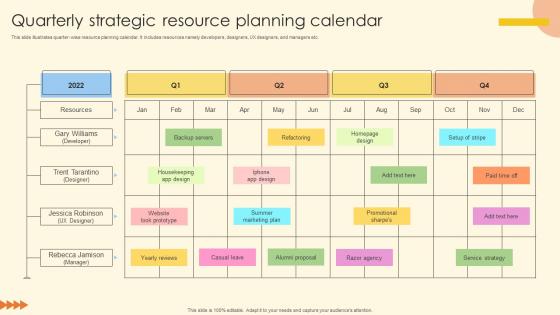
This slide illustrates quarter wise resource planning calendar. It includes resources namely developers, designers, UX designers, and managers etc.
People who downloaded this PowerPoint presentation also viewed the following :
Quarterly Strategic Resource Planning Calendar with all 6 slides:
Use our Quarterly Strategic Resource Planning Calendar to effectively help you save your valuable time. They are readymade to fit into any presentation structure.





FAQs for Quarterly Strategic
You need five main pieces: figure out where you're at now, set your vision/mission, pick your goals, develop strategies, then plan implementation with regular check-ins. Most people totally skip that first step though - they jump straight to goal-setting which is honestly backwards. Start by understanding your current situation and what you're actually working with. Then set clear, measurable objectives. Map out how you'll hit them. I'd say do quarterly reviews to see if you're on track or need to pivot. The whole thing needs to actually be usable, not some fancy document you'll never look at again.
Honestly, print out your mission statement and stick it right on the wall during planning meetings. Sounds basic but most teams totally skip this! Map each goal back to your mission - you'll catch misalignments way faster. Do quarterly check-ins asking "does this actually serve our purpose?" I'm big on working backward from the mission when you're deciding what gets priority. Oh, and here's the thing - if some strategic piece doesn't clearly connect to your mission, maybe it doesn't belong there. Those disconnected initiatives are usually the ones that drain resources without moving the needle.
Honestly, you can't build a decent strategic plan without knowing what's actually happening in your market first. Look at your competition, figure out what customers really want, check the trends - all that stuff. Otherwise you're basically throwing darts blindfolded. I learned this the hard way at my last job when we launched something nobody wanted because we didn't do our homework. Market analysis shows you which opportunities are real and which strategies will flop before you waste money on them. Trust me, do the research before you set any big goals. It'll save you so much headache later.
Look, most companies do the big strategic review once a year, but that's honestly not enough anymore. I'd check your key numbers and assumptions every quarter - things change way too fast to just wing it. Your yearly deep dive should cover the usual suspects: market shifts, what competitors are doing, where your team's at capability-wise. But here's the thing - if something big hits (like economic weirdness or a new player), don't wait around for your next scheduled meeting. Seriously though, block out quarterly strategy sessions right now. Even just two hours with your leadership team beats flying blind.
Ugh, don't do what everyone does - make everything a "top priority." Pick 3-5 things max or you'll spread yourself too thin. Also avoid super vague goals that sound good but mean nothing. Get the right people involved from the start, not as an afterthought. Oh and please don't ignore what's actually happening with competitors - I've seen companies plan like they exist in a bubble. Worst mistake though? Creating this gorgeous strategic plan then never looking at it again. Build in regular check-ins so you can actually adjust when things go sideways.
Start by figuring out who actually matters in this decision - your key people. Then talk to them throughout the whole thing, not just when you're done. I'd do some one-on-ones first to really dig in, maybe focus groups if that works better. Follow up with surveys to cast a wider net. People eat this stuff up honestly - everyone wants their voice heard. But here's the thing: you have to show them what you did with their input or they'll think it was BS. Close that loop! Also set up check-ins during rollout. Keeps everyone bought in and you can pivot if needed.
Honestly, stick to the basics that actually matter - revenue growth, profit margins, market share. Those tell you if you're winning or not. Customer satisfaction and employee engagement are huge too since they predict what's coming next. Don't just look at quarterly results though, that's backwards-looking. Track stuff like pipeline growth or product milestones that give you a heads up. Keep it to maybe 5-7 metrics max, otherwise you'll drown in data. Review them monthly with your team and make sure they're things you can actually do something about.
Oh man, culture changes everything about strategic planning. Some places need months of consensus-building before anyone makes a move, while others just want the boss to decide fast. Time horizons are wild too - Japanese companies might plan 30 years out, but startups obviously focus on next quarter. Even feedback styles matter more than you'd think. Try being super direct in a high-context culture and watch your planning meetings go sideways. Honestly, I've seen brilliant strategies completely bomb because nobody adapted the process to local norms. You've got to match your timeline and stakeholder approach to each region.
Honestly, tech has become a game-changer for strategic planning. You get real data to spot trends instead of just winging it with gut instincts. AI helps find market opportunities you might've missed, and those scenario modeling tools let you test different "what if" situations before committing. Real-time dashboards show if your strategy's actually working or flopping. Plus collaboration platforms are clutch when your team's scattered everywhere. Just don't fall for the trap of buying whatever flashy software everyone's hyping - pick what actually fits how you work.
So scenario planning is basically creating 3-4 different "what if" situations to test how your strategy would hold up. Think economic crash, new tech disrupting everything, regulatory changes - that kind of stuff. It's like those fire drills we used to hate in school, but for business strategy. Running your plans through these different futures shows you blind spots you'd probably miss otherwise. Plus you end up with more flexible strategies that can actually pivot when things go sideways (which they always do). I'd start with whatever keeps you up at night - your biggest uncertainties - and build scenarios around those first.
Honestly, most strategic plans flop because people announce them once and move on. Bad move. Start with leadership explaining the "why" to everyone, then break it down by department so teams get their specific piece. After that, you'll need regular touchpoints - town halls, newsletters, manager check-ins. Visual stuff helps too, like dashboards or even those cheesy posters (they actually work though). The trick is connecting people's daily tasks back to the big picture goals. Without constant follow-through, your strategy becomes that thing everyone forgot about by month two.
Big companies can plan years ahead because they've got solid data and know what's working. You're basically flying blind still. Keep your planning cycles short - like 3 months max. Any longer and you're just making stuff up honestly. The whole game changes when you don't have proven revenue yet. Big corps optimize what already works, but you need to stay ready to completely switch directions. Always have backup plans ready because your first idea probably won't stick. Focus on quick experiments over long-term forecasts right now.
Honestly, ditch those massive annual plans - they're basically useless after like 6 months anyway. Go quarterly instead so you can actually change direction when stuff happens. Rolling forecasts are your friend here. Oh, and do regular "health checks" where you sit down and ask if your assumptions still make sense. I'd focus more on building up what your team can do rather than just chasing specific numbers. Capabilities give you way more options when you need to pivot. Start doing those quarterly reviews now before your current plan becomes totally irrelevant.
Look, SWOT analysis isn't just about filling out those four boxes - that's where most people mess up. You gotta connect the dots between your strengths and opportunities, see how weaknesses make threats scarier. The magic happens when you actually use it to decide what to focus on and where to spend your budget. I probably sound like a broken record here, but revisit it every quarter because things shift constantly. My old team would do this exercise once a year and wonder why it felt useless. Don't be like them.
Make strategic thinking part of regular convos, not just those dreaded annual planning meetings. Push your team to ask "why" and "what if" during discussions. Actually reward people when they challenge stuff or spot trends - I've watched too many companies claim they want this but then shut down anyone questioning things. Cross-functional teams help people see beyond their little silos. Oh, and give them actual time to think! Block out like an hour weekly for exploring random ideas. Google's 20% time thing works for a reason. Your team needs space to just... think without someone breathing down their neck about deliverables.
-
Informative and engaging! I really like the design and quality of the slides.
-
Extensive range of templates! Highly impressed with the quality of the designs.