

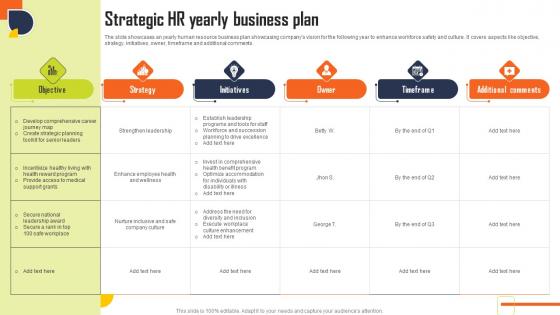
Strategic HR Yearly Business Plan




Try Before you Buy Download Free Sample Product
 Impress Your
 Audience
 100%
100% Editable
 Save Hours
 of Time


The slide showcases an yearly human resource business plan showcasing companys vision for the following year to enhance workforce safety and culture. It covers aspects like objective, strategy, initiatives, owner, timeframe and additional comments.
People who downloaded this PowerPoint presentation also viewed the following :
Strategic HR Yearly Business Plan with all 6 slides:
Use our Strategic HR Yearly Business Plan to effectively help you save your valuable time. They are readymade to fit into any presentation structure.





FAQs for Strategic HR
Honestly, start with figuring out what skills your team actually has versus what you need - that gap analysis is everything. Then look ahead and predict staffing needs based on where the business is going. Succession planning is huge too (I've seen companies get totally screwed when key people leave unexpectedly). You need solid metrics to track how it's all working, plus regular check-ins to pivot when stuff changes. The real trick? Getting leadership on board early. Otherwise you're just doing busy work that doesn't actually move the needle for the company's goals.
So workforce analytics is just using data to make better HR calls instead of winging it. You can catch patterns - like why accounting keeps bleeding people or what skills you'll need next year. Think of it as a crystal ball made of spreadsheets (honestly way more reliable than mystical stuff). When your company's growing into new markets, the data shows exactly who to hire and when. Oh, and it keeps your hiring aligned with actual business goals instead of random hunches. Start small though - pick metrics that actually move the needle for your business, then expand from there.
Okay so first thing - figure out what's actually keeping their executives awake at night. Growth targets? Cost cuts? Market expansion? Whatever it is, that's your north star. Map everything you do in HR directly back to those priorities. Scaling fast? Pour resources into hiring and onboarding. Profit margins tight? Focus on keeping good people and managing performance better. I swear it's like being the ultimate wingman for the business. Regular check-ins with leadership are clutch too - their priorities shift constantly and you've gotta stay flexible.
Dude, tech completely changes how you do HR planning. Instead of guessing, you get actual data showing turnover patterns and skill gaps. Analytics can predict who's likely to quit or what roles you'll need next year. The scenario modeling stuff is pretty cool too - shows you what happens if your star employees bail or you expand somewhere new. Honestly can't imagine doing this job without decent tools anymore. My advice? Figure out what data you're already sitting on, then find software that makes sense of it all. Way better than the old spreadsheet nightmare.
Honestly, start with your current workforce data - who's heading out the door, what skills you've got, where you're missing stuff. Your business strategy matters too because expanding into new markets totally changes what talent you need. Mix hard numbers (headcount projections, turnover rates) with what managers are telling you about new skill gaps coming up. External stuff like industry trends and how tight the labor market is will mess with your hiring timeline and budget. Quarterly reviews are clutch for adjusting forecasts - things move way too fast these days. Get department heads involved since they actually know their teams.
Honestly, the worst mistake is doing all your planning without talking to actual managers first. So many teams get obsessed with building these perfect theoretical models that have zero connection to reality - like, why spend three months on spreadsheets nobody will use? Also don't treat succession planning like some annual checkbox thing. Business changes constantly, so your plans need to flex with it. I'd start with small pilot programs instead of going company-wide right away. Oh, and actually have real conversations with department heads about what they need, not just whatever they scribble on forms. Keep it simple and stay connected to what's actually happening.
Employee engagement is your go-to metric for making smart HR calls. Disengaged people kill productivity and bail on jobs faster. So when you're planning workforce stuff, think about how changes affect engagement first. That shiny new performance system? It'll probably just add more red tape (learned that one the hard way). Use your engagement data to actually drive decisions - compensation tweaks, training programs, whether to restructure teams. The trick is measuring it regularly and not letting those insights collect dust. Otherwise you're just shooting in the dark with strategy.
Your company culture basically controls your entire HR game. Got a collaborative vibe? You'll be all about team-building and cross-department training. More cutthroat and competitive? Merit pay and aggressive recruiting become your go-to moves. But here's what's wild - HR strategy doesn't just follow culture, it actually creates it too. So you gotta figure out: are we doubling down on who we are now, or trying to become something different? Then your hiring, training, and retention stuff needs to match that vision. It's like this weird chicken-and-egg situation honestly.
Look, you gotta stay ahead of what's coming instead of scrambling to catch up. Tech changes, economic weirdness, customer demands - they're all gonna hit whether you're ready or not. March 2020 taught us that lesson the hard way, right? So here's what works: scan the horizon constantly. What skills will you need in six months? Start reshaping roles now. Update those dusty job descriptions. My advice? Get your leadership team together every quarter - even if it's just pizza and brainstorming - to talk about what trends you're seeing and how they'll mess with your hiring plans.
Track turnover rates, time-to-fill for key roles, and engagement scores - those are your bread and butter. Revenue per employee is gold because it shows leadership you're actually moving the needle on business results. Here's the thing though - don't go metric crazy! Pick maybe 5-7 that match what you're trying to accomplish. I've seen HR teams drown in data and lose sight of what matters. Internal promotion rates are clutch too. Set up a basic dashboard and chat through it with your leadership team monthly. The real win happens when you can connect the dots between better HR numbers and actual business performance.
Look, you want to map out your talent needs before you're desperately posting job ads everywhere. Start by looking at your current team, then figure out what skills you'll actually need in 2-3 years based on where the business is going. This way you can spot gaps early and build a decent recruitment plan. You'll also figure out which people you absolutely can't afford to lose - trust me, losing someone critical at the worst possible moment will ruin your week. The whole process shows your current employees clear career paths too, which keeps them around longer.
Look, D&I can't just be this side project anymore - it needs to be baked into everything. Your hiring, development programs, performance reviews, all of it. Honestly, companies still treating it as optional are just shooting themselves in the foot at this point. Better decisions come from diverse teams, period. What really matters is your leadership pipeline though. Are you actually creating paths for different people to move up? Start with an audit of your current processes - I bet you'll find bias hiding in places you didn't expect. Then build some real D&I metrics into your HR scorecard so you're tracking progress.
Okay so here's what I've learned the hard way - you can't use the same pitch for everyone. Executives just want to see ROI and bottom line impact. Managers are worried about their teams. Regular employees? They're thinking "how does this mess with my day-to-day?" Always lead with WHY you're doing something, not just what you're planning. I've watched so many HR strategies crash because they sounded too textbook-y. Skip the jargon - use real numbers and actual examples instead. Visual stuff works great, like simple dashboards that show progress. Oh, and don't just present once then vanish! Make it a conversation. Ask what people think and actually use their feedback.
Talk to people early about what's happening and why - nobody likes being blindsided by HR changes. Get your team involved in the planning process so they actually feel like they have some control. People usually freak out more about not knowing than the actual change itself, honestly. Set up training or mentoring to help them through it. Clear deadlines help too so everyone knows what's coming when. Oh, and be around during the transition! Your team needs to see you're not just dumping this on them and disappearing.
Economic ups and downs mess with your hiring plans big time. When things go south, you're dealing with hiring freezes and maybe layoffs - plus trying to keep your best people from bailing. Growth spurts are honestly just as stressful though. You need bodies fast but everyone good is already taken or costs a fortune. My advice? Map out different scenarios before you need them so you're not freaking out later. Start building relationships with temp agencies now, and watch those industry trends like a hawk. That way you can shift gears before you're totally screwed.
-
“Ample and amazing variety of templates available, really helpful for making professional PPT for day to day workings.”
-
Great designs, really helpful.