


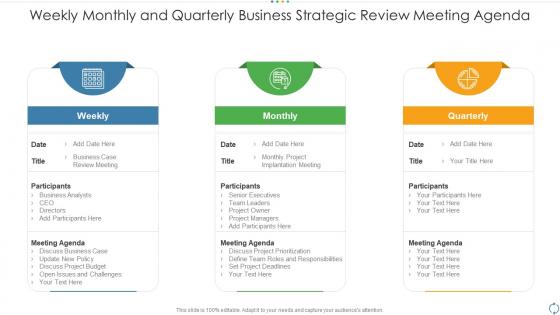
Weekly monthly and quarterly business strategic review meeting agenda




Try Before you Buy Download Free Sample Product
 Impress Your
 Audience
 100%
100% Editable
 Save Hours
 of Time


Our Weekly Monthly And Quarterly Business Strategic Review Meeting Agenda are topically designed to provide an attractive backdrop to any subject. Use them to look like a presentation pro.
People who downloaded this PowerPoint presentation also viewed the following :
Weekly monthly and quarterly business strategic review meeting agenda with all 9 slides:
Use our Weekly Monthly And Quarterly Business Strategic Review Meeting Agenda to effectively help you save your valuable time. They are readymade to fit into any presentation structure.








FAQs for Weekly monthly and quarterly business strategic
Focus on the money stuff first - revenue growth, profit margins, ROI. But honestly those don't tell the whole story. Customer acquisition costs and retention rates are way more telling about where you're headed. Market share and employee satisfaction matter too (happy employees = better results, obviously). Oh and don't sleep on operational metrics like how fast you're getting products to market. I'd stick to maybe 5-7 KPIs that actually connect to your main goals. Tracking everything just makes you crazy and doesn't help decision-making.
Market trends can totally flip your strategy on its head - either you're riding the wave or getting crushed by it. Look at how COVID suddenly made remote work strategies golden while others became irrelevant overnight. New tech, changing customer habits, economic shifts - they all expose blind spots you didn't know you had. Honestly, I've seen too many companies get blindsided by stuff they should've seen coming. You'll want to do quarterly check-ins to see if you're still on track. Don't wait until you're scrambling to catch up - that's when things get messy.
Look, competitive analysis is your sanity check when you're reviewing strategy. Shows you where you actually stand vs where you think you stand. You'll find gaps in positioning and spot threats coming your way. Plus opportunities you're probably missing. Think of it as peripheral vision for your business - and let's be honest, we all need more of that. Helps you figure out if your current strategy actually makes sense or if it's time to switch things up. One thing though: just focus on 3-5 key competitors and check what they're doing quarterly, not once a year.
Don't try reviewing everything at once - you'll just drown in data and never actually do anything. Trust me, I've wasted weeks doing exactly that. Get your team involved too, they see stuff you don't. Here's what kills me though: people spend forever analyzing what went wrong but barely think about what's coming next. Split your time between both. Most important thing? Pick 2-3 specific changes with real deadlines. I can't tell you how many "comprehensive reviews" I've seen that just sit there doing nothing afterward. Start small and actually follow through.
Look, you need those outside voices because you're probably missing huge blind spots. Customers see stuff differently than you do. So do employees and investors. They'll catch problems before they blow up your whole plan - I've seen strategies tank because leadership was too insular, you know? Getting their input early helps validate what you're thinking and spots market changes faster. Short surveys work great. Plus here's the thing - people actually buy into changes way more when they had a say in shaping them. It's like basic psychology or whatever. Try polling your key groups before your next strategy session.
Porter's Five Forces and SWOT analysis are solid starting points for mapping your competition. IBISWorld has decent financial data you can use to benchmark your margins and growth against industry averages. Honestly though? Just call your customers and ask why they picked you - that stuff's gold. Strategic group mapping works well too, where you plot competitors by price vs features or whatever makes sense for your space. Oh, and check if your trade association has reports, they're usually pretty helpful. Pick whichever method clicks with your industry first, then add more later.
Look, do it quarterly if you can swing it. Annual reviews are the bare minimum but honestly kinda useless on their own - markets change way too fast now. I'd split it up: quick quarterly check-ins for tracking metrics and catching new trends, then your big annual deep dive for the major strategic stuff. The quarterly ones are where you'll actually spot competitors making moves or catch opportunities early. Way better than scrambling to react six months later when everyone else is already talking about it. Most successful companies I know do this split approach. Start there and see how it feels.
Honestly, tech advancement just throws your whole business strategy out the window. Customer expectations change overnight. New competitors pop up from nowhere - look at how Netflix basically murdered Blockbuster, right? Your old methods might be completely useless now. I'd constantly question if what you're doing still works or if you're just being stubborn about outdated stuff. The smart move? Build flexibility into everything so you can actually pivot when some new technology flips the entire industry upside down.
So basically SWOT analysis is like doing a reality check on your business before you make big moves. Map out what you're good at, what sucks, what opportunities are out there, and what could screw you over. Honestly, it sounds super basic but you'd be surprised how much clarity it gives you when you actually sit down and think through each part. The real value comes when you start seeing connections between all four areas - that's where you find those "oh shit, why didn't we think of this before" moments. Just don't treat it like gospel, it's more of a jumping off point for bigger strategy conversations.
So customer insights basically reveal where you're totally off base about what people actually want. Dig into their feedback and behavior - you'll probably find out you're obsessing over price while they just want things to be easier. Classic mistake. This stuff can make you completely rethink your value prop or even pivot into markets you never considered. Honestly, most companies are just guessing without real data. Start with surveys and interviews to figure out where you're missing the mark. Those blind spots are usually hiding in plain sight.
So break it into three buckets: what's working, what isn't, and what you're missing. Skip the dense paragraphs - executives barely skim those anyway. Bullet points actually get read. Always throw in real numbers and examples instead of saying generic stuff like "things got worse." Connect each problem to what you think they should do about it. Honestly? Color coding helps a ton because these people are scanning fast. One page per big issue, then dump your extra details in the back. Oh and keep your sentences punchy - saves everyone time.
Honestly, just take your strategy stuff and see if it actually connects to your big vision. Like, write down what you're prioritizing right now - does it even get you closer to where you want to be? So many companies are basically working against themselves without realizing it. Look at where you're spending money and time. Ask your team if they understand how their daily work fits the bigger picture. If they're confused or can't explain it, there's your problem. Also check if you're spreading resources too thin across random projects that don't really matter.
Track revenue growth and profit margins obviously, but cash flow is what actually matters day-to-day. ROI tells you if you're making smart investments. Customer acquisition cost vs lifetime value is critical if you're trying to grow - I've seen too many companies ignore this and burn through cash. Debt-to-equity ratio shows whether you're financially stable or walking a tightrope. Don't overwhelm yourself though. Pick maybe 4-5 metrics that match your goals and check them monthly. More than that and you'll just get analysis paralysis.
So here's what I'd do - build 3-4 "what if" scenarios around the biggest unknowns in your business. Maybe your competitor drops prices by 30%, or supply chains get weird again (ugh, hopefully not). During your quarterly reviews, walk through each scenario first thing. Test your current plans against them and see what breaks. My old boss used to call it "stress testing" which sounds way more intense than it actually is. The trick is making it routine, not something you panic-do when things go sideways. Takes maybe 20 minutes but saves you from getting blindsided later.
Honestly? Your strategy can be absolutely brilliant, but if your team doesn't give a damn, it's going nowhere. Engaged employees will execute better and actually spot issues before they blow up. They'll even throw out ideas you never considered. But disengaged people? They just go through the motions. I've seen this happen so many times - companies spend months crafting these perfect plans, then wonder why nothing changes. The real question isn't whether your strategy looks good on paper. It's whether you can get your people genuinely excited about it.
-
Excellent design and quick turnaround.
-
Enough space for editing and adding your own content.