

Multi Cloud Migration Progress Status Seamless Data Transition Through Cloud CRP DK SS





Try Before you Buy Download Free Sample Product
 Impress Your
Audience
 100%
Editable
 Save Hours
of Time


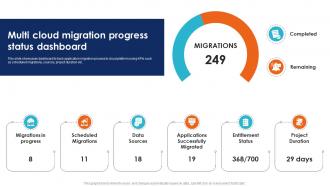
This slide showcases dashboard to track application migration process to cloud platform using KPIs such as scheduled migrations, sources, project duration etc.
People who downloaded this PowerPoint presentation also viewed the following :
Multi Cloud Migration Progress Status Seamless Data Transition Through Cloud CRP DK SS with all 10 slides:
Use our Multi Cloud Migration Progress Status Seamless Data Transition Through Cloud CRP DK SS to effectively help you save your valuable time. They are readymade to fit into any presentation structure.









FAQs for Multi Cloud Migration Progress Status Seamless Data Transition Through Cloud
So the big thing with multi-cloud is you're not stuck with one vendor forever. Better pricing when you can actually negotiate, plus you get the best stuff from each - like AWS for compute, Google's AI tools, Azure if you're heavy on Microsoft. Management gets trickier but honestly the flexibility pays off. One provider crashes? Your apps keep running elsewhere. Oh and definitely start small - grab two providers, test with something non-critical first. Don't jump into the deep end right away, trust me on that one.
Honestly, just audit everything first - your apps, dependencies, all that stuff. Map out how data flows and figure out which legacy systems are gonna fight you on this. Also check if your team actually knows other platforms besides AWS, because that matters more than people think. I'd run some test migrations on non-critical stuff to see what breaks (trust me, something always does). Don't forget about bandwidth and security either. Make yourself a scorecard covering technical and operational readiness so you're not flying blind when it's time for the real migration.
Dude, the data consistency thing will drive you nuts - stuff just doesn't sync right between platforms. Security gets messy fast too. Network lag between clouds is annoying, and don't even get me started on integration headaches. Your costs will spiral if you're not careful (learned that one the hard way). Plus your team suddenly needs to be experts on like three different systems. Honestly? Start with something small first. Get your governance sorted out early or you'll regret it later. And seriously invest in training your people before diving in headfirst.
Okay so three main things to tackle here. First, get your APIs talking to each other across all your cloud platforms - AWS, Azure, whatever you're running. API management is honestly such a pain but you gotta do it. Next up is data governance - basically just knowing where your stuff lives and who's responsible for what. Integration platforms like MuleSoft can help orchestrate everything between clouds, though they're kinda pricey. Oh and don't try to fix everything at once, that's a recipe for disaster. Map out what you have first, then go service by service.
Oh man, compliance stuff is such a pain but you can't ignore it. Regulations like GDPR and HIPAA will literally control which clouds you can even use - some providers are way better at handling data residency rules than others. Map out all your compliance requirements first because trust me, finding out you can't use a cloud provider halfway through is the worst. Different regs have weird specific rules about encryption and where data can live. I always tell people to audit what they're dealing with upfront, then check each provider's certifications against your list. It's messy but saves headaches later.
Here's what I'd do - play each cloud provider to their strengths. AWS crushes it for heavy compute stuff, Azure's your best bet if you're already deep in Microsoft land, and GCP usually wins on data analytics pricing. Watch out for those egress fees though, they're total budget killers if you're not careful. Set up monitoring dashboards so you can catch wasteful spending before it gets crazy. When you're splitting money between vendors, definitely push for enterprise discounts - they'll usually try to undercut each other. Oh, and audit what you're actually using first. You might find workloads that could run way cheaper somewhere else.
Honestly, get a centralized IAM system first - that's gonna be your biggest win security-wise. CSPM tools are clutch for keeping policies consistent across all your cloud providers. Zero trust sounds super buzzwordy but it actually works great in multi-cloud setups, basically treating everything like it's suspicious. Regular audits are a must, and unified logging is huge so you can actually see what's happening everywhere. Oh, and don't sleep on the monitoring - you'll thank yourself later when something goes sideways.
Yeah, multi-cloud can definitely boost performance if you plan it out. Geographic distribution is huge - users hit closer data centers with way less lag. Different clouds have different strengths too, so you can be smart about placement. AWS crushes compute stuff, Google Cloud's analytics are solid. Just watch out for data transfers between clouds though, that's where things get messy if your architecture sucks. Oh and definitely measure your current baselines first - I've seen too many teams migrate blindly then wonder if it actually helped. Makes the whole thing way more frustrating than it needs to be.
Honestly, start by figuring out what you actually need instead of just picking AWS because everyone else does. Pricing models vary like crazy between providers, and geographic coverage matters way more than people think - especially if you've got users everywhere. Check if they integrate well with each other too, since some combos are a nightmare to manage. Compliance stuff depends on your industry obviously. I'd definitely run a small pilot first to test their support quality (some are terrible) and see how everything performs before you commit to moving bigger workloads over.
Terraform and Ansible are lifesavers for this stuff - they let you script your entire infrastructure instead of clicking around AWS, Azure, and GCP like a madman. Kubernetes makes moving workloads between clouds way less painful too. Set up CI/CD pipelines to handle deployments automatically. The monitoring/rollback features are honestly what sold me on this approach - they catch problems before anyone notices. Oh, and don't try to migrate everything at once. Pick one workload first and figure out what works, then build from there.
So there's tons of migration tools out there. AWS has Migration Hub, Azure's got Azure Migrate, Google has their Compute Engine thing. Third-party stuff like CloudEndure and Carbonite work pretty well too. The cloud vendors really want to lock you in though - kinda annoying but whatever. If you're doing containers, Kubernetes makes life so much easier since it runs anywhere. Honestly? Start small with whatever your main cloud provider offers first. See how that goes, then maybe look at third-party options if you need to jump between different platforms more.
Honestly, the best defense is building layers between your apps and cloud services from the start. Containerization with Kubernetes helps a ton. So does picking databases that work across providers instead of vendor-specific ones. The hard part? You'll be tempted by those fancy proprietary features that make life easier but totally lock you in later. Don't fall for it. Set up common tooling and infrastructure-as-code templates early. Also audit what you're already using - map out which services have multi-cloud alternatives. Trust me, it's way easier than trying to escape later.
Dude, multi-cloud monitoring is a pain but you gotta do it. Each platform speaks its own language, so without proper tracking you'll get hit with surprise bills and miss performance issues. Been there - not fun. Get unified dashboards first so you can actually see what's happening across everything. Set up automated alerts for when stuff breaks (and it will). Cost monitoring tools are your best friend here, seriously. Oh and centralized logging too - that's probably the most boring part but it'll save your ass later. Start with those basics and build from there.
Get your team certified on whatever platforms you're actually using - AWS, Azure, GCP. The vendor certs are pretty decent starting points. Then add multi-cloud stuff like Terraform and Kubernetes on top. Sandbox environments are clutch. Let people mess around and break things - that's honestly how you learn this stuff best. Each provider does the same basic services totally differently, which is kinda annoying but you get used to it. Don't do some one-off training day either. Make it ongoing or half the info will just evaporate from their brains.
Honestly, the tooling is finally getting good - which is about time. AI automation for workload stuff is everywhere now. Cross-cloud networking solutions are way better too. Edge computing is becoming a real thing since everyone wants to be closer to users (makes sense). You're gonna see unified management platforms that don't completely suck, plus better cost optimization tools. Security orchestration across clouds is improving. My take? Start looking at those unified platforms now because managing multiple clouds by hand is gonna be a nightmare as you scale up. Trust me on that one.
-
I was mind-blown by the services that SlideTeam provided me. Thanks a ton!
-
The way SlideTeam professionals work is exceptional. Thanks for being so helpful!