


Music Producer Contract Proposal Powerpoint Presentation Slides




Try Before you Buy Download Free Sample Product
 Impress Your
 Audience
 100%
100% Editable
 Save Hours
 of Time


The art of creating, refining, and developing new sounds to entertain the audience is known as music production. Many industries around the world organize musical events and introduce musicians & artists who perform for the public. Music producers are the ones who develop or produce music from scratch and provide melody to any track. Presenting our topic-specific Music Producer Contract Proposal PowerPoint Presentation Slides that helps you to reach out to new clients. With the help of this visually-attractive music contract proposal PPT layout, you can render your services to potential clients with ease. Showcase your business offerings like music recording, music video shoots, sound production, studio session, production of jingles, marketing & sales music, production of audiobooks, sale of musical equipment, etc. Take advantage of this outwardly engaging music producer contract proposal PowerPoint theme to explain how you will create and deliver the master quality sound recordings to your clients. Our eye-catching music contract proposal PPT slide helps you to mention the key terms involved in music production. Provide a clear description of your company and its background to the clients that include the overall employee strength, geographic presence, revenue, vision statement, mission statement, and core strength. Use this well-informed and professionally designed music contract proposal PPT slide to introduce the skills and proven qualities of your highly-professional team. Included here are high-grade visuals, and graphics with which you can make your music proposal even more creative. Employ this professionally designed music producer contract proposal PowerPoint presentation to talk about your rewards and certifications that you have received for your best work. To impress your clients, you can portray the logo of your company that helps you to adhere to your identity. Make better music records and tracks for your clients by downloading our ready-to-use music ppt templates.
People who downloaded this PowerPoint presentation also viewed the following :
Content of this Powerpoint Presentation
Slide 1: This slide introduces Music Producer Contract Proposal. State Company name, Client name, Submission date and User name.
Slide 2: This slide depicts Cover Letter.
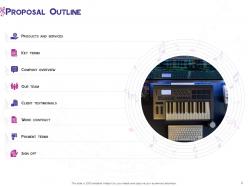
Slide 3: This slide showcases Proposal Outline containing- Products and services, Key terms, Company overview, Our team, Client testimonials, Work contract, Sign off, Payment terms.
Slide 4: This slide showcases Proposal Outline.
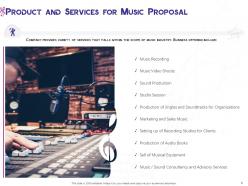
Slide 5: This slide presents Product and Services for Music Proposal.
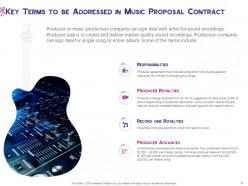
Slide 6: This slide showcases Key Terms to be Addressed in Music Proposal Contract.
Slide 7: This slide showcases Proposal Outline
Slide 8: This slide shows Company Overview.
Slide 9: This is Our Team slide with names and designations.
Slide 10: This is Our Team slide with names and designations.
Slide 11: This slide showcases Client Testimonials.
Slide 12: This slide shows Proposal Outline.
Slide 13: This slide showcases Work Contract.
Slide 14: This slide is continued with Work Contract.
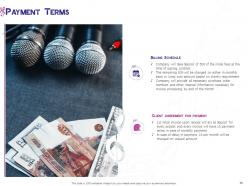
Slide 15: This slide shows Payment Terms.
Slide 16: This is Sign Off slide.
Slide 17: This is Contact us slide with Company Address, Phone number, Website and Social media accounts.
Slide 18: This slide is titled as Additional Slides for moving forward.
Slide 19: This is About Us slide to showcase Company specifications.
Slide 20: This is Our Mission slide with Vision, Mission and Goal.
Slide 21: This is 30 60 90 days plan slide.
Slide 22: This slide depicts Timeline process.
Slide 23: This slide shows Roadmap process.
Slide 24: This slide shows Roadmap process.
Slide 25: This slide depicts Roadmap process.
Slide 26: This slide also shows Roadmap process.
Slide 27: This slide shows Roadmap 7 process.
Music Producer Contract Proposal Powerpoint Presentation Slides with all 27 slides:
Feel electric with our Music Producer Contract Proposal Powerpoint Presentation Slides. Ideas will come like a bolt from the blue.
















FAQs for Music Producer Contract Proposal
A music producer contract proposal should include production scope and deliverables, payment terms and royalty structures, timeline and milestones, creative control agreements, and ownership rights for master recordings. These components streamline negotiations by establishing clear expectations, protecting intellectual property, and defining revenue sharing, with many artists and producers finding that comprehensive agreements ultimately deliver smoother collaborations and stronger professional relationships.
A music producer can effectively outline services by detailing recording, mixing, mastering, arrangement, and creative consultation offerings, along with specific deliverables, timelines, and revision policies. Through comprehensive service descriptions, producers establish clear expectations while showcasing their expertise in songwriting collaboration, technical production, and artist development, ultimately delivering professional transparency and competitive positioning in an increasingly competitive music industry landscape.
Music producers should seek protections including clear ownership rights, credit guarantees, royalty specifications, payment terms, and liability limitations. These contractual elements streamline revenue protection by defining publishing splits, ensuring proper attribution, and establishing dispute resolution mechanisms, with many producers finding that comprehensive agreements ultimately deliver sustained income streams and enhanced professional credibility.
Music producers can determine fair compensation by researching industry standards for their experience level, evaluating project scope and timeline, considering their track record and specialized skills, and analyzing comparable deals within similar genres or markets. Many producers combine upfront fees with royalty percentages, typically ranging from 3-7% of net revenues, while factoring in production costs, studio time, and potential backend earnings, ultimately ensuring compensation reflects both immediate value delivered and long-term commercial potential of the project.
Music producer contract proposals are influenced by project scope, budget complexity, producer experience level, artist requirements, and legal stipulations. These factors determine proposal depth, with established producers requiring comprehensive agreements covering royalties, creative control, and timeline expectations, while emerging artists often need streamlined contracts that balance professional protection with accessible terms, ultimately delivering clarity for both parties.
A music producer should clearly define copyright ownership for original compositions, sound recordings, and production elements, while specifying publishing rights, master recording ownership, and revenue splits between all parties. Through detailed clauses addressing work-for-hire arrangements, credit requirements, and future licensing rights, producers protect their creative contributions and establish clear monetization pathways, ultimately delivering legal protection and sustainable income streams.
Including timelines and deadlines in music producer contracts ensures project accountability, budget control, and coordinated release schedules across all stakeholders. These parameters streamline production workflows by establishing clear milestones for recording, mixing, and mastering phases, while enabling artists, labels, and distributors to synchronize marketing campaigns, ultimately delivering professional outcomes and minimizing costly delays.
Music producers tailor contract proposals by adjusting royalty structures, creative control clauses, timeline requirements, and collaboration terms based on genre-specific needs and industry standards. For instance, electronic music contracts often emphasize remix rights and digital distribution, while classical projects focus on recording quality and performance royalties, ultimately ensuring alignment with each style's commercial expectations and artistic workflows.
Common pitfalls include unclear ownership rights, vague compensation structures, missing deadlines and deliverables, inadequate cancellation clauses, and poorly defined creative control boundaries. Music producers often overlook revenue sharing specifics, sample clearance responsibilities, and credit requirements, with many finding that ambiguous terms regarding studio costs, revision limits, and intellectual property ultimately lead to disputes and project delays.
Testimonials and past work should be presented through dedicated portfolio sections showcasing specific project outcomes, client success metrics, and recognizable collaborations, while integrating brief client quotes that highlight your unique value proposition. This strategic combination demonstrates credibility and expertise, with many music producers finding that including streaming numbers, chart positions, and genre-specific achievements ultimately delivers stronger negotiating positions and faster client decisions.
Exclusivity in music producer contract proposals determines whether the producer can work with competing artists or labels during the agreement period, affecting creative control, market positioning, and compensation structures. While exclusive arrangements often command higher fees and stronger promotional commitments, they also limit producers' income diversification, with many finding that strategic exclusivity clauses enhance long-term partnerships while preserving creative flexibility.
Music producers should craft termination clauses that specify clear grounds for contract ending, including breach of agreement, missed deadlines, creative differences, and mutual consent options. These provisions should outline notice periods, payment obligations for completed work, ownership rights to existing recordings, and return of materials, with many producers finding that balanced termination terms protect both parties while maintaining professional relationships for future collaborations.
Best practices for negotiating music producer contract proposals include defining clear payment structures, establishing ownership rights, setting specific deliverable timelines, outlining creative control parameters, and including termination clauses. These negotiations streamline project expectations by addressing royalty percentages, production credits, and revision limits upfront, with many independent artists and labels finding that transparent discussions about budget constraints and creative vision ultimately deliver smoother collaborations and stronger professional relationships.
Music producers can differentiate their proposals by showcasing a diverse portfolio, demonstrating measurable results from previous projects, offering competitive pricing packages, and highlighting unique technical expertise or genre specialization. Through personalized approaches that address each client's specific vision, clear communication of production timelines, and inclusion of testimonials from successful collaborations, producers ultimately deliver compelling proposals that demonstrate both creative capability and professional reliability.
Non-disclosure agreements protect confidential creative content, unreleased tracks, production techniques, artist personal information, and business strategies shared during collaboration. These agreements ensure producers cannot leak sensitive material or share proprietary methods with competitors, while artists maintain control over their unreleased work, ultimately preserving competitive advantage and creative integrity in an increasingly interconnected music industry.
No Reviews