

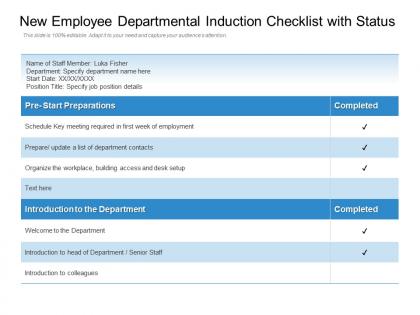
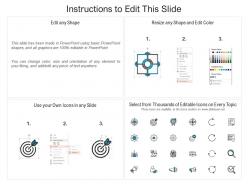
New employee departmental induction checklist with status




Try Before you Buy Download Free Sample Product
 Impress Your
 Audience
 100%
100% Editable
 Save Hours
 of Time


Our New Employee Departmental Induction Checklist With Status are topically designed to provide an attractive backdrop to any subject. Use them to look like a presentation pro.
People who downloaded this PowerPoint presentation also viewed the following :
New employee departmental induction checklist with status with all 2 slides:
Use our New Employee Departmental Induction Checklist With Status to effectively help you save your valuable time. They are readymade to fit into any presentation structure.
FAQs for New employee departmental induction
An effective induction checklist should include company overview and culture orientation, role-specific training modules, workplace policies and procedures, IT setup and system access, health and safety protocols, and introductions to key team members. These elements streamline the onboarding process by ensuring consistent information delivery, reducing administrative overhead, and accelerating new hire productivity, with many organizations finding that comprehensive checklists significantly enhance employee retention and early engagement.
An induction checklist improves employee onboarding by standardizing processes, ensuring consistent information delivery, tracking completion milestones, and reducing administrative gaps that create confusion. Through structured guidance, organizations streamline orientation workflows, enhance new hire confidence, and accelerate time-to-productivity, while HR teams maintain better oversight and compliance, ultimately delivering more positive first impressions and stronger employee retention.
Company culture plays a foundational role in induction checklists by shaping values communication, behavioral expectations, team integration activities, and organizational identity transfer. Through structured culture immersion, organizations enhance employee engagement, accelerate assimilation, and strengthen retention rates, with many companies finding that comprehensive cultural onboarding ultimately delivers improved performance and long-term organizational alignment.
**INPUT**: How frequently should an induction checklist be updated to remain relevant? **OUTPUT**: Induction checklists should be updated quarterly or bi-annually, with immediate revisions following significant organizational changes, policy updates, or regulatory shifts. This regular review cycle ensures new employees receive current information about procedures, technologies, and compliance requirements, while many organizations find that systematic updates enhance onboarding efficiency and reduce confusion. [Word count: 52 words]
Best practices for personalizing induction checklists include role-specific skill assessments, department-focused introductions, tailored training modules, position-relevant compliance requirements, and customized goal-setting frameworks. These personalized approaches enhance employee engagement by ensuring relevant content delivery, accelerating time-to-productivity through targeted learning paths, and improving retention rates, with many organizations finding that customized onboarding increases new hire satisfaction and long-term performance outcomes.
Feedback from new hires can be incorporated through post-induction surveys, regular check-ins during the first 90 days, and structured exit interviews from the onboarding process. This feedback enables organizations to identify gaps, streamline redundant processes, and enhance training modules, with many companies finding that incorporating new hire insights reduces time-to-productivity and improves retention rates significantly.
Digital onboarding platforms, HR management systems, learning management systems, collaboration tools, and mobile applications can significantly enhance induction checklist effectiveness. These technologies streamline the process by automating task tracking, enabling real-time progress monitoring, and facilitating seamless communication between HR teams and new hires, ultimately delivering faster integration and improved employee experiences.
A comprehensive induction checklist significantly improves employee retention by establishing clear expectations, accelerating role competency, and creating structured support systems that reduce early-stage confusion and anxiety. Organizations implementing thorough induction processes typically see 25-30% higher retention rates, with new hires feeling more connected, confident, and committed to long-term success.
A well-structured induction checklist addresses key onboarding challenges including inconsistent training delivery, missed compliance requirements, unclear role expectations, delayed productivity, and poor early engagement. Through systematic documentation and standardized processes, organizations streamline new hire integration, ensure regulatory compliance, and accelerate time-to-productivity, with many companies finding that structured checklists reduce onboarding time while enhancing employee satisfaction and retention rates.
Induction checklists for remote or hybrid environments should incorporate virtual introductions, digital tool training, online document access, video-based orientation sessions, and structured check-ins with managers and team members. These adaptations streamline remote onboarding by ensuring seamless technology integration, clear communication protocols, and consistent engagement touchpoints, ultimately delivering efficient workforce integration and enhanced employee experiences across distributed teams.
Key metrics for evaluating induction checklist success include completion rates, time-to-productivity measures, new hire satisfaction scores, retention rates within the first 90 days, and manager feedback assessments. These metrics work together by tracking engagement, measuring knowledge acquisition, and identifying process gaps, with many organizations finding that comprehensive measurement ultimately delivers faster onboarding and improved employee experiences.
A checklist facilitates knowledge transfer by systematically capturing institutional knowledge, standardizing training processes, and ensuring consistent information delivery from experienced employees to new hires. This structured approach enables mentors to cover critical procedures, company protocols, and role-specific insights comprehensively, while new employees retain information more effectively, ultimately accelerating onboarding timelines and reducing knowledge gaps across departments.
Common pitfalls include creating overly generic checklists, overwhelming new hires with excessive information, neglecting role-specific requirements, poor timing of activities, and lack of feedback mechanisms. These issues can be avoided by tailoring content to specific positions, spacing activities strategically, and incorporating regular check-ins, with many organizations finding that personalized, phased approaches significantly enhance employee engagement and retention rates.
Yes, induction checklists should include training resources, ongoing development opportunities, mentorship programs, skill-building modules, and career pathway information. These elements enhance employee engagement, accelerate competency development, and improve retention rates, with many organizations finding that comprehensive onboarding programs ultimately deliver higher productivity, reduced turnover, and stronger long-term performance outcomes.
Visual elements in induction checklists enhance comprehension through infographics, flowcharts, progress indicators, color-coding systems, and interactive icons that simplify complex information and create intuitive navigation pathways. These design features streamline the onboarding experience by reducing cognitive load, improving information retention, and maintaining employee engagement throughout the process, with many organizations finding that visually-enhanced checklists significantly accelerate training completion rates.
-
Attractive design and informative presentation.
-
Unique and attractive product design.