

One page marketing plan powerpoint presentation slides




Try Before you Buy Download Free Sample Product
 Impress Your
 Audience
 100%
100% Editable
 Save Hours
 of Time


A full-fledged marketing plan is an in-depth document that specifies the company mission and goals, market and customer insights, marketing objectives, and measurement. However, many small businesses and entrepreneurs demand a one-page marketing plan to get a complete snapshot of the detailed marketing strategy on one page. Here is an efficiently designed One Page Marketing Plan template that will help you outline your big marketing strategy and sum it up in one page to get a faster buy-in from top management or clients. A one-page marketing plan generally includes a snapshot of who the target customer is, what is the product or service being offered, what are your unique strengths, marketing goals, and tactics to achieve that goal. Having everything on one page helps you align your marketing goals with customer needs and lets you focus all energy on implementing the action plan instead of preparing long marketing strategies. Download this 100 percent editable one-page marketing plan now.
People who downloaded this PowerPoint presentation also viewed the following :
Content of this Powerpoint Presentation
Slide 1: This slide displays title i.e. 'One Page Marketing Plan'.
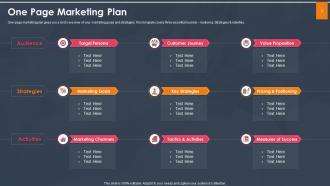
Slide 2: This slide presents One Page Marketing Plan along with audience, strategies, and activities.
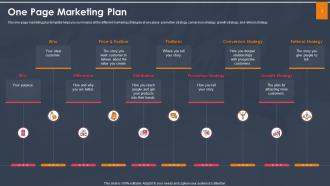
Slide 3: This slide helps you summarize all the different marketing strategies at one place- promotion strategy, conversion strategy, etc.
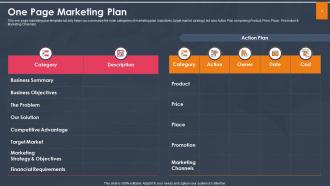
Slide 4: This slide helps you summarize the main categories of marketing plan (objectives, target market, strategy) but also Action Plan.
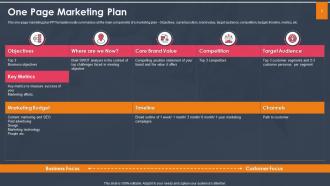
Slide 5: This slide summarizes all the main components of a marketing plan – Objectives, current position, brand value, target audience, competition, etc.
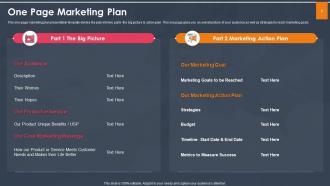
Slide 6: This slide divides the plan into two parts- the big picture & action plan.
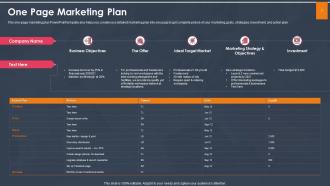
Slide 7: This slide helps you condense a detailed marketing plan into one page to get complete picture of your marketing goals, strategies, investment, and action plan.
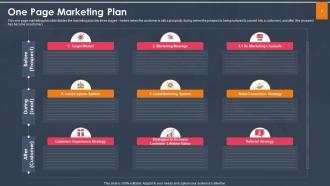
Slide 8: This slide divides the marketing plan into three stages – before, during, and after (the prospect has become a customer).
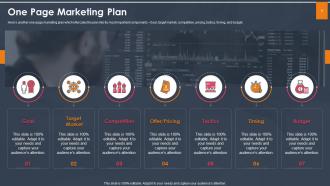
Slide 9: This slide bifurcates the plan into its most important components –Goal, target market, competition, pricing, tactics, timing, and budget.
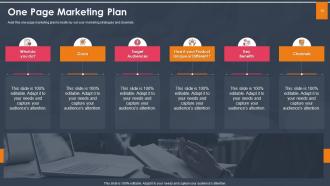
Slide 10: This slide lays out your marketing strategies and channels.
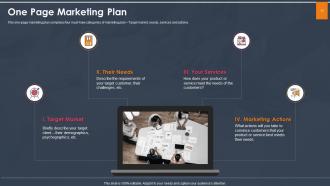
Slide 11: This slide comprises four must-have categories of marketing plan – Target market, needs, services and actions.
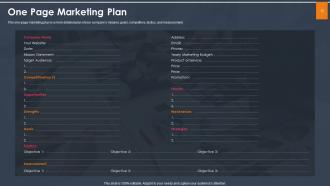
Slide 12: This slide showcases your company’s mission, goals, competitors, tactics, and measurement.
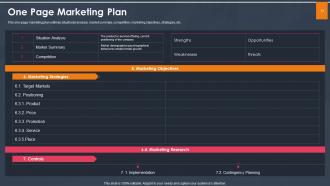
Slide 13: This slide outlines situational analysis, market summary, competition, marketing objectives, strategies, etc.
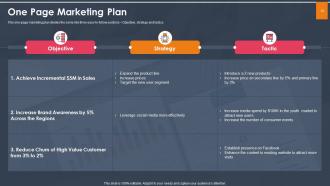
Slide 14: This slide divides the same into three easy-to-follow sections – Objective, strategy and tactics.
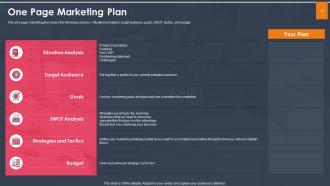
Slide 15: This slide covers the following sections – Situational Analysis, target audience, goals, SWOT, tactics, and budget.
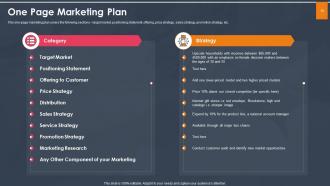
Slide 16: This slide covers the following sections – target market, positioning statement, offering, price strategy, sales strategy, promotion strategy, etc.
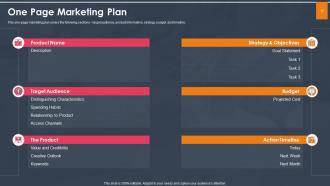
Slide 17: This slide covers the following sections – target audience, product information, strategy, budget, and timeline.
Slide 18: This is the icons slide.
Slide 19: This slide presents title for additional slides.
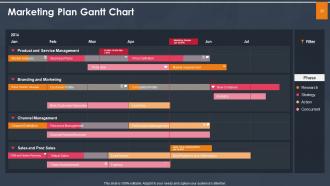
Slide 20: This slide exhibits Marketing Plan Gantt Chart.
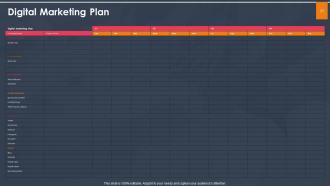
Slide 21: This slide showcases Digital Marketing Plan.
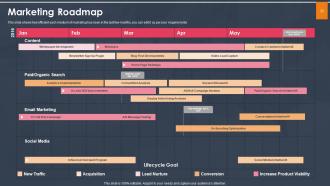
Slide 22: This slide highlights Marketing Roadmap.
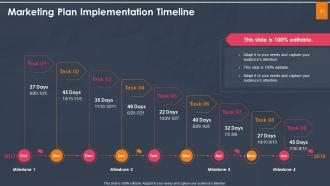
Slide 23: This slide illustrates Marketing Plan Implementation Timeline.
Slide 24: This slide shows details of team members like name, designation, etc.
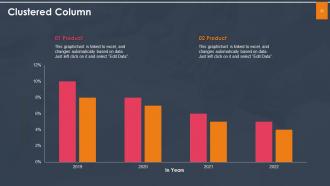
Slide 25: This slide exhibits yearly clustered column charts for different products. The charts are linked to Excel.
Slide 26: This slide depicts 30-60-90 days plan for projects.
Slide 27: This slide display targets of your company.
Slide 28: This slide displays puzzle.
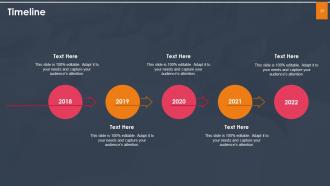
Slide 29: This slide exhibits yearly timeline.
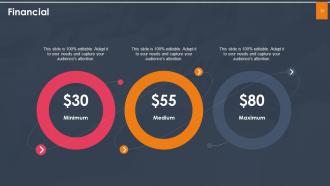
Slide 30: This slide showcases financials.
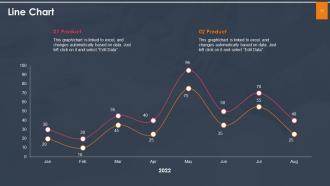
Slide 31: This slide exhibits monthly line charts for different products. The charts are linked to Excel.
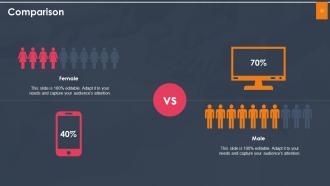
Slide 32: This slide highlights comparison of products based on selects.
Slide 33: This slide displays Venn.
Slide 34: This is thank you slide & contains contact details of company like office address, phone no., etc.
One page marketing plan powerpoint presentation slides with all 39 slides:
Use our One Page Marketing Plan Powerpoint Presentation Slides to effectively help you save your valuable time. They are readymade to fit into any presentation structure.






FAQs for One page marketing plan
Okay so break your marketing plan into three chunks: who you're targeting, what you're telling them, and where you'll reach them. Get super specific about your audience - like actual demographics and problems they face. Your message should hit their pain points directly. For channels, go where they actually are, not where you assume (spoiler: Instagram probably won't work for enterprise software). Keep everything to 2-3 bullets per section max. The whole point is fitting it on one page so you'll actually look at it instead of burying it in some folder.
Honestly, one-page marketing plans are where it's at. You skip all the corporate BS and nail down what actually works - who you're selling to, your main message, and how you'll reach them. No more drowning in massive documents that sit on shelves collecting dust. Plus your whole team can glance at it and instantly get what you're doing. I've seen too many businesses overthink this stuff. Quick decisions become way easier when everything's right there. Start with your dream customer first, then figure out the best ways to get in front of them. Simple but super effective.
Pick 3-4 metrics max that actually connect to what you're trying to do. Awareness campaign? Track reach and impressions. Lead gen means conversion rates and cost per lead matter most. I've seen way too many plans with like 15 metrics that just collect dust - nobody has time for that. Keep it simple and make sure you can track progress weekly or monthly if it's a quarterly thing. Use whatever you can easily pull from tools you already have. Your team won't check complicated dashboards anyway, so stick with stuff they'll actually look at regularly.
Honestly, those giant marketing plans are such a waste of time. Like, who has energy to read 50 pages? One-page plans cut straight to what actually matters: who you're selling to, what you're telling them, and where you'll find them. Regular plans take forever to write, and by then half your info is already wrong anyway. The short version makes you get super clear about your target customer right away. Start with your ideal buyer and figure out the rest from there. Way less overthinking, way more doing. Plus you can actually update it without wanting to cry.
Yeah totally! The framework translates to basically any industry - you're still figuring out your audience, your message, and where to reach people. A cupcake shop and a software company will have completely different tactics (obviously), but they're using the same basic structure. That's honestly what makes it so useful. You just swap in your own industry details - different messaging, different channels, metrics that actually make sense for your business. I started with the template when I was working on my friend's gym marketing and just customized from there. Works pretty well.
Look, target audience analysis is literally the backbone of your whole one-page plan. Without knowing who you're talking to, you're just shooting in the dark hoping something sticks. A message that hits with millennials? Probably gonna fall flat with boomers. Your audience determines everything - what tone you use, which platforms you pick, how you spend your budget. Honestly, I've seen too many plans fail because people skipped this step. Create 1-2 solid buyer personas first, then build everything else around them. Don't even touch the rest of your plan until you nail this part down.
Honestly, visuals are a game-changer for marketing plans. Nobody wants to stare at walls of text - I mean, I zone out just thinking about it. Charts and icons make everything so much easier to scan quickly. Color-coding is clutch too. When you're forced to turn ideas into simple graphics, it actually clarifies your whole strategy. Way better than rambling paragraphs that nobody reads anyway. Stakeholders will actually keep your plan around if it looks decent. I'd go with flowcharts for customer journeys and maybe icons for different channels. Keeps everything clean without being boring.
Honestly, the worst thing you can do is try to squeeze everything onto one page. You'll get this microscopic text that nobody can read - kind of defeats the point, right? Skip the "everyone's my target audience" trap too. That's never true. Oh, and be specific with goals! "Boost sales by 25% in Q2" beats some vague "increase sales" nonsense any day. Just figure out what's absolutely critical and cut the rest. I know it's brutal, but your one-pager will actually work if you're ruthless about it.
Honestly? I look at mine every month because everything changes so damn fast now. Quarterly is the bare minimum most people say, but monthly works better for me. If something big hits - like your budget gets slashed or a campaign totally bombs - just update it right away instead of waiting. That's the whole point of keeping it one page, right? Takes maybe 30 minutes to see what's actually working. Oh, and definitely set a calendar reminder or you'll forget (I always do). Quick monthly check-ins beat scrambling when things go sideways.
For creating a one-page marketing plan, I'd definitely start with Canva - their templates look amazing and you don't need design skills. Google Docs works too if you're more of a text person. The Allan Dib template is actually pretty genius, breaks everything into nine sections so you can't overthink it. I know it sounds old school, but sometimes I still grab a whiteboard first just to dump ideas. Whatever you use though, make sure it forces you to stick to the basics: who you're targeting, what you're saying, and how you'll reach them. Just use whatever you already have honestly.
So basically, you stick everything on one page and boom - no more hunting through massive slide decks when someone asks "wait, what's our strategy again?" Your whole team can actually see how their work fits together instead of working in silos. Sales, product, customer service - they all get it instantly. Honestly, those 50-slide presentations are such a waste of time anyway. Put it somewhere people will actually look at it, like pinned in Slack or whatever you use. The goal is getting everyone aligned without the usual back-and-forth confusion that happens when your strategy's scattered everywhere.
Okay so break it into three buckets: getting new customers, keeping current ones happy, and testing new stuff. List actual dollar amounts for each channel - paid ads, content, tools, events, whatever you're doing. Those random software subscriptions and freelancer fees? They'll bite you if you don't account for them. Set aside like 10-20% for experimenting because honestly, you never know what random tactic might blow up. I learned this the hard way lol. Skip percentages and use real numbers - makes you face what you can actually spend instead of living in fantasy land.
Turn your marketing plan into your customer's story - seriously, this works so much better than boring bullet points. Their problem becomes the conflict. Your solution? That's the hero swooping in. Then show what happens after - the transformation they get. Testimonials are perfect here because they're real proof, not just you talking yourself up. I mean, everyone loves a good before-and-after story, right? Frame your value prop as that bridge from "ugh this sucks" to "wow this is exactly what I needed." Way more interesting than just rattling off features.
Honestly, one-page marketing plans are perfect for startups because you're broke and can't waste time on fancy strategies that don't work anyway. Forces you to nail down what actually matters. Bigger companies use them differently - testing new stuff without messing up their main game plan. Also super helpful when you need the whole team on the same page quickly. Nobody wants to sit through a 50-slide presentation about market penetration or whatever. Oh, and always start with figuring out who you're actually selling to. Everything else flows from there.
Honestly, a one-page marketing plan is a game changer. You stop wasting time on random Instagram posts that go nowhere. Instead, everything has purpose - your emails, ads, content, whatever. Map out who your ideal customer actually is first (and where they hang out online). Then you've got this quick reference sheet that keeps you focused. No more "should I post this?" moments - you just check your plan. I used to jump around between platforms with zero strategy and it was exhausting. Now when I'm setting up Facebook ads or writing email sequences, I know exactly what message hits. Way less scattered, way better results.
-
Visually stunning presentation, love the content.
-
Amazing product with appealing content and design.