

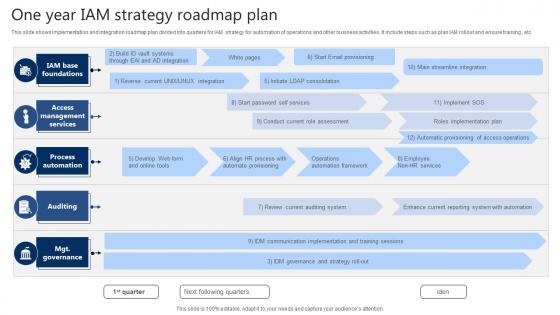
One Year IAM Strategy Roadmap Plan




Try Before you Buy Download Free Sample Product
 Impress Your
 Audience
 100%
100% Editable
 Save Hours
 of Time


This slide shows implementation and integration roadmap plan divided into quarters for IAM strategy for automation of operations and other business activities. It include steps such as plan IAM rollout and ensure training , etc
People who downloaded this PowerPoint presentation also viewed the following :
One Year IAM Strategy Roadmap Plan with all 6 slides:
Use our One Year IAM Strategy Roadmap Plan to effectively help you save your valuable time. They are readymade to fit into any presentation structure.





FAQs for One Year IAM
Okay so for your IAM roadmap, start with figuring out what you've got now - like what's your current access situation looking like? Define where you want to end up and how you'll govern it. Build out the tech plan, but honestly the communication piece is make-or-break here. I've watched so many of these crash because nobody got stakeholders on board. Don't forget compliance stuff from the beginning either. Oh and definitely pilot first! Test it small before going company-wide. You'll catch issues early and can tweak things based on what actually works.
Start with auditing what you've got - user management, access controls, authentication, all that stuff. NIST frameworks work great for scoring everything from basic to advanced. Honestly, seeing it all laid out is kinda shocking sometimes! Check your technical setup AND day-to-day processes. How's onboarding handled? Got automated provisioning? What about password policies and compliance reporting? Document where you're falling short compared to where you need to be. Then prioritize your roadmap based on those gaps. Trust me, the assessment part is tedious but totally worth it.
Look, compliance stuff is basically your safety net - GDPR, SOX, HIPAA, whatever applies to you. You literally can't ignore these without risking massive fines. But don't just check the box and call it done. I always tell people to use frameworks like NIST as your starting point, then layer on extra security. Honestly, most companies I've seen treat compliance like it's the finish line when it should be mile one. First step? Figure out where you're currently failing compliance requirements and fix those gaps immediately. Everything else can wait.
Track a few key things to see if your IAM setup is actually working. Security metrics like failed logins, privileged account counts, and how fast you handle access requests matter. Operational stuff too - provisioning speed, help desk tickets about access problems, cost per user. Your auditors will obsess over compliance metrics, which is annoying but whatever. Don't forget user experience though - new hires shouldn't wait forever for proper access. Oh, and start small with maybe 3-5 metrics. Trying to measure everything right away just creates chaos you don't need.
Look, first thing - talk to the business people, not just your IT team. I know it sounds basic but trust me, most places totally blow this off. Figure out what's actually driving the company. Growing internationally? You'll need identity stuff that scales. Heavy compliance requirements? Better get those audit features locked down. Map everything back to real business wins like getting new hires up and running faster or making customers happy. Don't just sell it as "preventing bad things" - show how it actually moves the needle. Honestly, the stakeholder interviews should be your very first move. Once you get their pain points, the technical requirements basically write themselves.
Honestly, I'd go with AI-powered identity governance and zero trust architecture first. Passwordless auth is solid too. Biometrics have gotten way less terrible lately - remember those awful fingerprint readers? Behavioral analytics is pretty impressive now. Identity fabric could help unify all your scattered systems, which sounds like a headache you probably have. Blockchain-based decentralized identity is interesting but maybe not priority one. Don't try to do everything at once though. Pick 2-3 things that'll actually fix your biggest problems and run a pilot. Way better than getting distracted by every new tech that pops up.
Make it stupid easy for people to use - that's honestly what kills most IAM projects. Single sign-on needs to actually work without glitches. Don't create workflows that feel like solving a puzzle just to log in. Get your users involved from day one. Run pilots first. I've watched so many teams skip this step and then wonder why everyone hates the new system. Training helps, but showing clear benefits works better. Like "hey, you'll never have to remember 12 different passwords again." People get that immediately. Oh, and make sure the interface doesn't look like it's from 2003.
Ugh, executive buy-in is always a nightmare - they never want to spend money on stuff they can't see. Legacy systems are another pain because nothing talks to each other properly. Honestly, mapping your current access points will take forever and you'll keep finding random stuff you forgot about. Balancing security with making users happy is tricky too. Different teams will fight you on priorities, and good luck finding people who actually know this stuff well. Oh, and budgets are always tight. I'd start with something small first - prove it works, then use that to get more resources.
Look, risk-based IAM is just smart prioritization. Instead of going nuts trying to secure everything at once, you figure out what actually matters most. Map your crown jewels first - high-privilege accounts, sensitive data, sketchy third-party access. Then build your controls around those areas. Way more efficient than blanket policies everywhere, and honestly? Your budget conversations get so much easier when you're addressing real business risks. I'd start with identifying what would hurt most if compromised, then work backwards from there. Don't try to boil the ocean right away.
So identity governance is like the foundation of your whole IAM setup. You need it to manage user lifecycles, run access reviews, handle compliance stuff, and assess risks. Basically it's your quality control - keeps everything from turning into a mess. Trust me, skip this and you'll be drowning in access creep and orphaned accounts everywhere. Plus compliance becomes a total headache. I'd start by figuring out where your gaps are right now, then focus on automating those access reviews first. That'll give you the biggest bang for your buck.
Start with a basic risk matrix - high/medium/low for likelihood vs impact. Honestly, the really dangerous stuff is usually pretty obvious, so don't overthink it. Prioritize anything that could cause data breaches or compliance issues first, especially around privileged access. Quick wins are your friend here - MFA rollouts, killing orphaned accounts, stuff like that. Build a simple scoring system that factors in business risk, regulatory requirements, and how much effort it'll take. Oh, and this gives you solid backup when leadership inevitably questions why you're doing X before Y. Most orgs make this way more complicated than it needs to be.
Don't tear down everything at once - that's a recipe for disaster. Map out what you've got first, then tackle SSO for your biggest apps. APIs will save your sanity here since you won't need to rebuild everything from scratch. Roll it out slowly though. Users get seriously pissed when they can't access their daily tools. Document your current identity flows before touching anything - I learned this the hard way during a migration that went sideways. Trust me on this one. Short version: build on what works, go slow, and document like your job depends on it.
Honestly, cloud services are a game changer for IAM stuff. Azure AD or AWS IAM come with SSO, MFA, and user provisioning already built in - saves you tons of time vs building it yourself. The scalability blows on-prem out of the water too. SaaS integrations work way better, and you get solid analytics to see how people are actually accessing things. First thing - map out what identity sources you're currently using. Then just pick whichever cloud provider plays nice with your existing setup. Oh, and don't overthink it - most of these platforms are pretty similar feature-wise anyway.
So basically zero trust flips everything - you stop trusting people just because they're "inside" your network. Every single access request gets verified, no matter where someone's connecting from. Your identity systems become like the main security hub (which honestly makes way more sense than the old way). You'll want stronger auth methods and real-time risk checking. The big shift? Going from "trust but verify" to just... never trust anyone, ha. I'd start by looking at where you currently verify people and figure out what needs tighter controls.
Yeah totally! SSO is a lifesaver - nobody wants to remember 20 different passwords. Risk-based auth is clutch too since it only bugs users when something actually looks sketchy. Biometrics and passwordless stuff makes everything smoother. Honestly, modern MFA isn't nearly as painful as it used to be. The trick is keeping security invisible during normal use but having it jump in when weird stuff happens. I'd start by mapping out where users get most frustrated in your flow - that's probably where you'll see the biggest wins. Oh and don't sleep on the passwordless options, they're getting really good.
-
The Designed Graphic are very professional and classic.
-
Great product with highly impressive and engaging designs.