


 0 Comment
 Customer Reviews

Think of a busy international airport. People come and go from all over the world. Some are regular travellers and others are just passing through. Everyone has their level of access—some can board planes, others can go behind the scenes and only a few can step into the control tower. It’s not just about getting in—it’s about getting in where you’re supposed to be. That’s the basic idea behind Identity and Access Management (IAM).
Explore our top 10 identity and access management presentation templates, featuring samples and examples.
Today, almost everything we do at work happens online. Our files, tools, and systems live in the cloud. We log into dozens of platforms each day—and we aren’t the only ones. Employees, partners, freelancers, and even automated tools all need access to different things. As our systems become increasingly connected, controlling access to information and resources becomes even more crucial.
In 2025, cybersecurity experts estimate that cybercrime will cost the world over $10 trillion. Most of those breaches happen because someone obtained a password or tricked their way into a system. Strong passwords are no longer enough. Businesses need a smart identity management strategy and access.
That’s where identity and access management (IAM) comes in. It ensures that the right people can access the right information and keeps everyone else out. It allows you to give employees access to only the tools they need. If someone exits the company or changes roles, their access is updated automatically. And if something suspicious occurs, such as someone logging in from an unusual location, IAM can flag it or shut it down.
The 100% editable and downloadable templates featured in this blog make it easier to create a comprehensive plan for managing identities and access in any organization. They cover everything from setting up IAM, planning how access is controlled, shaping your overall identity strategy framework, and making sure everything is secure and well-governed. You’ll also find guidance on designing your IAM system, User identity strategy, IAM modernization roadmap, identity governance framework, secure access strategy, and handling the full lifecycle of user access. They’re handy for sharing ideas with your IT team, security folks, or anyone involved in these decisions.
Explore the top 10 strategy roadmap templates with samples and examples.
Let’s explore!
Template 1: One-Year IAM Strategy Roadmap Plan
Want to know how to implement a year-long plan of Identity and Access Management (IAM) blueprint? This slide is for you. It’s laid out by quarter, so it’s easy to see what’s happening when. It starts with the basics—setting up systems to manage IDs, connecting everything properly, and reworking some older setups. Over time, what becomes important is offering self-service tools for passwords, determining the actual roles people need, and ensuring everything integrates smoothly with HR processes. It also examines ways to enhance access tracking and auditing, as well as ensuring the right individuals are involved in managing and communicating the changes. Each section of the plan builds upon the one before, helping your team stay organized and providing a solid foundation to present during reviews or meetings with stakeholders. It’s a useful way to help others with your approach without getting lost in the details.

Template 2: Steps for Access Governance IAM Strategy Five-Year Roadmap
This slide outlines a simple five-year plan for Access Governance in IAM. In the first year, the goal is to establish clear visibility by setting up the right tools, gathering user data, and eliminating outdated systems. Year two is all about building accountability with certifications and automating the control process. In year three, the focus shifts to improving access requests through simple interfaces, streamlined approval workflows, and better audit trails. By year four, the plan focuses on enhancing automation through application integrations and refining access controls. The fifth year is all about refining and strengthening the system based on the previous work. This roadmap clearly shows the direction and progress of the IAM strategy over the next five years.

Template 3: Roadmap for Identity and Access Management Implementation
This slide presents a simple, step-by-step approach to implementing an Identity and Access Management (IAM) strategy within an organization. It begins with deploying new IAM technologies, such as decentralized identity frameworks and blockchain. Then, the roadmap includes the adoption of BYOI (Bring Your Own Identity); this will ensure a smooth and seamless user experience. The third step involves penetration testing to ensure that security and compliance with the system take place. Lastly, the roadmap emphasizes ongoing monitoring and improvement to adapt the IAM process as needed. At the bottom of the slide, BYOI is explained, and its importance is underlined.

Template 4: Time Framework for Implementing IAM Proposal
This slide presents a simple timeline for implementing an Identity and Access Management (IAM) plan spanning five weeks. Week 1 focuses on setting clear objectives for the project and identifying the key people involved. In Week 2, you'll look at compliance requirements and create a detailed project plan. During Week 3, the focus is on integrating Identity and Access Management (IAM) with your existing systems, followed by the development and testing of the associated policies. In Week 4, you’ll set up a regular maintenance schedule and begin monitoring IAM logs to track performance. By Week 5, the project will have entered its next phase, with additional tasks to ensure the IAM system continues to operate smoothly.

Template 5: Timeline to Implement Identity and Access Management Plan
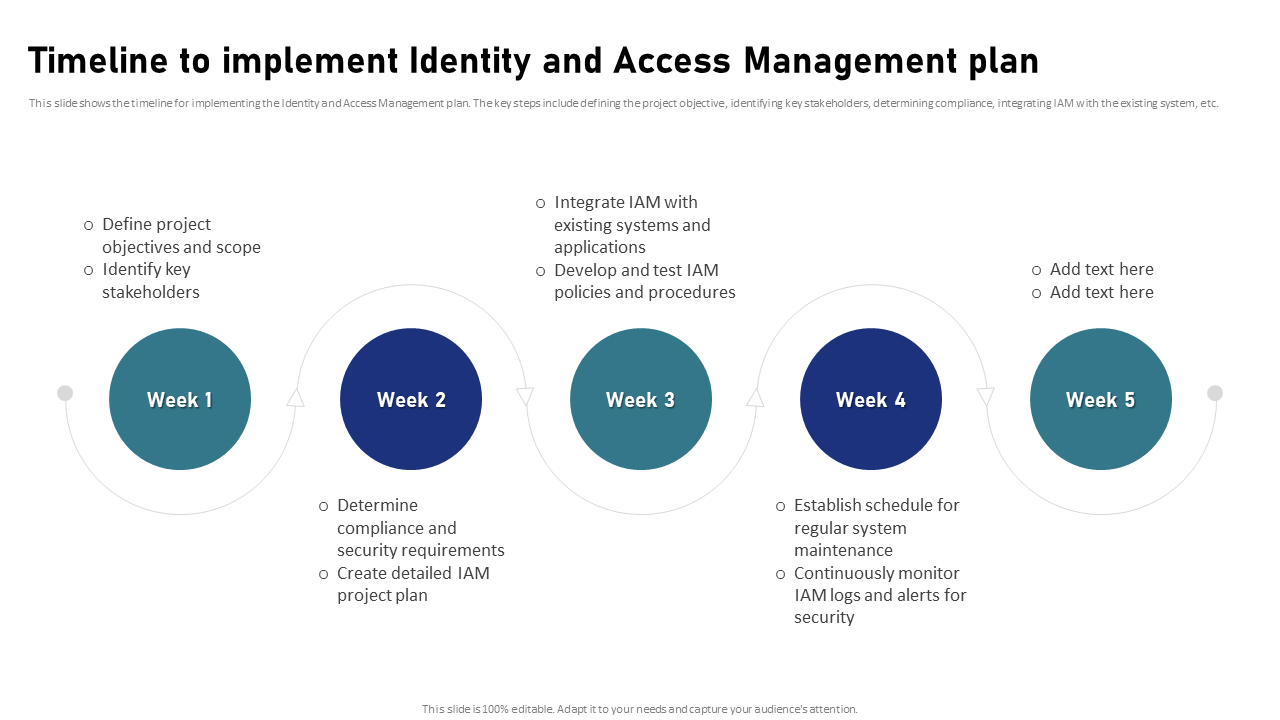
This slide is a simple five-week plan for executing an Identity and Access Management (IAM) system. In week one, you'll define the project goals and identify the key stakeholders. Week two focuses on understanding compliance and security needs, as well as creating a detailed IAM project plan. Week three involves integrating IAM with existing systems and conducting tests of the necessary policies. Week four focuses on establishing regular maintenance schedules and monitoring IAM logs for security purposes. In the final week, you'll wrap up any remaining tasks to make sure everything runs smoothly. The plan guides you from initial setup through to ongoing monitoring and maintenance.
Template 6: 30-60-90 Days Plan for IAM Implementation
Want a 30-60-90 day plan for implementing Identity and Access Management (IAM)? Then, this slide has it all. It is divided into three key phases. Within the first 30 days, the goal is to develop an overall IAM plan, establish the project team, and assign roles and responsibilities to team members. The next 30 days will focus on developing IAM policies and procedures, as well as initiating user training. By day 90, the goal is to roll out identity provisioning and de-provisioning processes, as well as establish monitoring and auditing mechanisms to track performance.

Template 7: Identity and Access Management Process in the Workplace
This slide outlines how Identity and Access Management (IAM) works in the workplace. With the increasing use of applications and SaaS solutions, managing access is becoming increasingly important. It focuses on three main areas: first, the need to authorize users across different services as SaaS adoption increases; second, the management of identity data, typically stored in Active Directory and linked to applications; and third, the complexity of access scenarios, where individuals have multiple identities and specific access requirements. These points prove why Identity and Access Management (IAM) is needed for secure and efficient access control today.

Template 8: Steps to Implement Identity and Access Management Program
This slide outlines the key steps for implementing an Identity and Access Management (IAM) program, enabling organizations to follow a clear process. It begins with understanding why your organization requires Identity and Access Management (IAM) and how it aligns with your broader objectives. Once that’s clear, the next step is to explore various approaches to Identity and Access Management (IAM) and ensure it meets your security and compliance requirements. After that, you pick a solution that works well with what you already have, such as your on-premises Active Directory. Then comes budgeting, where you try to gauge the costs and see where you can move expenses from capital to operational. Later, you build a clear strategy and plan for getting started, including timelines and milestones. The final step is to implement that plan and get the IAM system up and running.

Template 9: Identity and access management implementation roadmap
This slide discusses the IAM implementation plan, which is divided into two phases: the first three months and the subsequent nine months. In the first phase, the focus is on laying the foundation, which includes tasks such as integrating Unix/Linux, setting up a reverse proxy, building an ID vault, and connecting with key systems like SAP. It also covers custom authentication and authorization plans, as well as starting access management through role assessments and setting up basic tools for contractor recruitment. Over the next nine months, it will be all about consolidating LDAP, provisioning email access, and defining roles. It also involves automating self-service features and aligning HR processes with provisioning. Auditing and reporting will be enhanced, and governance activities will commence with executive support, communication, and training, followed by the rollout of the IAM governance strategy. This roadmap provides a clear path from initial setup to ongoing optimization and management.

Template 10: Steps for IAM Strategy Initiative Five-Year Roadmap
This slide outlines a five-year IAM strategy organized into three phases: "Do Now," "Do Next," and "Do Later." In the first year, the focus is on establishing a governance framework, selecting the future IAM architecture plan, and completing some essential projects. However, it may still spill over into Year 2, when additional projects begin, including transitioning legacy IAM processes to maintenance mode. In Year 3, attention shifts to ongoing projects, with new initiatives taking effect. The last two years have focused primarily on the "Do Later" tasks, gradually completing projects as they move through different stages. The roadmap provides a clear and structured approach, with priorities assigned to each stage, ensuring that IAM implementation is carried out smoothly over time.

Over to you!
Download our templates to sharpen your presentations on IAM topics, as they offer everything from basic ideas to fresh perspectives, making it simple for you to craft a compelling presentation. The IAM strategy roadmap prioritizes immediate objectives, including implementing governance frameworks and selecting the appropriate technology, while also establishing long-term targets for ongoing projects.
Start your strategic journey towards your company's success with our comprehensive Growth Roadmap Templates!
FAQs
1. What is the IAM roadmap?
An IAM roadmap is a plan that outlines how an organization will implement Identity and Access Management over time, including key phases and priorities. It helps guide the process and allocate resources effectively.
2. What is the IAM lifecycle?
The IAM lifecycle describes the stages a user's identity goes through, from creation to deactivation, making sure access is properly managed throughout. It covers user setup, access control roadmap, and monitoring.
3. What is the IAM workflow?
IAM workflow is the process that handles how user identities are managed, from requesting access to approving and granting it. It ensures that access control is smooth, secure, and efficient.