


Site Reliability Engineering Execution Roadmap




Try Before you Buy Download Free Sample Product
 Impress Your
 Audience
 100%
100% Editable
 Save Hours
 of Time


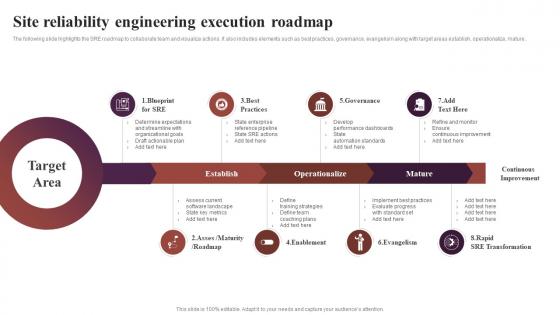
The following slide highlights the SRE roadmap to collaborate team and visualize actions. It also includes elements such as best practices, governance, evangelism along with target areas establish, operationalize, mature.
People who downloaded this PowerPoint presentation also viewed the following :
Site Reliability Engineering Execution Roadmap with all 6 slides:
Use our Site Reliability Engineering Execution Roadmap to effectively help you save your valuable time. They are readymade to fit into any presentation structure.





FAQs for Site Reliability
SRE is basically treating ops work like coding problems. Manual stuff will destroy your team's sanity, so automate whatever you can. Accept that things break - don't try to make everything perfect. Set clear SLOs so you actually know what "working" means for users. Dev and ops shouldn't be enemies throwing code over the fence at each other. Error budgets are huge for balancing new features against keeping stuff stable. Honestly, just pick one service and define its SLOs first. That'll give you something real to work with instead of theory.
So SRE is ops but with a dev mindset - you're writing code to solve reliability problems instead of just firefighting all day. Traditional ops is super reactive and manual. SRE teams build automation and treat uptime like an engineering challenge. Way less grunt work, more time building monitoring tools and setting error budgets. The whole point is preventing disasters rather than scrambling when stuff breaks. Honestly, it's so much better than the old "wait for alerts then panic" approach. You'll basically think of every ops headache as something you can code your way out of.
Start with the four golden signals - latency, traffic, errors, and saturation. They're your best bet for understanding system health. MTTR is honestly where you'll see how good your team really is at handling stuff when it breaks. Track uptime, deployment frequency, and don't ignore the customer stuff like conversion rates. Technical metrics mean nothing if users are having a terrible time, you know? Oh, and resist the urge to monitor everything at once - stick to these basics first.
Honestly, SRE is pretty solid for keeping things running smoothly. You set error budgets and SLOs upfront so you catch problems before your users start complaining. The monitoring alone is worth it - beats finding out about outages from Twitter, trust me. Post-mortems actually mean something because there's a real process behind them. Your ops team starts thinking more like developers too, which pushes everyone toward better architecture choices. Oh, and automated incident response is clutch. I'd say start with defining your SLOs first - once you know what "good" looks like, everything else clicks into place.
Incident management is basically how you deal with outages without losing your mind. When stuff breaks, you need clear roles and escalation paths so people aren't just running around panicking. The real magic happens in post-mortems though - that's where you actually learn from the mess. Document your current process first (trust me, you'll find holes everywhere). Good runbooks are clutch when you're stressed at 2am and can't think straight. Yeah, it's about putting out fires, but the smart teams use those disasters to get better. Blameless post-mortems are key - otherwise people just hide problems.
First thing - get leadership on board and figure out which metrics actually matter to users. Honestly, the trickiest part is shifting that blame culture. People need to feel safe talking about failures without getting thrown under the bus. Set up blameless postmortems and error budgets so teams can move fast without breaking everything constantly. Measure how much manual grunt work your team's doing and automate that stuff away. Don't silo your SREs either - embed them with dev teams. Oh, and start with just one service to prove it works before you go crazy expanding everywhere.
Start with monitoring stuff - Prometheus, Grafana, maybe Datadog if you've got budget. You can't fix what you can't see, right? Terraform's pretty much mandatory for infrastructure as code. PagerDuty or OpsGenie will save your sanity when things break at 3am (and they will). CI/CD pipelines are obvious. ELK stack's solid for logs. Oh, and automation frameworks - whatever fits your stack. Honestly though, don't get caught up chasing the shiniest tools. Pick stuff that actually works together instead of fighting your toolchain constantly.
So basically SRE teams get this thing called an error budget - it's like your monthly allowance for stuff breaking. Burn through it too quick? Time to pump the brakes on new releases and fix what's busted. Way under budget though? Go wild with those risky deployments. What's cool is it turns those endless "should we ship this?" arguments into actual math instead of people just going with their gut. I mean, engineers love data anyway so this works perfectly. Just track that budget obsessively and let the numbers tell you when to speed up or slow down releases.
Track your actual CPU, memory, disk, and network usage instead of just guessing. Most teams totally wing it until something breaks - learned that one the hard way. Set up forecasting to predict when you'll hit 70-80% capacity, then plan your scaling 3-6 months out. Don't forget about traffic spikes and seasonal stuff either. Automated alerts are clutch so you're not panicking at 2am. Growth projections matter too, but honestly those business estimates are usually way off anyway.
Honestly, automation is a game changer for cutting down mistakes and speeding up response times. You know how it is - deployments, rollbacks, scaling stuff - all those things where you're prone to mess up, especially when you're tired. Automated monitoring catches problems way before you'd notice them manually too. Start with something small though, like that one annoying repetitive task that always trips people up. I'd probably go for whatever's causing the most headaches first. Once you get that running smoothly, the consistency improvement is pretty obvious and you can expand from there.
First thing - get your rotation schedules sorted so people aren't stuck on-call forever. Your runbooks need to actually help (mine were garbage until we rewrote them last year). Automate the easy stuff or you'll drown in alerts. Don't chase 100% uptime - set SLOs based on what actually matters to the business. Post-incident reviews are huge for catching patterns, just keep blame out of it. Response time expectations should match severity levels too. Here's the real talk though - track your on-call burden and speak up if it's too much. Exhausted engineers screw up more, which just creates more incidents.
So SRE is like having translators between dev and ops teams - they actually get both sides. Instead of tacking on monitoring stuff later, you build it right into your workflow from the start. Error budgets are honestly brilliant because devs know exactly how much they can push things without breaking everything. These people can handle both "we need this shipped now" and "yeah but what if it crashes?" Pretty smart to get your SRE folks in sprint planning early. Catches the messy stuff before it becomes a real problem.
Think of SLOs as your reliability goals - stuff like "99.9% uptime" or "API calls under 200ms." Way better than crossing your fingers and hoping things don't break (spoiler: they will). Here's the thing though - pick targets based on what users actually need, not what sounds cool in meetings. I'd start with maybe 2-3 metrics that matter most to your users. They're super helpful when your boss wants "five nines" reliability but you know that's overkill. You'll have real data to show what's realistic vs. what's just engineering theater.
Look, postmortems work best when nobody's pointing fingers. Focus on what broke in your systems, not who broke it. Map out the timeline, dig into root causes, figure out where monitoring failed you. I've watched teams spiral into blame games and it's such a waste - kills any chance of actually learning something. Document everything, assign action items with real deadlines, then actually do them (shocking concept, right?). Share what you learned with other teams too. They'll hit similar problems eventually, so why not save everyone the headache?
So SRE makes incident response way more systematic - you're tracking error budgets instead of just scrambling to fix everything. Game changer honestly. Those blameless postmortems actually work too (saves so much team drama). The mindset shift is huge: each incident becomes data to improve your monitoring and automation, not just another fire to put out. Error budgets help you figure out which incidents actually matter vs. which ones can wait. I was skeptical at first but tracking those budgets completely changed how we prioritize stuff. Way less stress once you stop treating every alert like the world's ending.
-
Thank you for offering such helpful pre-designed templates. They are really beneficial to me in my job.
-
The quality of PowerPoint templates I found here is unique and unbeatable. Keep up the good work and continue providing us with the best slides!