

Site Reliability Engineering Powerpoint Presentation Slides




Try Before you Buy Download Free Sample Product
 Impress Your
 Audience
 100%
100% Editable
 Save Hours
 of Time


This Site Reliability Engineering PPT includes an Introduction, Importance, and Benefits of SRE. It also explains the principles, best practices, and applications of site reliability engineering. Additionally, this SRE Tools and Resources PowerPoint Presentation includes the standard tools used in Site reliability engineering along with its features. Furthermore, the Observability in SRE PowerPoint Presentation contains an introduction, metrics, and monitoring aspects of observability in site reliability engineering. It outlines the monitoring metrics of SRE. Moreover, Reliability in Cloud PPT explains the design principles and strategies for reliable service and highlights the best practices for release engineering. Lastly, this Service Level Agreement in SRE PowerPoint Presentation contains availability, service level indicators, service level agreement, and components of service level agreement. Download our 100 percent editable and customizable template, also compatible with Google Slides.
People who downloaded this PowerPoint presentation also viewed the following :
Content of this Powerpoint Presentation
Slide 1: This slide introduces Site Reliability Engineering. State Your Company Name and begin.
Slide 2: This slide is an Agenda slide. State your agendas here.
Slide 3: This slide shows a Table of Contents for the presentation.
Slide 4: This slide is an introductory slide.
Slide 5: This slide gives an overview of site reliability engineering which is defined as software engineering approach to IT operations and automate tasks for reliability.
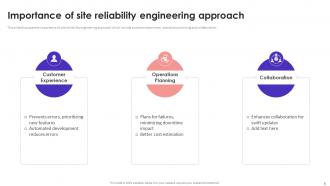
Slide 6: This slide discusses the importance of site reliability engineering approach which include customer experience, operations planning and collaboration.
Slide 7: This slide highlights the primary principles of site reliability engineering which includes change implementation and reliability automation.
Slide 8: This slide shows the major benefits of site reliability engineering which include enhanced visibility and improve response with streamlined alerting.
Slide 9: This slide discusses the best practices for site reliability engineering which include holistic analysis, skill diversification, automated efficiency and user centric SLOs.
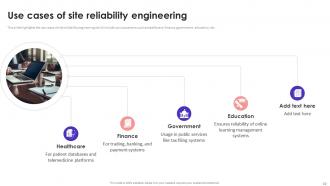
Slide 10: This slide puts the use cases of site reliability engineering which include various sectors such as healthcare, finance, government, education, etc.
Slide 11: This slide is an introductory slide.
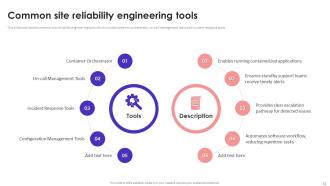
Slide 12: This slide outlines the common site reliability engineering tools which include container orchestrator, on-call management tools and incident response tools.
Slide 13: This slide is an introductory slide.
Slide 14: This slide gives an overview of observability in site reliability engineering which is defined as understanding system’s internal state and behaviour based on output.
Slide 15: This slide discusses the observability metrics in site reliability engineering which include service level objectives, service level indicators, error budgets, etc.
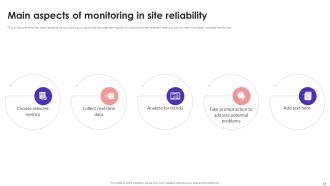
Slide 16: This slide overviews the main aspects of monitoring in site reliability engineering which involve choose relevant metrics, collect real-time data, analyze trends, etc.
Slide 17: This slide portrays the key monitoring metrics in site reliability engineering based on metrics such as latency, traffic, errors and saturation.
Slide 18: This slide is an introductory slide.
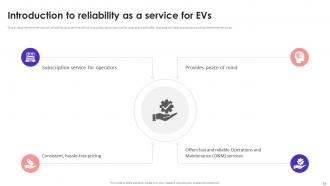
Slide 19: This slide gives an overview of reliability as a service which is a subscription service for operators and offer fast and reliable operations and maintenance services.
Slide 20: This slide represents site reliability engineering dashboard for web application with various sections such as end user response time, error budget and SLO.
Slide 21: This slide is an introductory slide.
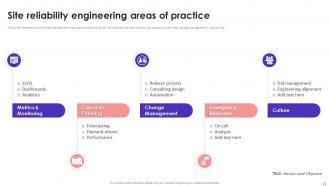
Slide 22: This slide presents site reliability engineering areas of practice which include metrics and monitoring, capacity planning, change management, culture, etc.
Slide 23: This slide is an introductory slide.
Slide 24: This slide outlines the concept of availability in site reliability engineering which refers to uptime of site and can be measured in two different ways.
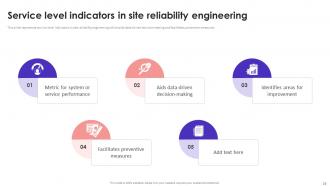
Slide 25: This slide contains service level indicators in site reliability engineering which aids data driven decision making and facilitates preventive measures.
Slide 26: This slide caters to service level agreement in site reliability engineering which is a contractual agreement between business and its customers.
Slide 27: This slide explains the various components of typical SLA in SRE which include availability and responsiveness, performance measurement metrics, etc.
Slide 28: This slide is an introductory slide.
Slide 29: This slide discusses the major design principles for reliability in cloud which include auto recover from failure, test recovery methods and handle automation changes.
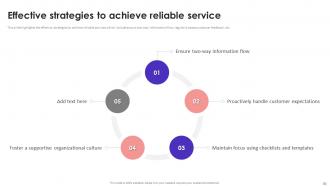
Slide 30: This slide projects the effective strategies to achieve reliable services which include ensure two-way information flow, regularly assess customer feedback, etc.
Slide 31: This slide gives an overview of release engineering best practices in product management which include version control implementation, collaboration, etc.
Slide 32: This slide is an introductory slide.
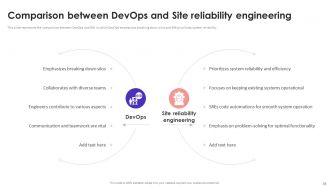
Slide 33: This slide represents the comparison between DevOps and SRE in which DevOps emphasizes breaking down silos and SRE prioritizes system reliability.
Slide 34: This slide is an introductory slide.
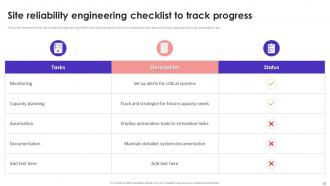
Slide 35: This slide presents the site reliability engineering checklist to track progress which include tasks such as monitoring, capacity planning, automation, etc.
Slide 36: This slide highlights the training budget plan for site reliability engineering in an organization based on categories like training programs, certifications, etc
Slide 37: This slide puts the training plan for site reliability engineering which has modules such as introduction to SRE, linux fundamentals and monitoring.
Slide 38: This slide demonstrates the implementation budget plan for site reliability engineering based on expenses like training and onboarding, recruitment and tools.
Slide 39: This slide provides a 30-60-90-day plan with text boxes.
Slide 40: This slide represents the 30-60-90 day plan for SRE implementation which include onboarding and assessment, skill enhancement and collaboration, etc.
Slide 41: This slide highlights the implementation timeline for site reliability engineering which include skill enhancement and collaboration, implementation and tooling.
Slide 42: This slide is an introductory slide.
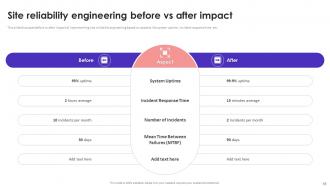
Slide 43: This slide discusses before vs after impact of implementing site reliability engineering based on aspects like system uptime, incident response time, etc.
Slide 44: This slide shows all the icons included in the presentation.
Slide 45: This slide is titled Additional Slides for moving forward.
Slide 46: This slide highlights the major limitations of site reliability engineering which include scarce SRE expertise complicates hiring, recruiting SRE engineers, etc.
Slide 47: This slide represents the salient features of SRE tools and resources which include use of SRE principles to monitor service health, promote collaboration, etc.
Slide 48: This slide is a Timeline slide. Show data related to time intervals here.
Slide 49: This slide is a financial slide. Show your finance-related stuff here.
Slide 50: This slide is Our Target slide. State your targets here.
Slide 51: This slide presents a Roadmap with additional text boxes.
Slide 52: This slide depicts a Venn diagram with text boxes.
Slide 53: This slide contains a Puzzle with related icons and text.
Slide 54: This slide is Our Mission slide with related imagery and text.
Slide 55: This slide shows Post-It Notes. Post your important notes here.
Slide 56: This slide is a Comparison slide to state comparisons between commodities, entities, etc.
Slide 57: This slide is a thank-you slide with address, contact numbers, and email address.
Site Reliability Engineering Powerpoint Presentation Slides with all 65 slides:
Use our Site Reliability Engineering Powerpoint Presentation Slides to effectively help you save your valuable time. They are readymade to fit into any presentation structure.

































FAQs for Site Reliability Engineering
SRE is all about running ops like you'd write code. Automate the repetitive crap that drives you nuts - that's where I'd start. Set error budgets so you're not arguing with devs about when to ship vs when to fix things. Everything that affects users should be measured, obviously. Instead of constantly putting out fires, design systems that heal themselves. Failures happen anyway, so plan for them upfront. The big shift is getting dev and ops to actually work together instead of blaming each other when stuff breaks. Honestly, just pick your most annoying manual task and automate it first.
So SRE is basically treating ops like software dev - you're writing code to fix problems instead of manually patching stuff when it breaks. Way more proactive than traditional IT ops. You'll be coding in Python or Go, setting up monitoring, trying to prevent disasters before they happen. Though honestly, there's still gonna be some firefighting no matter what they tell you. Error budgets are this cool concept where you balance keeping things stable vs shipping new features fast. If you're thinking about making the switch, definitely get comfortable with those languages and monitoring tools first - that's what'll make you stand out.
Think of error budgets as your "oops allowance" - you set a reliability target like 99.9% uptime, then get to "spend" that leftover 0.1% on risky deployments or whatever. Game changer for teams honestly. No more arguing about moving fast vs being safe. Got budget left? Ship away and experiment. Burned through it already? Time to slow down and fix stuff until you're good again. I always tell people to nail down their SLOs first, then you can actually calculate how much downtime you can afford. Way better than just winging it.
Focus on SLIs and SLOs - the stuff users actually care about. Availability, latency, error rates, throughput. Don't get sucked into fancy server metrics that look cool but miss real user pain (learned this the hard way). Work backwards from your user journey to find what really matters. Set SLOs based on actual business needs, then use error budgets to balance keeping things running vs shipping features. Honestly, less is more here. Pick maybe 3-5 key indicators and automate the monitoring. You'll go crazy trying to track everything.
Honestly, I'd start with monitoring stuff like Prometheus and Grafana - you can't fix what you can't see, right? ELK stack is solid for logs too. Terraform or Ansible for infrastructure as code is pretty much non-negotiable these days. Kubernetes is the standard now, though fair warning - it's a pain to wrap your head around at first. For when things inevitably break, grab PagerDuty or something similar, plus get Slack hooked up with decent integrations. CI/CD wise, Jenkins works but GitLab Actions is honestly way cleaner. Build monitoring first, then add pieces as you figure out what's actually broken in your setup.
So we basically use severity levels based on how badly it's screwing with customers and revenue. P0/P1 stuff is like when user-facing services are down or we're bleeding money. Backend problems with workarounds? That's more P2/P3 territory. Most teams have these escalation matrices that honestly feel super bureaucratic until everything's on fire - then you're grateful they exist. You gotta look at blast radius too, how many users are hit, and whether SLAs are getting wrecked. The trick is documenting all this severity stuff ahead of time so you're not arguing about what's urgent while your site's melting down.
Look, focus on what users actually feel - response times, uptime, error rates. Skip the internal stuff they don't notice. I'd pick maybe 3-4 key things max (learned that lesson when I tried tracking literally everything). Go for 99.9% uptime instead of 99.99% unless you're ready to throw serious money at reliability. Time windows matter too - make sure you can actually measure this stuff with whatever tools you've got. Oh, and don't set it in stone. Check quarterly and tweak based on real feedback, not just what sounds good on paper.
Honestly, SRE is all about making failure work for you instead of against you. Post-mortems become these awesome learning sessions where nobody gets blamed - just pure problem-solving. Error budgets are genius because they let teams take risks without everything falling apart. The toil reduction part? Game changer. You're basically automating all the boring repetitive stuff so people can focus on work that actually matters. Knowledge sharing happens naturally through runbooks and cross-training between teams. Start with blameless post-mortems after incidents - they're seriously goldmines for spotting bigger issues and getting everyone on the same page.
Dude, automation completely changed how I do SRE work. No more staying up all night fixing the same stupid issues over and over. You can automate incident response, deployments, monitoring - basically all that repetitive crap that burns you out. I'd honestly quit before going back to doing everything manually lol. The best part? It gives you time for the actually interesting stuff like system design and prevention work. My advice is pick whatever manual task pisses you off the most and automate that first. You'll notice the difference immediately.
SRE teams work best when they're actually embedded with devs from the start. Get them in sprint planning, code reviews, the whole deal. They share error budgets and reliability metrics so everyone knows what success looks like. Honestly, the old model of devs building stuff and ops fixing it is broken - you want joint ownership instead. SREs should be reviewing architecture early on, not just firefighting later. Oh, and definitely start with shared on-call rotations. That alone changes how people think about writing code. Maybe have your SRE folks join dev standups too.
Honestly, start by making sure everyone shares the pain equally - rotate that pager so one person doesn't get stuck with all the weekend calls. Write down your troubleshooting steps beforehand because trust me, your 3am brain won't remember how to fix that weird database thing. Set your alerts so they're not going off for every tiny blip (learned that one the hard way). Have clear rules about when something's actually worth waking people up versus waiting till morning. After big outages, sit down and figure out what went wrong - otherwise you'll keep fixing the same stuff over and over. Oh, and definitely push for extra time off after those nightmare weeks where everything breaks.
SRE stuff can seriously slash your response times if you do it right. Automated monitoring catches problems before customers even notice - that's gold right there. Make runbooks for your common issues so nobody's scrambling around asking "wait, what now?" Honestly, the blameless postmortem thing changed everything for us. People actually share what went wrong instead of hiding it. Set up proper on-call rotations with clear escalation - kills the confusion about who owns what. I'd start simple: document your top three incident types and automate just the first response steps.
Honestly, focus on four main things to track your SRE success. Reliability stuff first - uptime, error rates, how fast you recover from incidents. That's the bread and butter. Then measure how much tedious manual work you've eliminated (trust me, automating those 3am server restarts is life-changing). Deployment frequency matters too - are you actually shipping faster? Oh, and don't forget team happiness metrics and who's getting hammered with on-call duties. Start simple with these basics. You can always get fancy with domain-specific tracking later once you've got the foundation down.
Look, SRE and DevOps work great together - they're not really competing. DevOps breaks down those annoying silos between development and operations teams. SRE takes it further by giving you actual tools to measure stuff: error budgets, SLIs, blameless postmortems. That kind of thing. Honestly? People overthink the differences. They're tackling the same basic problems. SRE just brings more engineering discipline to the table, which plain DevOps can be pretty loose about sometimes. My advice: start with SRE's measurement approach first. It'll make whatever DevOps practices you're already doing way more solid.
Honestly, the biggest pain is when everything becomes "urgent" and you're just firefighting constantly. Your sprint planning goes out the window. Work with product teams to set clear SLOs first - makes the reliability conversations way less painful when you have actual data. Alert fatigue will destroy your team's sanity, so be ruthless about cleaning up those 3am pages that don't need immediate action. Error budgets help a ton here. Product wants to ship fast? Cool, here's how much reliability risk we can actually afford this month. My advice? Don't try to fix everything at once. Pick one service, get its monitoring solid, then expand from there.
-
The content is very helpful from business point of view.
-
Making a presentation has never been this easy for me. Thank you SlideTeam for offering a splendid template library.