


Engineering Maintenance Service Proposal Powerpoint Presentation Slides




Try Before you Buy Download Free Sample Product
 Impress Your
 Audience
 100%
100% Editable
 Save Hours
 of Time


Engineering Maintenance Service Proposal caters to all the Companys needs. Check out Our insightfully crafted Engineering Maintenance Service Proposal. It provides comprehensive maintenance for all your engineering needs. Our team of certified engineers and technicians is highly skilled and experienced in engineering disciplines. We are committed to providing the highest quality of service, focusing on safety and reliability. Our services include preventive maintenance, emergency repairs, and system upgrades. We also offer training and consulting services to help you maximize the efficiency and effectiveness of your engineering systems. We aim to help you accomplish and maintain the highest performance and reliability standards. Looking forward to serving you and your engineering needs. Get access now.
People who downloaded this PowerPoint presentation also viewed the following :
Content of this Powerpoint Presentation
Slide 1: This slide introduces Engineering Maintenance Service Proposal. Commence by stating Your Company Name.
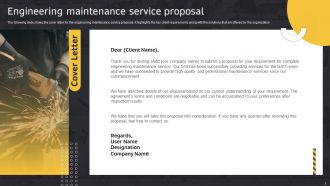
Slide 2: This slide elucidates the Cover Letter for the proposal.
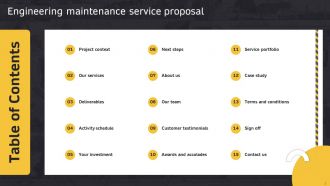
Slide 3: This slide elucidates the Table of Contents.
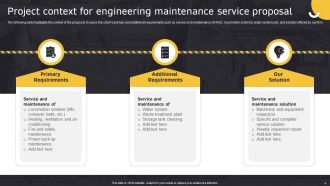
Slide 4: The following slide highlights the context of the proposal, it covers the client’s primary and additional requirements such as service and maintenance of HVAC, locomotion systems, water systems etc.
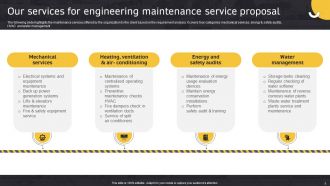
Slide 5: This slide presents the maintenance services offered by the organization to the clients.
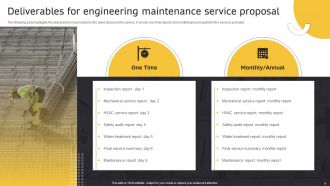
Slide 6: This slide portrays the deliverable to be provided to the client based on the service.
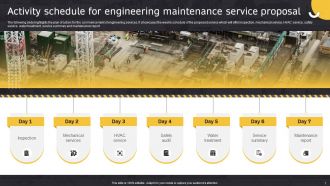
Slide 7: This slide displays the Activity schedule for engineering maintenance service proposal.
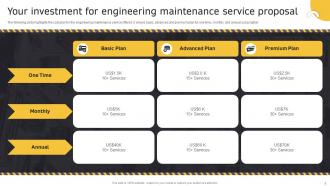
Slide 8: The following slide shows the cost plan for the engineering maintenance service offered.
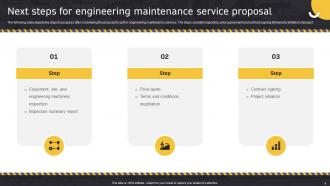
Slide 9: This slide states the steps to progress after considering the proposal to opt for engineering maintenance services.
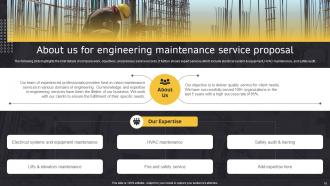
Slide 10: This is the About us showcasing the Company related information.
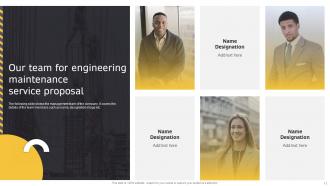
Slide 11: This is Our team slide. State the information related to your team members here.
Slide 12: This sldie continues the Team related information.
Slide 13: This slide indicates the Customer testimonials for engineering maintenance service proposal.
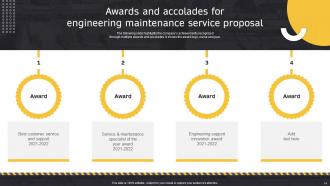
Slide 14: The following slide displays the company’s achievements recognized through multiple awards and accolades.
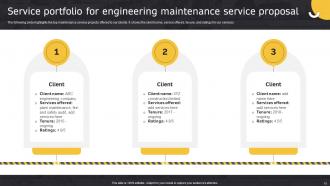
Slide 15: The following slide portrays the top maintenance service projects offered to the clients.
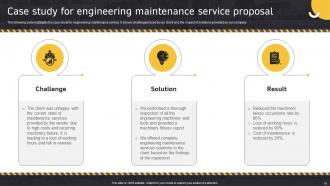
Slide 16: The following slide highlights the case study for engineering maintenance service.
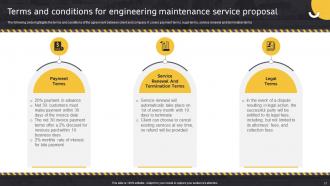
Slide 17: This slide presents the terms and conditions of the agreement between client and company.
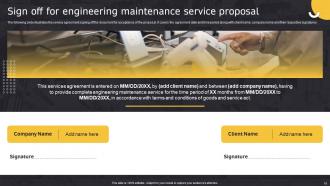
Slide 18: The following slide illustrates the service agreement signing off the document for acceptance of the proposal.
Slide 19: This slide exhibits the Contact details of the organization.
Slide 20: This is the Icons slide containing all the Icons used in the plan.
Slide 21: The purpose of this slide is to elucidate Additional information.
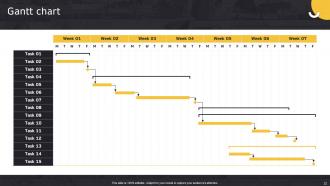
Slide 22: This is the Gantt chart with related imagery.
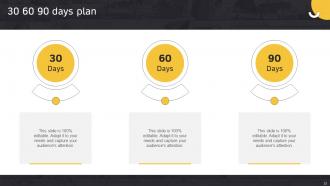
Slide 23: This is the 30 60 90 days plan slide for efficient planning.
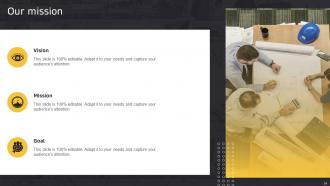
Slide 24: This slide incorporates the Company's mission, vision, and values.
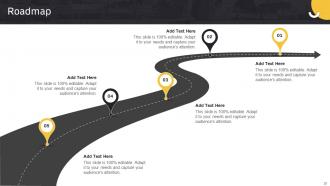
Slide 25: This slide reveals the Roadmap of the organization.
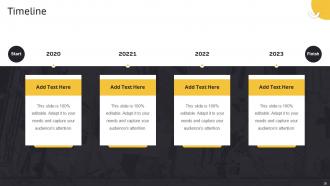
Slide 26: This slide showcases the Company's Timeline.
Engineering Maintenance Service Proposal Powerpoint Presentation Slides with all 31 slides:
Use our Engineering Maintenance Service Proposal Powerpoint Presentation Slides to effectively help you save your valuable time. They are readymade to fit into any presentation structure.






FAQs for Engineering Maintenance Service Proposal
Honestly, focus on five key things: what equipment you'll maintain and how often, your team's creds and certifications, emergency response times, and a super detailed price breakdown. KPIs matter too - uptime targets and stuff like that. Compliance paperwork is boring but necessary (safety standards, environmental regs). Price transparency is huge since that's where clients always look first. Throw in some case studies from similar gigs if you've got them. Be really specific about deliverables and timelines - saves you headaches down the road when clients get confused about what they're actually getting.
You don't want to sound like every other company saying "we fix broken stuff." Show them your proactive game instead. Talk about predictive analytics if you use them, or your certified specialists, guaranteed response times - whatever actually makes you different. The trick is tying those things to real results they care about. Like, will you save them money? Reduce downtime? Make their equipment last longer? Nobody wants a boring service list. They want to know you'll solve their maintenance nightmares better than the competition. That's honestly what closes deals.
Start with a full walkthrough - trust me, you'll find way more issues than the client mentioned. Take tons of photos and notes. Then dig into their maintenance logs to see what keeps breaking down. The staff interviews are clutch because they know exactly what's driving them crazy day-to-day. After that, do proper condition assessments on the big stuff like HVAC and electrical. I always do plumbing too since it's usually a mess. This whole process gives you real data to write a proposal that actually fixes their problems instead of just throwing generic services at them.
So here's what I'd do - start with predictive maintenance dashboards that track equipment performance and failure rates over time. Way better than just fixing stuff when it breaks, you know? Throw in some IoT sensors and automated reporting because honestly, clients eat up those colorful charts that actually make sense. Also include benchmarking against industry standards and ROI projections. The whole point is showing them how data transforms their maintenance from total guesswork into smart strategy. Pick 3-5 key metrics they'll actually care about and focus there first.
Honestly, talking to your client first is everything. You can't write a decent proposal without knowing what's actually breaking down in their facility or how much they're willing to spend. I've watched teams crash and burn because they just copied some template instead of figuring out the real problems. Budget constraints matter too - ask about that upfront along with their downtime tolerance. Some places can handle a few hours offline, others will lose their minds over 20 minutes. Once you know their critical systems and daily headaches, then you can actually build maintenance schedules and response times that make sense for them.
Look, compliance stuff is what makes or breaks these proposals. Clients freak out about liability - honestly can't blame them. You've got to spell out your certifications and show you know OSHA, EPA, whatever rules hit their industry. Don't just mention it once either. Walk them through your inspection schedules, how you'll handle documentation, compliance records, all that paperwork they hate but need. Make it clear you're not winging it on regulations. I've seen people lose contracts because they treated compliance like some boring checkbox instead of actually selling it as expertise.
Focus on four main things: equipment uptime, mean time between failures (MTBF), mean time to repair (MTTR), and how much you're cutting their total costs. These actually show real value to operations. If they're in a regulated industry, definitely include compliance rates too - audit failures are a nightmare nobody wants to deal with. Here's the thing though: be super specific with targets. Say "boost uptime from 85% to 95%" instead of some vague promise about "improvements." Oh, and make sure you can actually track and report this stuff regularly because they'll be watching those numbers like hawks once you start.
Dude, you gotta dig into what actually keeps these people up at night first. Manufacturing folks? They're obsessed with machines not breaking down and hitting their numbers - so push your quick response times hard. Healthcare is a whole different beast though, honestly they have more regulations than you can shake a stick at. Patient safety trumps everything there. Here's the key: speak their language. Don't say "maintenance" to manufacturers - say you'll boost their OEE and throughput. Healthcare wants to hear about patient outcomes and staying compliant. Your case studies need to feel like they're written for their specific headaches, not some cookie-cutter pitch.
So here's what works - set up three tiers: basic, standard, premium. Most people go middle tier anyway, so start there. Show them what's in each package using bullet points or tables, not those giant text blocks that make everyone's eyes glaze over. Break down response times, hours you're available, what parts and labor cost. Oh and definitely put a "recommended" tag on whichever one you want them to pick. It's not pushy, just helpful guidance. The premium should feel like obvious value, basic covers the must-haves. Pretty straightforward approach that actually gets results.
Don't just list risks - show how you're fixing them. Make a section that matches each risk with your exact solution. Like "Equipment breaks? We keep parts stocked 24/7 with 4-hour fixes guaranteed." Clients eat up specific numbers and timelines, so use them everywhere. Toss in a quick story about handling similar stuff before - honestly makes a huge difference for trust. The whole thing should feel like you're ahead of problems, not scrambling to catch up. They want a solution partner, not someone who just points out what could go wrong.
Honestly, the worst thing you can do is be vague about scope. Like, spell out exactly what you'll fix vs what's on them. Pricing is tricky too - don't go super low just to get the job because when their server crashes at 2am, you'll be kicking yourself. Response times matter a lot, so define what counts as emergency vs regular stuff. Oh and never promise crazy uptime percentages without seeing their current setup first - learned that one the hard way. Build in extra time and money for weird issues that'll definitely come up.
Oh man, you HAVE to include those. Case studies are like showing your work - anyone can say they'll cut downtime by 30%, but proving you actually did it for another facility? That's what closes deals. Testimonials from other engineering managers hit different too since it's peer validation. I usually throw in 2-3 examples that match whatever industry I'm pitching. Honestly, skipping these is like showing up to a gunfight with a butter knife - maintenance clients want proof you won't screw up their operations.
Definitely focus on predictive analytics and IoT sensors - seriously, they catch problems before they turn into money pits. Mobile apps for work orders are huge too, plus AR for remote diagnostics. Drones work great for those annoying hard-to-reach spots. Cloud-based CMMS is basically standard now, so don't skip that. Here's the thing though - don't overwhelm them with every shiny tech out there. Pick 2-3 solutions that directly fix their worst headaches and prove you'll save them actual money and downtime. Just make sure you can deliver whatever you promise!
Throw in energy-efficient stuff like LED upgrades and smarter HVAC scheduling. Predictive maintenance is huge - fewer breakdowns means way less waste, plus you can mention recycling old equipment parts. Go paperless with your reporting and add remote monitoring tools. Honestly, the sustainability angle is kind of trendy right now but clients genuinely care about it. Any green certifications your team has? LEED training, that sort of thing - definitely include those. Oh, and give them actual numbers to track. Energy savings percentages, waste reduction rates. People love concrete metrics they can brag about to their boss.
Okay so definitely add some flowcharts showing your maintenance process - those are clutch. Before/after photos work really well too, especially if you've done similar work. I'd throw in some equipment diagrams and maybe a timeline graphic breaking down project phases. Cost breakdowns and maintenance schedules as charts instead of boring paragraphs will save your client's sanity. Oh, and don't forget team photos with little bios - people want to know who they're working with. Honestly, anything beats walls of text. Just try to get one visual per major section and you're golden.
-
Extensive range of templates! Highly impressed with the quality of the designs.
-
Definitely a time saver! Predesigned and easy-to-use templates just helped me put together an amazing presentation.