


Maintenance And Repair Proposal Powerpoint Presentation Slides




Try Before you Buy Download Free Sample Product
 Impress Your
 Audience
 100%
100% Editable
 Save Hours
 of Time


We would like to introduce our Maintenance and Repair Proposal, which is designed to fulfill all of your companys engineering needs. Our proposal offers comprehensive maintenance solutions, delivered by a team of highly skilled and certified engineers and technicians with extensive experience in various engineering disciplines. Our primary focus is on ensuring safety and reliability, and we strive to deliver the highest quality of service. Our range of services includes preventive maintenance, emergency repairs, and system upgrades, and we also provide training and consulting services to help you optimize the efficiency of your engineering systems. Our goal is to help you achieve and maintain the highest performance and reliability standards. We are excited to work with you and meet all of your engineering requirements. Dont hesitate, contact us today to learn more.
People who downloaded this PowerPoint presentation also viewed the following :
Content of this Powerpoint Presentation
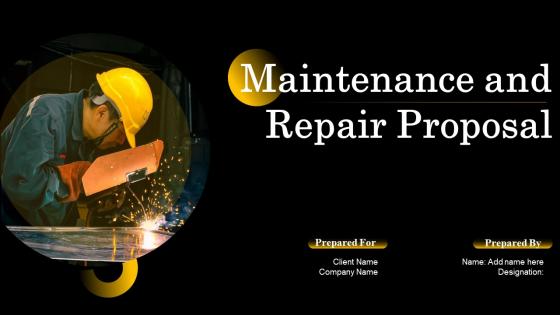
Slide 1: This slide introduces Maintenance and Repair Proposal. State your company name and begin.
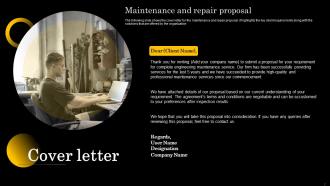
Slide 2: The following slide shows the cover letter for the maintenance and repair proposal.
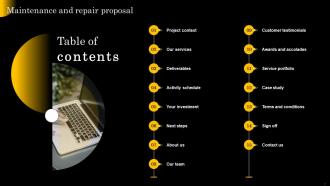
Slide 3: This slide shows Table of Content for the presentation.
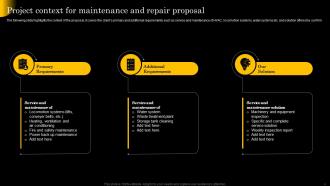
Slide 4: This slide presents Project context for maintenance and repair proposal.
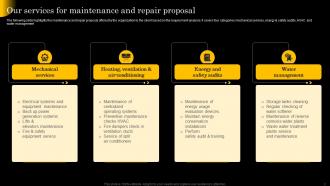
Slide 5: This slide displays Our services for maintenance and repair proposal.
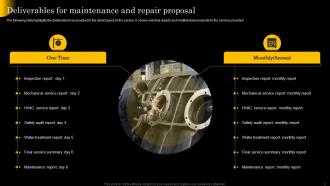
Slide 6: This slide represents Deliverables for maintenance and repair proposal.
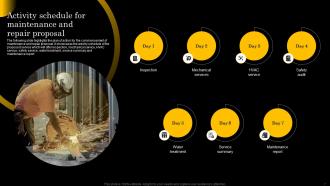
Slide 7: This slide showcases Activity schedule for maintenance and repair proposal.
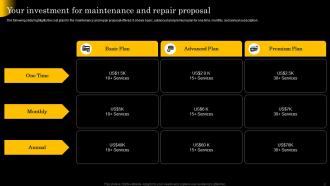
Slide 8: This slide shows Your investment for maintenance and repair proposal.
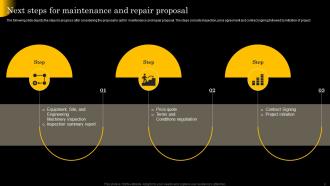
Slide 9: This slide presents Next steps for maintenance and repair proposal.
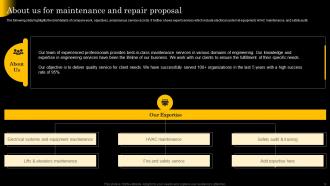
Slide 10: This slide displays About us for maintenance and repair proposal.
Slide 11: This slide represents Our team for maintenance and repair proposal.
Slide 12: This is another slide continuing Our team for maintenance and repair proposal.
Slide 13: This slide showcases Customer testimonials for maintenance and repair proposal.
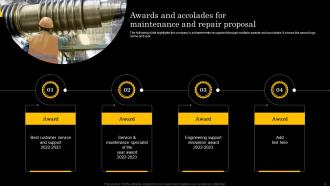
Slide 14: This slide shows Awards and accolades for maintenance and repair proposal.
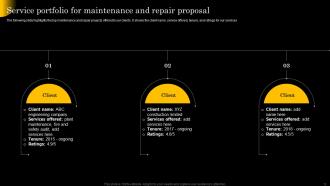
Slide 15: This slide presents Service portfolio for maintenance and repair proposal.
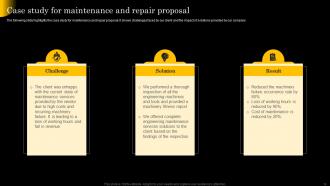
Slide 16: This slide displays Case study for maintenance and repair proposal.
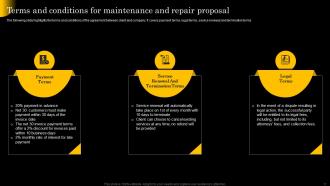
Slide 17: This slide represents Terms and conditions for maintenance and repair proposal.
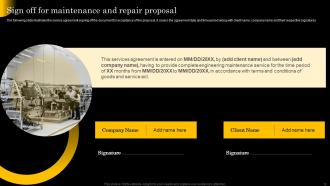
Slide 18: This slide showcases Sign off for maintenance and repair proposal.
Slide 19: This slide shows Contact us for maintenance and repair proposal.
Slide 20: This slide contains all the icons used in this presentation.
Slide 21: This slide is titled as Additional Slides for moving forward.
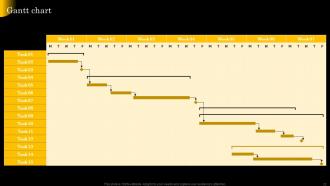
Slide 22: This slide shows Gantt chart with additional textboxes.
Slide 23: This slide provides 30 60 90 Days Plan with text boxes.
Slide 24: This is a Timeline slide. Show data related to time intervals here.
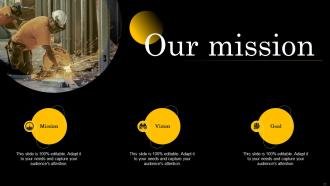
Slide 25: This is Our Mission slide with related imagery and text.
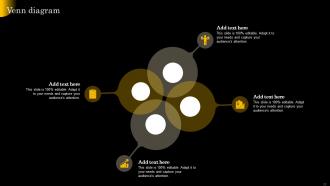
Slide 26: This slide depicts Venn diagram with text boxes.
Maintenance And Repair Proposal Powerpoint Presentation Slides with all 31 slides:
Use our Maintenance And Repair Proposal Powerpoint Presentation Slides to effectively help you save your valuable time. They are readymade to fit into any presentation structure.







FAQs for Maintenance And Repair Proposal
Start with a solid scope of work - be super specific about what you're fixing. Add realistic timelines and break down your costs for materials vs labor. I learned the hard way that vague proposals get tossed immediately. Show some examples of your past work to build credibility. Payment terms are crucial too - spell out the schedule upfront. If something changes mid-project, have that covered in writing. Oh, and take photos of the current issues before you submit. Makes you look like you actually know what you're talking about instead of just winging it.
Walk through everything first - HVAC, electrical, plumbing, the works. Safety stuff gets priority obviously. Pull those maintenance logs and see what's constantly breaking (there's always something). Your maintenance crew knows what's driving them crazy, so just ask them directly. Look for the obvious red flags - rust, weird noises, anything that looks like it belongs in a museum. Oh, and don't forget compliance requirements because that'll bite you later. Age matters too. Create a priority list based on safety risks, how much it'll screw up operations, and what it'll cost to fix.
Break it down into labor, materials, and overhead - then tack on some contingency money. Get supplier quotes first since those give you real numbers to work with. Labor's where people always mess up though - seriously, double whatever hours you think it'll take because maintenance work is sneaky like that. Current wages plus benefits, obviously. Oh and don't forget the random stuff like permits or equipment rental that adds up fast. I'd throw 10-15% on top for when things go sideways (and they will). Just write down what you're assuming so you can tweak it later if needed.
Honestly, tech makes a huge difference for proposal accuracy. Start with digital inspection tools - drones or IoT sensors beat eyeballing stuff any day. Machine learning spots equipment failure patterns you'd miss otherwise. Digital twin tech is pretty cool too, lets you test repairs virtually before proposing them. Real-time databases give you instant parts pricing and historical data, which saves tons of time. I'd grab basic inspection tools first since they immediately bump up your accuracy. Clients notice the difference right away. Oh, and the predictive analytics help catch maintenance needs early - that's where you really start looking like you know what you're doing.
Dude, preventive maintenance is what makes or breaks your proposal honestly. Position it as major cost savings - you're catching problems before they turn into expensive disasters. Equipment lasts way longer too. Include specific schedules and actual tasks you'll do, plus how it cuts their downtime. The money part is crucial - show them the ROI numbers so they see your preventive approach saves more than it costs over the long haul. I've seen too many proposals fail because they skip this part. It's what separates the pros from everyone else just winging it.
Honestly, just figure out what keeps each industry up at night. Healthcare? They're obsessed with infection control and can't afford any downtime that messes with patients. Manufacturing wants to avoid production shutdowns - those cost serious money. Retail's all about customer experience, so promise fast response during busy periods. Here's what I always do: ask about their biggest headaches right upfront. That conversation basically writes your proposal for you. Oh, and definitely look into their regulations beforehand because pharma rules are way different than what you'd pitch to a pizza place.
Track uptime/downtime first - that's what actually matters to production and your boss will notice. Also watch mean time between failures, total maintenance costs, and your planned vs unplanned work ratio. Maintenance costs per asset are huge too, btw. If you're doing more than 20-30% emergency repairs, something's broken in your system. I learned that one the hard way. Get a baseline for a few months, then check quarterly. Otherwise you're just guessing if anything you're doing actually works.
Dude, just talk money and risk - that's all they care about. Show them the real cost when stuff breaks down: equipment failures, safety problems, way more expensive replacements later. I always use the car oil example because it clicks instantly - skip the $30 oil change and you're buying a new engine. Pull some actual numbers from your place if you can, or grab industry stats proving preventive maintenance is like 5x cheaper than emergency fixes. Honestly, a basic cost comparison chart usually does the trick. Maintenance budget versus "oh crap everything's broken" budget.
Dude, scope creep will destroy you if you're not specific upfront. Write "monthly HVAC filter changes, quarterly inspections, annual deep cleaning" instead of just "routine maintenance." I've watched contractors lowball bids thinking they'll make it work somehow - spoiler alert, they don't. Build in buffer time for weird stuff that always pops up. Oh, and emergency response times need to be crystal clear in writing. Seriously though, the "what's included vs. extra" section is where most fights happen later. Your contract should read like instructions for someone who's never met you before.
Honestly, presentation is huge for getting maintenance proposals approved. If it's a mess of technical jargon and confusing timelines, they'll just toss it. I've watched solid proposals get rejected simply because nobody could follow them - such a waste. Break everything into bullet points with clear headers. Skip the fancy language. Decision-makers need to quickly see what's broken, why they should care, and the cost. Keep it simple so they can easily say yes. Oh, and put the main benefits right at the top - don't bury them halfway through the document.
Timelines are a lifesaver - they keep everyone on the same page about when stuff starts and finishes. Your client won't schedule their big presentation during demo day (trust me, learned that the hard way). It also stops scope creep dead in its tracks. When you map out each phase with real dates, clients see you're not just winging it. They actually respect detailed planning way more than vague estimates. Always pad your timeline though. Something will go wrong - maybe permits take forever or materials show up late. Those little buffers save your sanity.
Get specific with your post-project questions - skip the generic "how'd we do?" and ask about timeline accuracy, communication, scope matching. Document everything in a shared file (I use a simple Google doc but whatever works). Your whole team needs access to these insights. Honestly, most people skip this step and wonder why their proposals keep missing the mark. Review the feedback quarterly and actually change your approach - maybe your timelines are too aggressive or clients keep asking for services you don't mention. Short wins: add frequently requested add-ons to standard proposals.
Make sure you hit OSHA standards and any industry regs right at the start - can't skip that part. Detail your safety procedures for each task, list the PPE needed, and walk through hazard ID steps. Honestly, I've watched so many proposals crash because people half-ass the documentation. Training requirements for your crew? Include those too. Emergency protocols as well. Oh, and definitely attach your safety certs and inspection schedules - that stuff backs up everything you're claiming. The whole thing is about catching problems before they bite you.
Grab 2-3 solid case studies that match what they're dealing with. The best ones have clear problems, solutions, and actual numbers - like "cut downtime 40%" or "saved $50K yearly." Those hit different than vague success stories. Try to find at least one from their industry or with similar equipment so they can actually see themselves in it. Honestly, this is where you prove you're not just talking theory - you've literally fixed this mess before. Short versions work better than novel-length explanations. They just need to know you can deliver the same results for them.
Dude, warranties are a game changer. Clients trust you way more when they know you'll come back and fix stuff for free if it breaks. Makes you look legit compared to sketchy contractors who disappear after getting paid. Plus it forces you to do solid work the first time - nobody wants callbacks eating into profit, right? Bad reviews from failed jobs will kill your business faster than anything. I'd start small though, maybe 30-60 days depending on what you're doing. Just spell out exactly what's covered so there's no confusion later.
-
The designs are super attractive. Me and my team love using SlideTeam’s presentations.
-
The customer care of SlideTeam is very responsive. I was having a payment issue and they fixed it for me in no time.