

Total productivity maintenance tpm pillar 2 jishu hozen autonomous maintenance




Try Before you Buy Download Free Sample Product
 Impress Your
 Audience
 100%
100% Editable
 Save Hours
 of Time


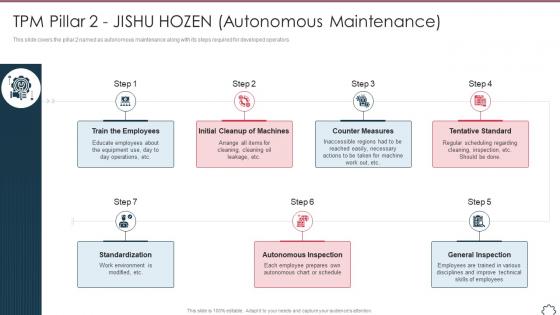
This slide covers the pillar 2 named as autonomous maintenance along with its steps required for developed operators.
People who downloaded this PowerPoint presentation also viewed the following :
Total productivity maintenance tpm pillar 2 jishu hozen autonomous maintenance with all 6 slides:
Use our Total Productivity Maintenance Tpm Pillar 2 Jishu Hozen Autonomous Maintenance to effectively help you save your valuable time. They are readymade to fit into any presentation structure.





FAQs for Total productivity maintenance tpm pillar 2 jishu
Yeah so TPM's got eight principles but don't worry about memorizing all of them. The main ones are autonomous maintenance, planned maintenance, and continuous improvement. Basically your operators handle the easy stuff - cleaning, lubing, basic checks - while maintenance does the heavy lifting. You'll also want focused improvement to cut down losses and training so people actually know what they're doing (shocking concept, right?). Quality maintenance and early equipment management are in there too. Honestly though? Start with getting operators doing daily equipment care. You'll notice better reliability pretty quick.
So basically, TPM gets your operators doing daily maintenance instead of just running machines until they break. Way better than waiting for catastrophic failures, trust me. Train your floor guys to handle basic stuff - cleaning, inspections, small fixes on their own equipment. They already know those machines better than anyone anyway. Small problems get spotted early, so you're not dealing with major breakdowns that kill your schedule. Less downtime means better OEE numbers. Pick one line to start with and teach those operators simple daily tasks. You'll be shocked how much your uptime improves.
Dude, TPM is nothing without your people actually caring about it. Operators need to feel like they own their equipment, not just babysit it - they're the ones hearing weird noises or feeling vibrations that seem off. Management can't just shove this down from above and expect miracles. Train everyone properly first, then give them real power to make calls about their machines. Get floor workers and supervisors both invested in maintenance and improvements. Honestly, I've watched so many companies crash and burn because they skipped the buy-in part. People need to take genuine pride in keeping things running smooth.
So TPM basically flips maintenance upside down - instead of waiting for stuff to break, your operators handle the day-to-day care themselves. Think cleaning, basic lubrication, quick inspections. The maintenance crew becomes more like trainers, dealing with the actually complicated problems while production handles routine stuff. Honestly, it makes way more sense than the old "call someone when it's already broken" approach. Just start with one machine and teach your team the basics. You'll probably cut down on those random 3am emergency calls pretty fast. Way less stressful for everyone.
Start with OEE - it's your best friend here since it rolls availability, performance, and quality into one solid number. MTBF and MTTR will show you what's really happening with your maintenance cycles. Track your planned vs unplanned downtime too, plus maintenance costs per unit. Oh, and safety incidents - people forget about those but they matter. Honestly, I'd just focus on OEE first though. If that's improving, you know your TPM is actually doing something. Set up a basic dashboard and check it weekly. Don't overcomplicate it at the start.
Honestly, the worst part is dealing with operators who think maintenance "isn't their job" - that resistance will kill you. Training's a nightmare too because people just follow checklists without actually understanding the equipment. Production teams are already swamped, so asking them to add more tasks? Good luck with that. Poor communication between shifts destroys any progress you make, and most places totally underestimate how much the culture needs to change. I'd start with a small pilot area first - you need some early wins to prove it works before going facility-wide or you'll lose credibility fast.
So TPM gets your whole team hunting for problems before they blow up - which is honestly the best part. Daily equipment checks mean operators start spotting patterns and throwing out ideas you wouldn't expect. Instead of just calling maintenance when stuff breaks, you're turning frontline people into actual problem-solvers. Those regular TPM meetings create this "how do we make it better?" vibe that kinda spreads. Plus you'll see real improvements in your OEE numbers, which feels pretty satisfying. My advice? Pick one machine and let it snowball from there.
Basic equipment stuff first - cleaning, lubing, daily checks that operators can actually do themselves. Problem-solving training is clutch because TPM's basically all about fixing root causes and improving things constantly. Communication skills matter way more than people think since you're breaking down those old walls between ops and maintenance teams. The cultural piece honestly kicks your butt more than the technical side! Oh, and definitely start with a pilot group to nail down some wins before rolling it out wider - saves you from looking like an idiot later.
You can cut costs by like 15-30% with TPM because your machines break down way less and last longer. Basically your operators start doing basic maintenance stuff instead of just the maintenance guys - they catch problems before they get expensive. Productivity goes up too since everything runs smoother. I know it sounds kinda gimmicky but I've seen it actually work. Your operators feel more invested when they're not just button-pushers, you know? I'd say start with just one line and track your downtime numbers. That way you'll see if it's actually helping or just creating busywork.
Get leadership on board first - seriously, this dies without their support. Form your TPM team with people from different departments. Don't go crazy trying to fix everything at once (learned that the hard way). Pick a pilot area and assess what equipment you're working with. Train operators on basic maintenance stuff and get cleaning routines going. Oh, and set up metrics early so you can actually show progress. Roll it out in phases instead of going company-wide immediately. Prove it works in one area, celebrate those wins, then expand from there.
Honestly, TPM and lean work together pretty naturally. Equipment reliability becomes your foundation for everything else. Your autonomous maintenance ties right into 5S, while planned maintenance keeps just-in-time running smoothly. Both push continuous improvement - that's the sweet spot. Focus on getting operators involved in maintenance AND process improvement. When they own both sides, results get way better. Connect your TPM metrics to lean KPIs like OEE. The whole point is cutting waste through fewer breakdowns and defects. It's one of those things that sounds complicated but clicks once you see it working.
CMMS software like Fiix or UpKeep is probably your best starting point - most companies see quick wins just getting their maintenance schedules organized. IoT sensors are solid for real-time monitoring of temps, vibration, all that stuff. Mobile apps for floor inspections are honestly a must-have now. Digital dashboards track your OEE pretty well. Predictive analytics can catch problems early, which saves you headaches later. AR glasses for maintenance procedures sound fancy but they actually work. Oh, and don't sleep on basic data organization - that's where you'll see immediate improvements before getting into the flashy tech.
Dude, TPM is actually genius for safety stuff. Your operators start doing daily equipment checks and suddenly they're catching problems way earlier - loose guards, sketchy parts, random leaks. The 5S thing alone makes workspaces way cleaner, so less people are slipping on crap or can't find safety gear when they need it. I've seen it work really well at a couple places. Start small though - just have your team do basic daily inspections. You'll be shocked how many safety issues they'll spot that would've sat there for weeks otherwise. It's like having extra eyes everywhere.
Yeah TPM totally works for service stuff! You just gotta think outside the box - your "equipment" is really your IT systems, POS terminals, customer service platforms, workspace layout, all that. Hotels do this with housekeeping routines, banks with their digital systems (which honestly makes so much sense when you think about it). Same basic idea though: fix problems before they break, get everyone thinking like a maintenance person, keep improving. Just figure out what assets actually matter for your customers' experience first, then build everything around those key pieces.
You should definitely check out Toyota's results - they cut equipment failures by 75% after rolling out TPM. Pretty impressive stuff. Harley-Davidson had crazy good outcomes too, slashing setup times by 75% and defects by over 60%. What's wild is even hospitals have made TPM work for them (wouldn't have expected that). Alcoa's another solid example where they totally transformed their safety and efficiency. Honestly, I'd dig into these specific case studies if you're thinking about TPM. You'll get the actual implementation details plus real numbers to compare your results against later.
-
Excellent Designs.
-
Out of the box and creative design.