


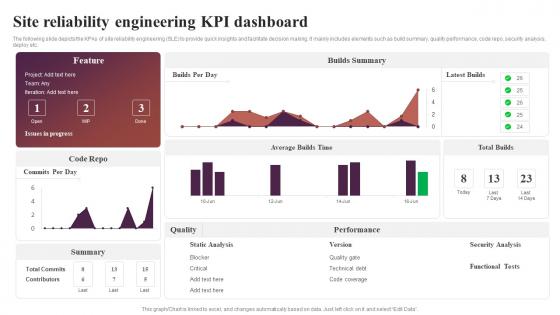
Site Reliability Engineering KPI Dashboard




Try Before you Buy Download Free Sample Product
 Impress Your
 Audience
 100%
100% Editable
 Save Hours
 of Time


The following slide depicts the KPAs of site reliability engineering SLE to provide quick insights and facilitate decision making. It mainly includes elements such as build summary, quality performance, code repo, security analysis, deploy etc.
People who downloaded this PowerPoint presentation also viewed the following :
Site Reliability Engineering KPI Dashboard with all 7 slides:
Use our Site Reliability Engineering KPI Dashboard to effectively help you save your valuable time. They are readymade to fit into any presentation structure.






FAQs for Site Reliability
SRE is basically about running ops like you'd write code - automate everything you can and actually measure reliability with SLOs instead of just hoping for the best. Error budgets are honestly brilliant once you get them, plus blameless postmortems when stuff breaks. The 50/50 rule matters too - SREs split time between ops work and actual development. Instead of that old "keep everything up no matter what" mentality, you're treating reliability as just another feature with real trade-offs. Start by figuring out what "good enough" looks like for your services through SLOs, then build everything around that balance between shipping features and staying stable.
So instead of ops just getting blamed when stuff breaks, SRE makes everyone own reliability together. You actually set measurable targets (SLIs/SLOs) and use error budgets to decide when to slow down on features vs. keep shipping. Traditional ops is mostly reactive - fire fighting and manual work. With SRE you're writing code to prevent problems before they happen. Honestly, the monitoring and automation focus is way better than just answering tickets constantly. I'd start by picking your most annoying manual task and automating that first. Way less stressful once you get into the rhythm.
Think of SLOs as reliability targets that actually matter to users. Pick something like "99.9% uptime" or "95% of requests under 200ms" - stuff users would notice if it breaks. Way better than monitoring every single metric under the sun, honestly. Here's the cool part: when you're hitting your targets, you get an "error budget" to take risks with new deployments. I'd start small though - grab 2-3 user-facing metrics and set realistic thresholds. Don't just pick numbers that sound impressive if they don't reflect real user pain.
Honestly, psychological safety is everything here. Start by making it super clear you're trying to learn, not hunt down who screwed up. When you're talking through what happened, stick to the timeline and focus on why systems broke down - not who touched what last. I've sat through way too many "blameless" postmortems that still felt like interrogations, so you really gotta drill it into people that human mistakes are gonna happen. Train whoever's running these things to shut down blame-y language fast. Oh, and actually fix the stuff you say you'll fix - nothing destroys trust like the same incident happening twice.
So first thing - designate someone as incident commander and get your communication sorted out. Focus on fixing the problem before you dive into what caused it. Set up severity levels now so people know when to wake the boss at 3am (honestly, nobody wants that responsibility). Document everything during the chaos because your brain will be mush afterward. Run postmortems within 48 hours while it's still fresh - keep them blameless though. Oh, and write your runbooks before you're drowning in an outage. Future you will thank present you.
So basically you want to look at your historical data - CPU, memory, disk usage, that stuff - and try to predict what you'll need. Most people set alerts around 70-80% so you're not scrambling when things hit the fan. Growth trends help too, obviously. The annoying part is you're always walking this tightrope between spending too much money and having your stuff crash. I'd start conservative and build in some buffer for when traffic goes crazy. Oh and definitely do regular reviews with your team because your projections will be wrong at first - everyone's are. Traffic patterns change way more than you'd expect.
For metrics, Prometheus is your best bet, then hook up Grafana for dashboards. PagerDuty or Opsgenie handle alerting pretty well. Once things get messy with multiple services, you'll want tracing - Jaeger or Zipkin are solid choices. ELK stack works great for logs, though honestly? A lot of teams just go with Datadog or New Relic now because it's all bundled together. Way less headache. Don't get caught up finding the "perfect" tool for each thing if they won't play nice together. Figure out what you actually need to monitor first, then pick tools that work as a team.
SRE makes you treat reliability like any other product feature, which honestly changes everything. Your team starts measuring stuff with SLOs and building way better monitoring right from the start. Error budgets are pure genius though - they give you actual numbers to work with when deciding between shipping fast vs. staying stable. Once you know how much downtime you can "afford," release decisions get so much clearer. The whole post-mortem thing means failures actually teach you something instead of just being fires to put out. I'd start with SLOs for your main user flows - even that small step will completely shift how your team thinks about quality and what matters.
So error budgets are like your "allowed downtime" quota - basically how much your service can break before you're actually in trouble with your SLA. Picture it like a spending account but for outages instead of money. Got a 99.9% uptime goal? That leftover 0.1% is yours to "spend" on failures without anyone getting mad. Here's where it gets smart though - you use this to decide when to ship new features vs. when to pump the brakes. Burning through your budget too quickly? Time to focus on stability work. Haven't touched it? You're probably playing it way too safe and missing out on shipping cool stuff faster.
Dude, automation is like having a safety net for all the stupid repetitive stuff. It cuts out human error and makes your systems way more predictable. Deploy code, handle alerts, restart crashed services - all that boring crap can run itself. Honestly, who has time to babysit servers at 3am anymore? You'll actually get to work on cool architecture problems instead of constantly putting out fires. My advice? Don't go crazy at first. Just pick whatever manual task is driving you nuts right now and start there.
Honestly, you're gonna need to get comfortable with both coding and ops stuff. Python or Go are solid choices for automation work. Linux is basically mandatory - no way around that one. Distributed systems, monitoring, incident response... all critical. Cloud platforms and CI/CD pipelines too, obviously. But here's what people don't talk about enough - the soft skills are massive. You'll constantly be working with different teams, so being able to communicate well and think through problems matters way more than most people realize. I'd pick your weakest area first and just focus there.
Track your SLIs/SLOs first - uptime, latency, error rates. But honestly, those numbers alone won't save you when leadership asks what you're actually doing for the business. Measure toil reduction and how much faster you're making product teams ship. Incident response times matter too. Don't ignore the people stuff - oncall burden and burnout will bite you eventually. I'd start with maybe 2-3 metrics that clearly connect to revenue or user experience, then build from there. Oh and track knowledge sharing across teams, that's huge for long-term success.
Honestly, the scale thing will destroy you - monitoring thousands of services is like finding a needle in a haystack made of needles. Engineering teams constantly push for faster shipping while you're trying to keep everything stable, which creates this weird tension. Alert fatigue becomes real, and debugging distributed failures? Total nightmare when everything cascades in random ways. My advice is get tight with the dev teams early on. Also invest in good observability tools before you're drowning - learned that one the hard way. Oh, and automation is your best friend here.
Look, the key thing is making failure about learning, not pointing fingers. Blameless postmortems are your friend here - let teams talk through what broke without anyone getting thrown under the bus. Give engineers real ownership of their stuff from code to production. Oh, and set up clear error budgets so people actually know what "good enough" means (this varies way more than you'd think). The teams that catch problems before customers do? Those are the ones you want to celebrate. Honestly, changing the culture is the hardest part, but once it clicks, everything else follows.
Dude, you absolutely need to keep learning or your SRE stuff will just become useless. Tech moves crazy fast - like what we used last year is already old news. Every outage should be a chance to learn something new, honestly that's how the best teams I know operate. They do solid post-mortems and actually share what they learned with everyone else. You've gotta study other people's incidents too, not just your own failures. Maybe start with weekly knowledge sharing sessions? Oh and don't just learn new tools - learn from what's actually working in production right now.
-
I came across many PowerPoint presentations with excellent creatives and I believe they would be beneficial to my work.
-
Great designs, Easily Editable.