


Apple Pay Case Study For Digital Wallet Implementation Unlocking Digital Wallets All You Need Fin SS




Try Before you Buy Download Free Sample Product
 Impress Your
 Audience
 100%
100% Editable
 Save Hours
 of Time


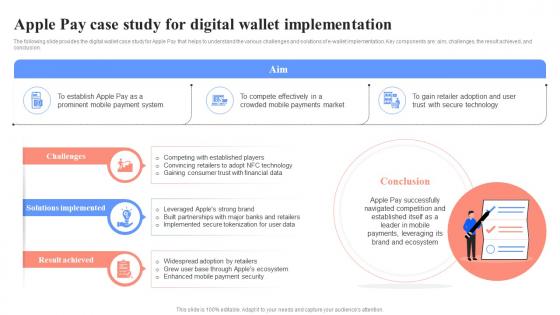
The following slide provides the digital wallet case study for Apple Pay that helps to understand the various challenges and solutions of e-wallet implementation. Key components are aim, challenges, the result achieved, and conclusion.
People who downloaded this PowerPoint presentation also viewed the following :
Apple Pay Case Study For Digital Wallet Implementation Unlocking Digital Wallets All You Need Fin SS with all 9 slides:
Use our Apple Pay Case Study For Digital Wallet Implementation Unlocking Digital Wallets All You Need Fin SS to effectively help you save your valuable time. They are readymade to fit into any presentation structure.








FAQs for Apple Pay Case Study For Digital Wallet Implementation Unlocking Digital Wallets All You
Apple Pay offers Touch ID and Face ID biometric authentication, tokenization that replaces card numbers with unique codes, encrypted transaction data, and device-specific security keys. Through these layered protections, financial institutions and retailers can minimize fraud risks while delivering faster, more secure payment experiences, with many banks finding that Apple Pay transactions show significantly lower fraud rates than traditional card payments.
Apple Pay ensures privacy by tokenizing payment information, encrypting transactions with device-specific security keys, and processing payments without storing actual card numbers on devices or Apple servers. Through biometric authentication and secure element technology, banks and merchants receive randomized transaction tokens rather than personal financial data, while Apple cannot track individual purchases, ultimately delivering anonymous payment processing and enhanced financial privacy protection.
Setting up Apple Pay on iPhone involves opening the Wallet app, tapping the plus sign, following prompts to add your credit or debit card through camera scanning or manual entry, and verifying with your bank. This streamlined process enables secure contactless payments at retail stores, online purchases, and in-app transactions, ultimately delivering faster checkout experiences and enhanced payment security for everyday commerce.
Apple Pay integrates with other payment services through APIs, NFC technology, and merchant payment processors, allowing seamless transactions across multiple platforms. Banks, retail chains, and e-commerce platforms leverage these integrations to offer unified checkout experiences, streamlined loyalty programs, and consolidated financial management, ultimately delivering faster customer transactions and reduced payment processing complexity.
Apple Pay offers businesses reduced transaction fees, enhanced security through tokenization, faster checkout processes, increased customer convenience, and improved data analytics capabilities. Through contactless payments and biometric authentication, retailers and service providers streamline operations, reduce fraud risks, and deliver seamless customer experiences, with many finding that Apple Pay integration ultimately drives higher transaction volumes and customer loyalty.
Yes, Apple Pay enables seamless in-app purchases across iOS applications, allowing users to complete transactions with Touch ID, Face ID, or passcode authentication without entering card details. This streamlined payment method enhances user experience by reducing checkout friction, increasing conversion rates for retailers, and delivering faster, more secure transactions, with many e-commerce and subscription-based apps finding significantly improved customer satisfaction and reduced cart abandonment rates.
Apple Pay is a contactless payment system for purchases at retailers, online stores, and apps using linked credit or debit cards, while Apple Cash is a peer-to-peer money transfer service for sending and receiving funds between individuals. These complementary services work together seamlessly within Apple's ecosystem, with many users finding that Apple Pay streamlines transactions while Apple Cash eliminates traditional payment hassles, ultimately delivering faster, more secure financial interactions.
Apple Pay supports loyalty programs through seamless integration with merchant apps, automatic reward point accumulation, and digital wallet storage for membership cards and coupons. Through partnerships with retailers like Walgreens, Target, and Starbucks, customers earn rewards automatically at checkout while merchants enhance customer retention, streamline transactions, and ultimately deliver personalized experiences that drive repeat business.
Apple Pay integrates with major global payment networks including Visa, Mastercard, American Express, Discover, and various regional networks like China UnionPay and JCB. These partnerships enable seamless transactions across millions of merchants worldwide, with financial institutions increasingly adopting Apple Pay integration to deliver faster, more secure payment experiences and enhanced customer convenience in an increasingly digital commerce landscape.
NFC technology enables Apple Pay's contactless payment functionality by creating secure, short-range communication between devices and payment terminals within four centimeters. This wireless technology facilitates instant authentication and transaction processing, allowing retailers, restaurants, and transit systems to offer seamless checkout experiences while reducing wait times and enhancing customer satisfaction through faster, more convenient payment interactions.
Apple Pay enhances the checkout experience by enabling contactless payments through facial recognition, fingerprint authentication, and near-field communication technology, eliminating the need for physical cards or cash. This streamlined approach significantly reduces transaction times, minimizes checkout lines, and provides enhanced security through tokenization, with many retailers finding that customers appreciate the seamless, hygienic payment process that accelerates purchasing decisions.
Merchants face challenges including integration costs with existing payment systems, staff training requirements, customer education efforts, and transaction fee considerations. While these implementation hurdles require initial investment, many retail businesses find that enhanced customer convenience, faster checkout experiences, and improved payment security ultimately deliver competitive advantages and increased customer satisfaction.
Apple Pay charges merchants standard credit card processing fees, typically ranging from 1.5% to 3% per transaction, similar to traditional card payments. However, Apple doesn't impose additional fees beyond standard payment processing costs, with many retailers finding that Apple Pay's enhanced security features, faster checkout times, and improved customer experiences often justify these processing costs while reducing fraud-related losses.
Apple Pay delivers superior user experience through seamless Touch ID or Face ID authentication, instant transaction completion, and intuitive integration across Apple devices and participating merchants. While competitors like Google Pay and Samsung Pay offer similar convenience, Apple Pay's streamlined interface, enhanced security protocols, and ecosystem integration create faster checkout processes, ultimately reducing transaction friction and improving customer satisfaction for millions of users.
Apple Pay has significantly accelerated mobile payment adoption by establishing consumer trust through biometric security, streamlining checkout experiences, and encouraging competitor innovation across the ecosystem. Its success has driven widespread NFC infrastructure deployment in retail environments, with banks, financial institutions, and merchants increasingly integrating contactless payment solutions, ultimately normalizing mobile transactions and enhancing customer convenience.
-
Amazing variety of PowerPoint slides. Really helpful in designing professional presentations.
-
I am a big fan of their newsletters because that is how I found my perfect requirement at the time of urgency. Thank God, I kept opening those.