


Five Phases Of Digital Wallet Payment Flow Implementation Of Omnichannel Banking Services




Try Before you Buy Download Free Sample Product
 Impress Your
 Audience
 100%
100% Editable
 Save Hours
 of Time


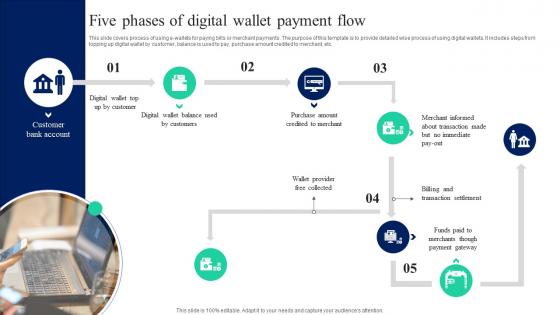
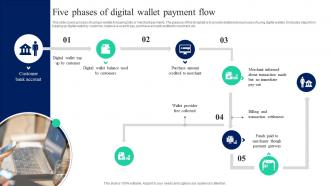
This slide covers process of using e wallets for paying bills or merchant payments. The purpose of this template is to provide detailed wise process of using digital wallets. It includes steps from topping up digital wallet by customer, balance is used to pay, purchase amount credited to merchant, etc.
People who downloaded this PowerPoint presentation also viewed the following :
Five Phases Of Digital Wallet Payment Flow Implementation Of Omnichannel Banking Services with all 6 slides:
Use our Five Phases Of Digital Wallet Payment Flow Implementation Of Omnichannel Banking Services to effectively help you save your valuable time. They are readymade to fit into any presentation structure.





FAQs for Five Phases Of Digital Wallet Payment Flow Implementation Of
Key components of a digital wallet payment flow include user authentication, payment method selection, merchant verification, transaction processing, and confirmation delivery. These technologies streamline commerce by enabling secure tokenization, real-time fraud detection, and seamless integration across platforms, with many retailers finding that digital wallets reduce checkout abandonment while delivering faster customer experiences and enhanced operational efficiency.
User authentication methods significantly enhance digital wallet security by implementing multi-factor verification, biometric scanning, tokenization, and encryption protocols that protect against unauthorized access and fraud. Through these layered security measures, financial institutions and retailers can minimize transaction risks, reduce chargebacks, and build customer trust, with many banks finding that robust authentication ultimately delivers faster payment processing while maintaining the highest security standards.
Payment gateways serve as secure intermediaries that authenticate, authorize, and process digital wallet transactions between customers, merchants, and financial institutions. These platforms streamline payment processing by encrypting sensitive data, validating payment credentials, and routing transactions through appropriate networks, with many retailers and service providers finding that robust gateway integration significantly reduces transaction failures while enhancing customer checkout experiences.
Different digital wallet types vary significantly in their payment flows, with mobile wallets using NFC or QR codes for instant transactions, online wallets requiring browser-based authentication and account verification, and hardware wallets demanding physical device confirmation for enhanced security. These distinct approaches enable businesses across retail, e-commerce, and financial services to offer tailored payment experiences, ultimately delivering faster checkout processes and improved customer satisfaction.
Digital wallet transaction fees typically include merchant processing fees ranging from 1.5-3.5%, interchange fees, network fees, and sometimes consumer transfer charges for funding sources like credit cards. These fees vary significantly by provider, with PayPal charging around 2.9% for merchants, Apple Pay leveraging existing card fees, and newer fintech wallets often offering competitive rates to gain market share, ultimately enabling businesses to choose solutions that balance cost efficiency with customer payment preferences.
User data is protected during digital wallet transactions through tokenization, end-to-end encryption, biometric authentication, and secure communication protocols. These security measures work by replacing sensitive card details with unique tokens, encrypting data transmission, and requiring fingerprint or facial verification, with many financial institutions finding that this multi-layered approach significantly reduces fraud while enhancing customer trust.
Common integration challenges include technical complexity with existing systems, security compliance requirements, transaction processing fees, customer adoption barriers, and multi-platform compatibility issues. These obstacles often require strategic planning around API integration, fraud prevention protocols, and user experience optimization, with many retailers finding that partnering with experienced payment processors significantly streamlines implementation while reducing operational costs.
Digital wallets enhance customer experience by streamlining transactions, reducing checkout times, and eliminating the need for physical cards or cash. Through features like one-click payments, biometric authentication, and stored payment preferences, customers in retail, e-commerce, and hospitality enjoy faster service, enhanced security, and seamless integration across platforms, ultimately delivering greater convenience and satisfaction.
Digital wallets rely on Near Field Communication (NFC), tokenization, encryption protocols, biometric authentication, and cloud-based servers for secure payment processing. These technologies work together by replacing sensitive card data with unique tokens, encrypting transactions end-to-end, and enabling contactless payments, with many financial institutions finding that this strategic combination delivers faster checkout experiences, reduced fraud risk, and enhanced customer convenience across retail environments.
Digital wallets manage currency conversion through integrated exchange rate APIs, real-time market data feeds, and partnerships with financial institutions or payment processors. These systems automatically calculate conversion rates, apply transparent fees, and process transactions seamlessly, with many international businesses finding that automated currency handling reduces processing time and enhances customer experience across global markets.
Companies must navigate data protection regulations like GDPR and CCPA, financial compliance requirements including PCI DSS and AML standards, consumer protection laws, and jurisdiction-specific payment regulations. These regulatory frameworks vary significantly across regions, with financial services and retail organizations finding that proactive compliance strategies streamline implementation while building customer trust and competitive advantage.
Fraud detection systems within digital wallet payment flows operate through real-time transaction monitoring, machine learning algorithms, behavioral analysis, and multi-factor authentication protocols. These systems analyze spending patterns, device fingerprints, and location data to identify suspicious activities, with many financial institutions finding that automated fraud detection reduces false positives while enhancing customer trust and transaction security.
Digital wallets enhance loyalty programs through seamless point accumulation, automated reward redemption, personalized offers based on spending patterns, and integrated cashback systems. Retail chains, coffee shops, and airlines increasingly leverage these features to deliver targeted promotions, streamline customer experiences, and build stronger brand engagement, ultimately driving repeat purchases and customer retention.
Blockchain technologies revolutionize digital wallet payments by enabling decentralized transactions, eliminating intermediaries, reducing settlement times, and enhancing security through cryptographic verification. These innovations streamline cross-border payments, minimize transaction fees, and deliver greater financial inclusion, with banks and fintech companies increasingly adopting blockchain solutions to gain competitive advantage in digital payment landscapes.
Emerging trends include biometric authentication, blockchain integration, AI-powered fraud detection, cross-border cryptocurrency support, and IoT payment connectivity. These innovations streamline transactions by eliminating password dependencies, enhancing security protocols, and enabling seamless device-to-device payments, with financial institutions finding that customers increasingly demand faster, more secure experiences across all digital touchpoints.
-
Spacious slides, just right to include text. SlideTeam has also helped us focus on the most important points that need to be highlighted for our clients.
-
You know what? I'm so glad I opted for this PPT design. It has been a total game-changer for me and my presentations. Thank you!