

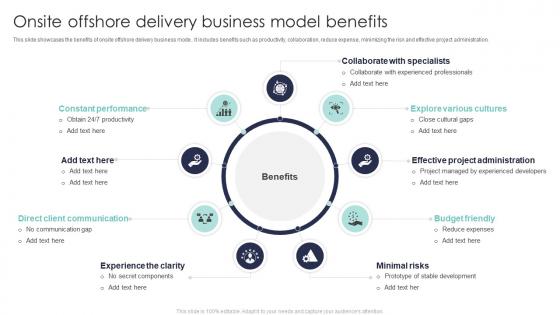
Onsite Offshore Delivery Business Model Benefits




Try Before you Buy Download Free Sample Product
 Impress Your
 Audience
 100%
100% Editable
 Save Hours
 of Time


This slide showcases the benefits of onsite offshore delivery business mode. It includes benefits such as productivity, collaboration, reduce expense, minimizing the risk and effective project administration.
People who downloaded this PowerPoint presentation also viewed the following :
Onsite Offshore Delivery Business Model Benefits with all 6 slides:
Use our Onsite Offshore Delivery Business Model Benefits to effectively help you save your valuable time. They are readymade to fit into any presentation structure.





FAQs for Onsite Offshore Delivery
Honestly, the cost savings alone make it worth considering - you're looking at way lower rates for development work. Your onsite team handles client stuff and complex problem-solving while the offshore guys do the heavy coding. Time zones actually help too since work keeps moving while you sleep. Quality doesn't suffer because your local leads stay involved with oversight and communication. Oh, and the talent pool is massive compared to just hiring locally. I'd probably test it out with something small first though, just to see how the whole coordination thing works before you go all-in.
Honestly, the key is finding meeting times that don't completely destroy anyone's schedule - though someone's always gonna get stuck with weird hours. Daily standups help but rotate who takes the awkward calls. Slack's your best friend for async stuff so people aren't just sitting around waiting. Oh, and document literally everything because stuff gets lost in translation across time zones way more than you'd think. If you can swing it budget-wise, try to get people to visit each other in person at least once. Sounds cheesy but it actually makes a massive difference for working together.
Honestly, I'd start by figuring out if you can handle the time zone chaos - offshore is way cheaper but those 3am calls get old fast. Simple stuff that doesn't need much back-and-forth? Perfect for offshore teams. But complex projects where you're constantly tweaking things work better with local people. Security's huge too - some clients freak out about their data leaving the country. Your PM skills matter more than you think here. Weak project management plus offshore = total disaster. Maybe try a mix first? Keep the important stuff close and ship the boring tasks overseas.
Honestly, the onsite-offshore thing can be a game changer if you don't mess it up. Your offshore team cranks out the heavy development work for way less money. Meanwhile your local people handle clients and tricky stuff. Time zones actually work in your favor - they're coding while you sleep, which is kinda cool. But yeah, you'll need extra time at the start for training everyone and figuring out communication. We usually see 30-40% cost savings compared to keeping everything local. Oh, and definitely get solid project management tools and do daily check-ins. Otherwise things get messy fast.
Dude, you absolutely need solid tech or the whole thing falls apart. We use Teams for video calls and Slack for quick messages - that combo works pretty well. Project management wise, Jira keeps everyone on the same page with deadlines and stuff. Screen sharing tools are clutch too, honestly can't imagine doing code reviews without them. The trick is picking your tools early and sticking with them. Both teams need decent internet though - learned that one the hard way when our offshore team kept dropping calls for like a week straight. Just make sure everyone has the same setup and you'll be fine.
Honestly, start small with joint projects to build trust first. Get some overlapping hours set up so teams can actually talk in real-time - makes a huge difference. Rotating people between locations is gold if you can swing the budget. Cultural training is fine I guess, but working together on real stuff beats seminars every time. Set up casual chat channels where people share random local stuff or weekend pics - sounds cheesy but it works. Different perspectives actually solve problems better anyway. Oh, and don't make it all formal - let people just get to know each other as humans first.
Set clear KPIs from day one - delivery times, code quality, how fast they respond to messages. Daily standups help, but seriously don't become that micromanaging boss nobody wants to work for. Sprint reviews and good collaboration tools let you see what's happening without being creepy about it. Trust beats spying every time. Oh, and quarterly reviews where everyone can give feedback both ways - that's huge. I'd start with weekly dashboards, then back off if things are running smooth. The whole thing's really about transparency, not surveillance.
So first thing - get your communication nailed down with regular check-ins and shared quality metrics. Code reviews at every milestone are non-negotiable. The time zone difference is actually pretty sweet since work keeps moving while you sleep. Documentation has to be crystal clear upfront though, like painfully detailed. I learned that the hard way on my last project. Don't treat them as separate teams - that's where things fall apart. Both sides need the same quality standards from day one. Oh, and stick to those standards no matter what. Trust me on this one.
Honestly, the biggest headaches are gonna be communication breakdowns and time zone chaos. Your offshore team might end up guessing what you want because the documentation sucks - seen this happen way too many times. Cultural stuff gets tricky too. Set up solid communication schedules with overlap hours that actually work. Good project managers on both sides are non-negotiable. Start small with projects that won't kill you if they go sideways. Oh, and if you can swing it, rotate people between locations so everyone gets the full picture. Documentation tools are boring but they'll save your sanity later.
So basically you'll have your senior folks onsite dealing with clients and managing stuff, then your bigger dev team offshore doing the actual coding and testing. Honestly took me a while to get the hang of it. Time zones are gonna mess with you at first - you really have to think through those handoffs between teams. Don't just do it to save money though, that's where people screw up. Figure out what each location is actually good at. I'd start by writing down which jobs need face-to-face client time versus what can be done remotely. Makes the whole thing way clearer.
Data protection stuff is your biggest headache - GDPR and all those cross-border rules are no joke. Employment laws vary wildly between countries too, so you're dealing with different tax setups and worker classifications everywhere. Honestly, IP protection is where I've seen companies mess up the most. Your contracts need to be super clear about who owns what data and how it moves around. Don't forget solid vendor agreements that spell out who's responsible for what compliance-wise. Oh, and map out which regulations hit your specific countries first - that'll save you tons of time later when drafting everything.
Honestly, the biggest thing is getting everyone on the same goals and metrics - make success feel collective, you know? Cross-team problem-solving sessions help way more than just boring status calls. I've watched companies totally blow this by treating offshore teams like they're just there to code without any real input (so frustrating to see). Give your distributed people actual visibility into business decisions and impact. Oh, and set up feedback loops where each team's work directly impacts the other's success. That way accountability just happens naturally instead of you having to police it all the time.
So you're basically putting some people close to the client for all the face-to-face stuff - requirements, meetings, decision making. Meanwhile your offshore crew handles most of the actual coding and testing work. Honestly works great for big enterprise apps or anything long-term where requirements keep changing (which let's be real, they always do). You get that personal client relationship but don't blow your budget on a full onsite team. Just nail down your communication process first and try to get some overlapping hours between locations. Perfect for when you need both quality client interaction and cost efficiency.
So you'd basically set up a "follow-the-sun" thing where work never stops. Your local team finishes up, then hands everything off to the offshore folks who are just getting started. While you're sleeping, they're crushing through dev work, testing, whatever needs doing. It's honestly pretty cool when it clicks - like a 24-hour assembly line but for code. The tricky part is nailing those handoffs so nothing falls through the cracks. You'll want rock-solid documentation and maybe start small with tasks that transfer easily between teams. Daily sync meetings are clutch too.
Honestly, I'd do a solid 2-week onboarding plan covering tech setup and company culture stuff. Give your offshore people the exact same tool access and docs as everyone else - being treated like the "remote team" sucks. Pair each new person with someone onsite for daily chats their first month. Find maybe 2-3 hours of overlap for real collaboration (timezone math is annoying but worth it). Record process walkthroughs since live training gets messy across time zones. Oh, and actually include them in team calls and decisions from the start, not just the "important" stuff.
-
Great quality slides in rapid time.
-
Topic best represented with attractive design.