

Reestruturação de Organogramas e Modelos de Negócios Slides de Apresentação em Powerpoint





Try Before you Buy Download Free Sample Product
 Impress Your
Audience
 100%
Editable
 Save Hours
of Time


A reestruturação de modelos de negócios simplifica os reordenamentos de gestão e remove as barreiras à produção. Os gráficos são preparados para melhorar a tomada de decisões, organizar melhor as necessidades presentes e tornar o modelo mais lucrativo. Confira nosso modelo de Organogramas Organizacionais e Reestruturação de Modelos de Negócios projetados com eficiência para aprimorar a comunicação e o processo de tomada de decisão. Também dá uma breve ideia sobre como simplificar a gestão, reordenar a hierarquia organizacional da empresa e remover barreiras à produtividade. Esta proposta pode ser útil para os responsáveis pela gestão de mudanças em reestruturações corporativas. O esboço deste modelo abrange a análise da situação atual da organização, incluindo processos de negócios atuais, funções e responsabilidades e avaliação de prontidão para mudanças. Além disso, esta proposta inclui Abordagens de Reestruturação de Negócios, Organograma Estratégico, checklist de prontidão para reestruturação, estratégias de reestruturação e riscos associados a elas. Este modelo também abrange a identificação de riscos da organização, oportunidades na reestruturação do fluxo de trabalho da empresa, planos de mitigação e processos. Além disso, envolve planos de treinamento de funcionários, novos planos de comunicação. Este conjunto de reestruturação de organizações inclui KPIs pós-implementação, pesquisas, cronogramas e relatórios de medição de desempenho. Baixe nosso modelo 100% editável e personalizável reservando uma demonstração gratuita com nossa equipe de pesquisa ou design. Obtenha acesso agora.
People who downloaded this PowerPoint presentation also viewed the following :
Conteúdo desta apresentação em PowerPoint
Slide 1 : Este slide apresenta o título, ou seja, 'Organograma e Reestruturação do Modelo de Negócios'.
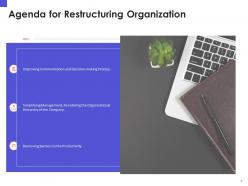
Slide 2 : Este slide apresenta a agenda.
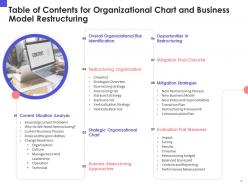
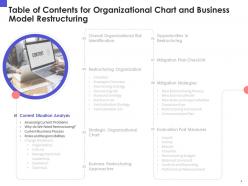
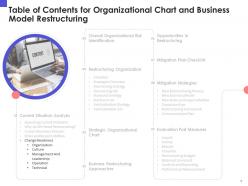
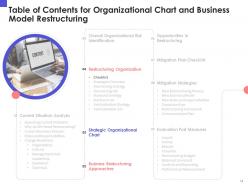
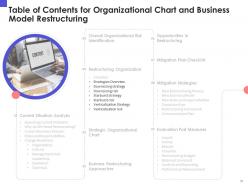
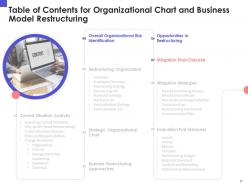
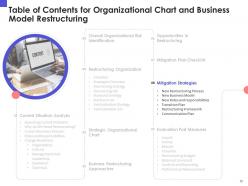
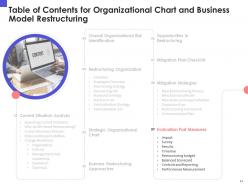
Slide 3 : Este slide apresenta o índice.
Slide 4 : Este slide mostra o título de 'Análise da situação atual'.
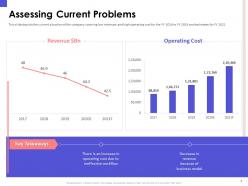
Slide 5 : Este slide mostra a situação atual da empresa abrangendo baixa receita e alto custo operacional para o ano fiscal de 2016 ao ano fiscal de 2019.
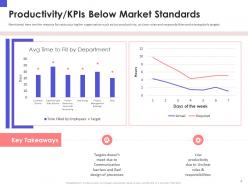
Slide 6 : Este slide destaca 'Produtividade/KPIs Abaixo dos Padrões de Mercado'.
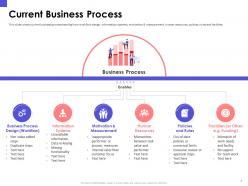
Slide 7 : Este slide cobre o processo de negócios atual, começando pelo design do fluxo de trabalho, sistemas de informação, etc.
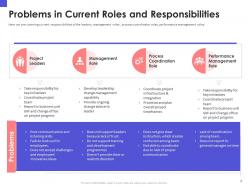
Slide 8 : Este slide mostra Problemas nas Funções e Responsabilidades Atuais.
Slide 9 : Este slide apresenta o título de 'Prontidão para mudança'.
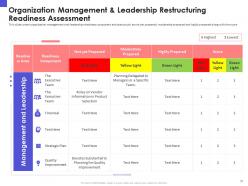
Slide 10 : Este slide cobre o componente e o status de prontidão da gestão e liderança da organização.
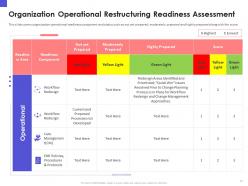
Slide 11 : Este slide cobre o componente de prontidão operacional da organização e o status, como ainda não preparado, etc.
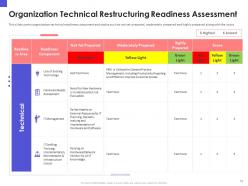
Slide 12 : Este slide cobre o componente de prontidão técnica da organização e o status, como moderadamente preparado, etc.
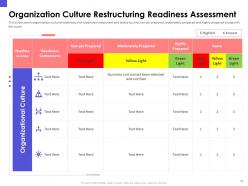
Slide 13 : Este slide cobre a prontidão cultural da organização com o componente de prontidão e status.
Slide 14 : Este slide apresenta o título de três tópicos que serão abordados a seguir no modelo.
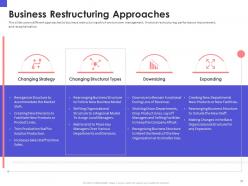
Slide 15 : Este slide cobre diferentes abordagens para reestruturação de negócios, que são gestão de rotatividade, reestruturação financeira, etc.
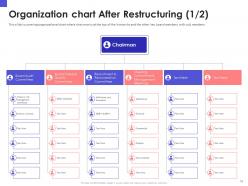
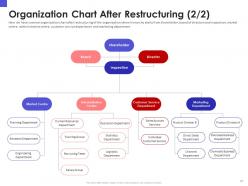
Slide 16 : Este slide abrange o organograma onde o presidente está no topo da hierarquia e os outros membros-chave do conselho com submembros.
Slide 17 : Este slide mostra o conteúdo continuado.
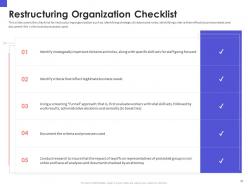
Slide 18 : Este slide cobre a lista de verificação para reestruturar a organização, como identificar divisões e funções estratégicas, etc.
Slide 19 : Este slide destaca o título dos elementos de 'Reestruturação da organização'.
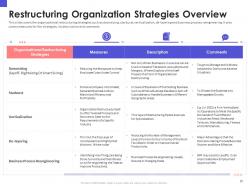
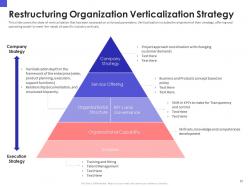
Slide 20 : Este slide aborda as estratégias de reestruturação organizacional como downsizing, starburst, verticalização, etc.
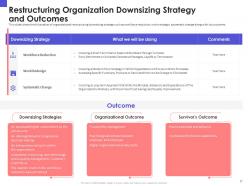
Slide 21 : Este slide cobre a bifurcação da estratégia de downsizing de reestruturação organizacional, como redução da força de trabalho, redesenho do trabalho, etc.
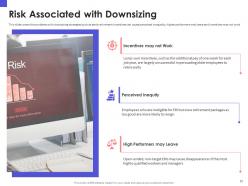
Slide 22 : Este slide aborda os problemas com estratégias de downsizing, como incentivos à aposentadoria antecipada, etc.
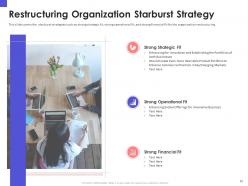
Slide 23 : Este slide cobre as estratégias starburst, como forte ajuste estratégico, forte ajuste operacional, etc.
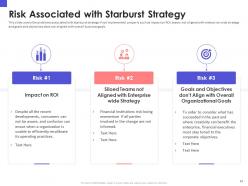
Slide 24 : Este slide cobre os problemas associados à estratégia starburst se não for implementada corretamente, como impacto no ROI, etc.
Slide 25 : Este slide cobre o estado de verticalização que foi avaliado em seis parâmetros amplos.
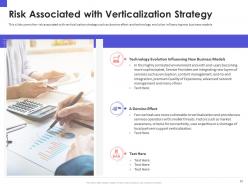
Slide 26 : Este slide cobre o risco associado à estratégia de verticalização, como efeito dominó e evolução da tecnologia.
Slide 27 : Este slide exibe o título de três tópicos a serem abordados a seguir no modelo.
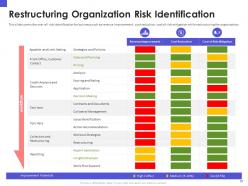
Slide 28 : Este slide cobre a identificação geral de riscos para os negócios, como melhoria de receita, redução de custos, etc.
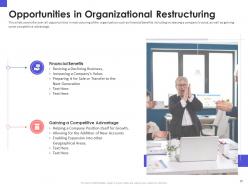
Slide 29 : Este slide cobre todas as oportunidades na reestruturação da organização, como benefícios financeiros, etc.
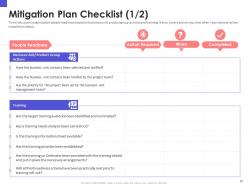
Slide 30 : Este slide aborda a prontidão das pessoas da organização com base nas ações e treinamento da unidade de negócios/grupo de produtos.
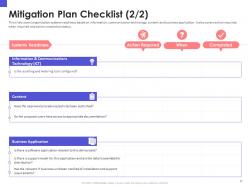
Slide 31 : Este slide aborda a prontidão dos sistemas da organização com base na informação, tecnologia de comunicação, conteúdo e aplicação de negócios.
Slide 32 : Este slide apresenta o título de 'Estratégias de Mitigação'.
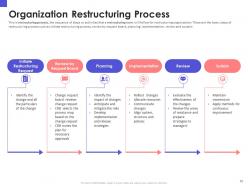
Slide 33 : Este slide mostra o processo de reestruturação organizacional.
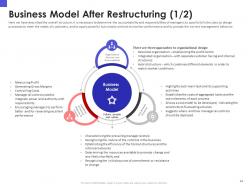
Slide 34 : Este slide mostra o modelo de negócios após a reestruturação.
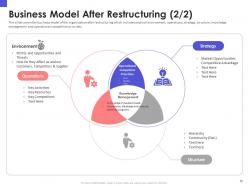
Slide 35 : Este slide cobre o conteúdo continuado.
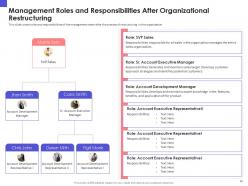
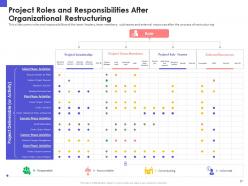
Slide 36 : Este slide aborda as funções e responsabilidades da equipe de gestão após o processo de reestruturação na organização.
Slide 37 : Este slide cobre as funções e responsabilidades dos líderes de equipe, membros da equipe, subequipes, etc.
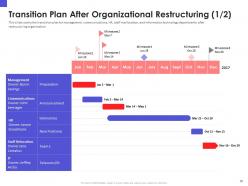
Slide 38 : Este slide cobre o plano de transição para gestão, comunicações, RH, realocação de pessoal, etc.
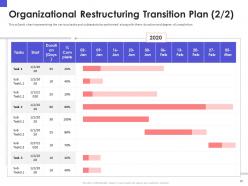
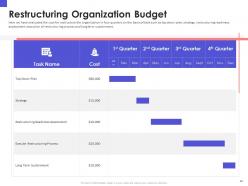
Slide 39 : Este slide mostra o gráfico de Gantt representando as várias tarefas e subtarefas a serem executadas.
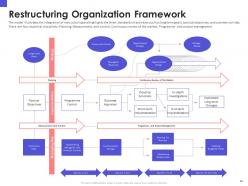
Slide 40 : Este slide destaca a 'Reestruturação da Estrutura Organizacional'.
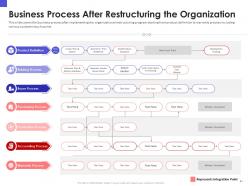
Slide 41 : Este slide aborda o processo de negócios após a implementação do programa de reestruturação organizacional.
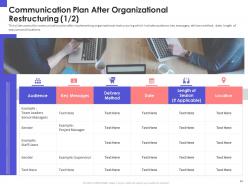
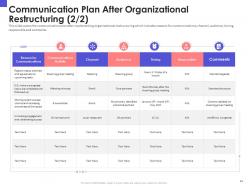
Slide 42 : Este slide aborda o plano de comunicação após a implementação da reestruturação organizacional que inclui público, etc.
Slide 43 : Este slide apresenta conteúdo continuado.
Slide 44 : Este slide apresenta o título de 'Medidas pós-avaliação'.
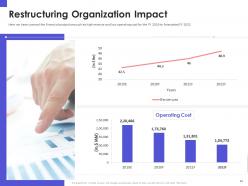
Slide 45 : Este slide mostra o 'Impacto da Reestruturação da Organização'.
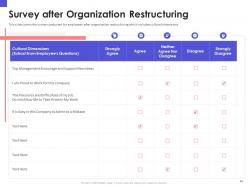
Slide 46 : Este slide abrange a pesquisa realizada com os funcionários após a reestruturação organizacional que inclui dimensões culturais.
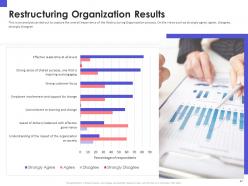
Slide 47 : Este slide mostra a 'Reestruturação dos Resultados da Organização'.
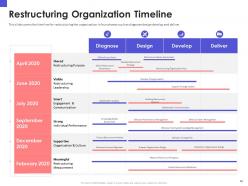
Slide 48 : Este slide cobre o cronograma para a reestruturação da organização em quatro fases.
Slide 49 : Este slide ilustra a 'Reestruturação do Orçamento da Organização'.
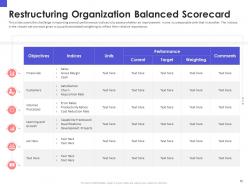
Slide 50 : Este slide aborda o desafio de reportar diversos índices de desempenho.
Slide 51 : Este slide apresenta 'Controles e relatórios após a reestruturação organizacional'.
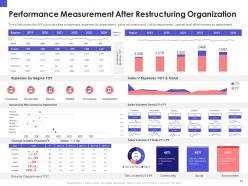
Slide 52 : Este slide abrange os KPIs, como vendas x despesas, despesas por departamento, tendência de volumes de vendas, etc.
Slide 53 : Este é o slide dos ícones.
Slide 54 : Este slide apresenta o título para slides adicionais.
Slide 55 : Este slide mostra sobre sua empresa, público-alvo e os valores de seus clientes.
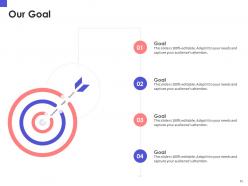
Slide 56 : Este slide mostra os objetivos.
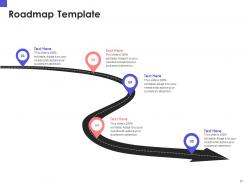
Slide 57 : Este slide mostra o roteiro.
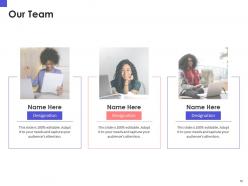
Slide 58 : Este slide mostra detalhes dos membros da equipe, como nome, designação, etc.
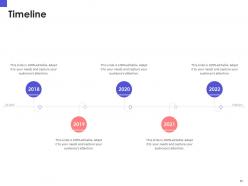
Slide 59 : Este slide mostra a linha do tempo anual.
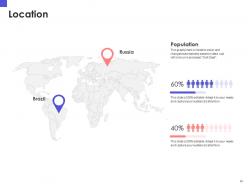
Slide 60 : Este slide mostra a localização da empresa no mapa-múndi.
Slide 61 : Este slide mostra o quebra-cabeça.
Slide 62 : Este slide mostra postagens de experiências anteriores de clientes.
Slide 63 : Este slide apresenta a visão, missão e objetivos da sua empresa.
Slide 64 : Este é o slide de agradecimento e contém detalhes de contato da empresa, como endereço do escritório, número de telefone etc.
Organograma e Modelo de Negócios Reestruturando Slides de Apresentação em Powerpoint com todos os 64 slides:
Use nossos slides de apresentação de Powerpoint de reestruturação de modelo de negócios e organograma para ajudá-lo a economizar seu valioso tempo. Eles estão prontos para se encaixar em qualquer estrutura de apresentação.

FAQs for Organizational chart and business model restructuring
Honestly, watch for stuff that just won't get better no matter what you try - like revenue keeps dropping or you're missing targets constantly. Communication between teams falls apart. People start doing the same work twice because nobody knows who's supposed to handle what. Good employees bail and complain about "the way things work here" - that's huge. Your competition keeps beating you even though you have similar budgets and talent? Yeah, that stings but it's telling you something. The trick is figuring out if it's just temporary chaos or deeper problems. I'd start writing down patterns instead of just remembering random incidents.
Honestly, just talk to people constantly - like way more than feels normal. People's imaginations run wild when they don't know what's happening, and trust me, they'll come up with scenarios way worse than reality. Hit them from all angles - emails, meetings, those awkward all-hands things. Tell them what you know AND what you're still figuring out. That part's huge. Make sure your managers aren't all saying different things because that's how rumors start. Even if nothing's changed, still check in weekly. Radio silence kills morale faster than bad news does.
Oh man, restructuring is brutal but good leadership makes or breaks it. You've got to be the calm one while everyone's panicking - which honestly sucks but someone has to do it. Communication is huge. Tell people WHY things are changing and what the end goal actually looks like. Don't hide in your office having back-to-back meetings either. Stay visible and keep your messaging consistent. People will stress out no matter what, but if you're transparent about what's happening, they'll trust you more. Quick decisions help too. Better to over-communicate than leave everyone guessing what's next.
Oh man, communication breakdowns are the absolute worst. Teams get blindsided by changes nobody told them about, then morale just tanks. Leadership always thinks stuff will happen way faster than it actually does - I swear they live in some fantasy timeline lol. Then they freak out when everything takes longer. Also? Don't plan major restructures without talking to people who actually do the work. Looks amazing on paper, total disaster in real life. Honestly, just tell everyone everything twice and assume it'll take 50% longer than you think.
Honestly, you can't communicate enough during changes - like way more than feels normal. Map out who matters and what keeps them up at night, then actually speak to those worries instead of sending boring company-wide emails. I swear, generic updates just make people panic more. Host Q&As regularly. Send updates even when nothing's happening - silence freaks people out. Be real about delays and what you don't know yet. Oh, and don't just talk AT people. Set up ways for them to talk back, like surveys or whatever. People need to feel heard, not just lectured at.
Tell them what's happening before they hear it through the grapevine - trust me, office gossip spreads ridiculously fast. Be upfront about the "why" behind everything and get people involved in planning when you can. Nobody likes being kept in the dark, so share realistic timelines even if they're not pretty. Offer whatever support you can - training, counseling, help with transitions. Most people freak out because they don't know what's coming next. Keep talking to them throughout the whole mess, not just at the beginning. Honestly, having these conversations early beats scrambling to control the narrative later.
Honestly, data analytics is a game-changer here. It'll show you exactly where things are breaking down - like which teams are drowning while others barely have work, or where communication just dies. Way better than those endless meetings where people just say "but we've always done it this way." You can actually see the workflow patterns and spot all the weird role overlaps that make zero sense. The cool part? You can test different restructuring ideas on paper first, see how they'd affect costs and productivity before you blow everything up. I'd start by mapping out your current mess (I mean processes lol) and go from there.
Start by mapping out your current mess - workflows, who talks to who, where things get stuck. Most companies are structured around "we've always done it this way" which is honestly pretty useless. Look at whether your setup actually helps you hit your goals or just creates more hoops to jump through. Who makes decisions? How does info travel up and down the ladder? Oh, and don't underestimate how much people hate change - that's half the battle right there. Figure out what's broken before you try fixing it.
Ugh, yeah restructuring is rough at first. People get anxious about their jobs and productivity tanks while everyone's figuring out new processes. But honestly? How you communicate makes all the difference. Be transparent about why it's happening and actually involve people in planning the transition - I've seen cultures come out stronger that way. The worst thing you can do is stay quiet and let rumors spread. Give clear timelines, acknowledge it sucks, and don't leave information gaps. Communication is literally everything here.
Look at your financials and operational stuff first - are you actually hitting those goals you set? But honestly, the soft stuff matters just as much. Employee surveys, retention rates, how fast decisions happen now. Customer satisfaction too, since that shows if you're actually delivering better service. I'd probably set up maybe 3-4 key things to track monthly for the first year. The numbers don't lie, but they're not everything either. Oh and retention is huge - if good people are bailing after the restructure, that tells you something's off.
Honestly, joint meetings are your lifeline here - get everyone in a room to hash out concerns and new goals first. I learned this the hard way once. Rotate project leads so teams actually work together instead of staying in their bubbles. Quick collaborative wins help too. Be super upfront about role changes and who reports to whom now. People would rather know bad news than sit in limbo wondering. Set up check-ins for the first three months to catch problems early. Oh, and don't forget new communication rhythms - maybe weekly syncs or whatever works for your culture.
Dude, restructuring can totally tank customer relationships if you're not paying attention. Customers get confused about who their contact is now, their usual rep disappears, and service gets wonky during transitions. I've watched companies blow major deals just because nobody communicated during the chaos. You've got to tell customers what's happening upfront and when. Set up clear handoff processes so accounts don't get dropped. Maybe assign temp relationship managers while you figure out the internal mess? Also - and this might sound obvious - but having dedicated communication channels actually saves your ass. Trust me on that one.
So restructuring is basically the catch-all term for any big organizational shake-up - could be new reporting structures, department mergers, whatever. Downsizing is just the lovely euphemism for layoffs to cut costs. Reengineering though? That's when they blow up your entire workflow and rebuild it from zero. Honestly, the scope is what matters most. You really want to figure out which one you're dealing with first because your game plan changes completely. Timeline's different, how they'll communicate it is different - the whole thing. Makes sense?
Dude, training programs literally save companies during restructuring. Your people need actual skills for their new roles - workshops on processes, cross-training between departments, stress management stuff. I've watched teams completely implode without this support, it's brutal. Don't just focus on technical skills either, the emotional side matters too. Oh and timing is huge - start planning now, don't wait until everything's already changed. Survey your employees first to see what they actually need most. Trust me, getting ahead of this makes all the difference.
Honestly, employment law stuff will bite you if you're not careful - proper notice periods, severance, all that. Contract reviews are critical because restructuring can mess with change-of-control clauses. Also data protection gets tricky when you're moving employee records around between entities. Union stuff? That's a whole nightmare if they're in the picture. Oh, and definitely loop in your lawyers from day one - way better than trying to clean up the mess after you've already told everyone what's happening.
-
Great quality product.
-
Perfect template with attractive color combination.
-
Thanks for all your great templates they have saved me lots of time and accelerate my presentations. Great product, keep them up!