


Organizational Structure For Effective Grocery Store Business Plan BP SS




Try Before you Buy Download Free Sample Product
 Impress Your
 Audience
 100%
100% Editable
 Save Hours
 of Time


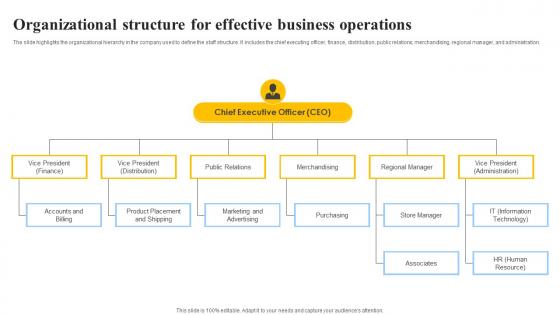
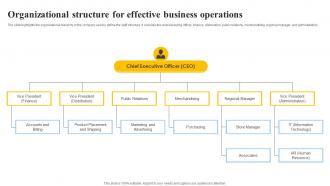
The slide highlights the organizational hierarchy in the company used to define the staff structure. It includes the chief executing officer, finance, distribution, public relations, merchandising, regional manager, and administration.
People who downloaded this PowerPoint presentation also viewed the following :
Organizational Structure For Effective Grocery Store Business Plan BP SS with all 9 slides:
Use our Organizational Structure For Effective Grocery Store Business Plan BP SS to effectively help you save your valuable time. They are readymade to fit into any presentation structure.








FAQs for Organizational Structure For Effective Grocery Store Business
Key components of an effective organizational structure include clear reporting hierarchies, defined roles and responsibilities, streamlined communication channels, appropriate spans of control, and flexible departmentalization. These elements work together by eliminating operational confusion, enhancing accountability, and facilitating strategic decision-making, with many organizations finding that well-designed structures ultimately deliver improved efficiency and competitive advantage.
Organizational structure impacts employee performance and collaboration by defining communication channels, clarifying reporting relationships, and establishing decision-making processes. Clear hierarchies and well-defined roles enable faster project execution, reduce operational confusion, and enhance cross-departmental coordination, with many organizations finding that streamlined structures ultimately deliver improved productivity and stronger team alignment.
Functional structures organize by departments like marketing and finance, divisional structures group by products or regions, and matrix structures combine both with dual reporting relationships. While functional structures enhance specialization and efficiency, divisional structures enable faster market responsiveness, and matrix structures deliver flexibility and resource sharing, ultimately allowing organizations to align structure with strategic priorities.
Organizations can determine their most suitable structure by analyzing their strategic goals, operational complexity, market environment, and growth trajectory through comprehensive assessment frameworks. Companies in dynamic sectors like technology often favor flat, agile structures for innovation, while manufacturing and financial services typically benefit from hierarchical models, with many finding that hybrid approaches ultimately deliver optimal alignment between organizational capabilities and strategic objectives.
Organizational culture significantly influences structure by determining communication patterns, decision-making processes, hierarchy levels, and collaboration approaches within companies. Hierarchical cultures typically adopt centralized structures with clear chains of command, while collaborative cultures favor flatter organizations with cross-functional teams, ultimately enabling faster innovation and enhanced employee engagement across diverse industries.
Technology transforms organizational structure by enabling flatter hierarchies, remote collaboration, and real-time communication across all levels. Through cloud platforms, project management tools, and digital communication systems, companies streamline decision-making, reduce bureaucratic layers, and enhance cross-functional teamwork, with many organizations finding that these technologies ultimately deliver faster innovation cycles and improved operational efficiency.
Flat organizational structures offer faster decision-making, improved communication, reduced costs, enhanced employee empowerment, and greater flexibility in operations. While this approach streamlines processes and increases autonomy, it can present challenges with role clarity and management spans, with many growing companies finding that strategic implementation delivers competitive advantage through increased agility and innovation.
Organizations can adapt their structures by flattening hierarchies, establishing clear digital communication protocols, creating cross-functional remote teams, and implementing outcome-based performance metrics rather than time-based oversight. Many companies are finding that decentralized decision-making, enhanced project management systems, and regular virtual collaboration sessions ultimately deliver greater flexibility and employee satisfaction while maintaining operational efficiency.
Key metrics for evaluating organizational structure effectiveness include decision-making speed, communication flow efficiency, employee satisfaction scores, operational cost ratios, and cross-departmental collaboration frequency. These measurements help organizations assess whether their structure streamlines workflows, enhances productivity, and supports strategic goals, with many companies finding that regular structural assessment ultimately delivers improved performance and competitive advantage.
Strategy alignment with organizational structure enhances overall performance by ensuring clear communication channels, streamlined decision-making processes, and efficient resource allocation across departments. When structure supports strategic goals, organizations experience faster project execution, reduced operational conflicts, and improved employee engagement, with many companies finding that aligned structures deliver measurable productivity gains and competitive advantages.
Common restructuring pitfalls include inadequate communication with employees, rushing implementation timelines, neglecting cultural integration, insufficient change management support, and underestimating resource requirements. These challenges often result in decreased employee morale, operational disruptions, and reduced productivity, with many organizations finding that phased approaches and transparent communication significantly improve restructuring outcomes and long-term success.
Leadership styles significantly influence organizational structure by determining decision-making processes, communication patterns, hierarchy levels, and control mechanisms. Autocratic leaders typically favor centralized, hierarchical structures with clear command chains, while collaborative leaders often implement flatter, decentralized frameworks that encourage cross-functional teams and distributed authority, ultimately delivering enhanced agility and employee engagement.
A strong organizational structure enhances innovation by establishing clear communication channels, defined decision-making processes, resource allocation frameworks, and cross-functional collaboration pathways. This enables organizations to streamline idea development, minimize bureaucratic delays, and accelerate time-to-market, with many technology companies and pharmaceutical firms finding that structured innovation processes deliver faster product launches and sustained competitive advantage.
Traditional hierarchical structures can limit agility through slower decision-making, reduced innovation, and communication bottlenecks that hinder rapid market responses. While these structures provide clear accountability and stability, organizations increasingly find that flatter structures enable faster adaptation, cross-functional collaboration, and employee empowerment, ultimately delivering competitive advantage in dynamic markets.
Employee feedback can be integrated through regular surveys, focus groups, cross-functional committees, and collaborative design workshops that capture insights on workflow bottlenecks, communication gaps, and role clarity needs. These mechanisms enable organizations to create more responsive structures by identifying pain points in current hierarchies, optimizing reporting relationships, and designing teams that enhance both operational efficiency and employee satisfaction.
-
Their products can save your time, effort and money. What else you need. All in one package for presentation needs!
-
“Thank you to the SlideTeam. Your presentations look really skillful and have made my life so much easier.”