

Perfume Business Plan Powerpoint Presentation Slides




Try Before you Buy Download Free Sample Product
 Impress Your
 Audience
 100%
100% Editable
 Save Hours
 of Time


For entrepreneurs venturing into the perfume industry, a comprehensive business plan is crucial. Our Perfume Business Plan PowerPoint presentation serves as an invaluable resource, meticulously crafted to guide and elevate your fragrance business. It covers every facet necessary for a thriving perfume venture. The journey begins with an insightful executive summary, providing a comprehensive overview of the entire plan. Following that, delve into an intricate portrayal of your company, encompassing its history, ownership structure, and legal framework. Additionally, our scent business plan PPT excels in market analysis, dissecting the industry, dissecting customer segments, and scrutinizing the competitive landscape. The marketing strategy unfurls, outlining promotional tactics, target demographics, and the sales funnel. The financial projections segment meticulously encompasses revenue models, balance sheets, cash flow statements, break-even analyses, and profit and loss statements. Furthermore, the fragrance business plan module anticipates potential risks and challenges, arming you with a strategic contingency framework. Download this fully editable PPT offering to embark on a journey enriched with meticulous research and expertly crafted insights that will steer your perfume business toward triumph.
People who downloaded this PowerPoint presentation also viewed the following :
Content of this Powerpoint Presentation
Slide 1: This slide introduces Perfume Business Plan. State your company name and begin.
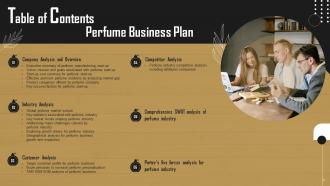
Slide 2: This slide shows Table of Content for the presentation.
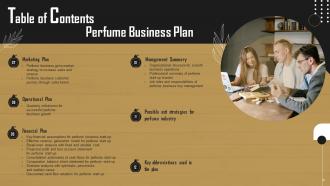
Slide 3: This is another slide continuing Table of Content for the presentation.
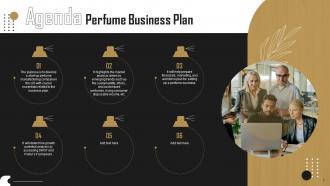
Slide 4: This slide states Agenda of the presentation.
Slide 5: This slide highlights title for topics that are to be covered next in the template.
Slide 6: This slide presents Executive summary of perfume manufacturing start-up.
Slide 7: This slide displays Executive summary of perfume manufacturing start-up.
Slide 8: This slide covers the perfume company's vision, mission, and goals to ensure that it will deliver outstanding perfumes while providing top-notch fragrance experiences to the customer.
Slide 9: This slide represents Start-up cost summary for perfume start-up.
Slide 10: This slide showcases Effective premium perfume solutions by analyzing market gap.
Slide 11: This slide shows Product categories offered by perfume company.
Slide 12: This slide presents Key success factors for perfume start-up.
Slide 13: This slide highlights title for topics that are to be covered next in the template.
Slide 14: This slide displays Global perfume market outlook.
Slide 15: This slide represents Key statistics associated with perfume industry.
Slide 16: This slide highlights the thorough assessment of a market within the perfume industry.
Slide 17: This slide showcases Key market trends shaping perfume industry.
Slide 18: This is another slide continuing Key market trends shaping perfume industry.
Slide 19: This slide shows Addressing major challenges catered by perfume industry.
Slide 20: This slide presents Exploring growth drivers for perfume industry.
Slide 21: This slide displays Geographical analysis for perfume business growth and expansion.
Slide 22: This slide highlights title for topics that are to be covered next in the template.
Slide 23: This slide represents Target customer profile for perfume business.
Slide 24: This slide showcases Buyer personas to increase perfume personalization.
Slide 25: This slide shows TAM SAM SOM analysis of perfume business.
Slide 26: This slide highlights title for topics that are to be covered next in the template.
Slide 27: This slide presents Perfume industry competitive analysis including attributes comparison.
Slide 28: This is another slide continuing Perfume industry competitive analysis including attributes comparison.
Slide 29: This slide highlights title for topics that are to be covered next in the template.
Slide 30: This slide displays Comprehensive SWOT analysis of perfume industry.
Slide 31: This slide highlights title for topics that are to be covered next in the template.
Slide 32: This slide represents Porter’s five forces analysis for perfume industry.
Slide 33: This slide highlights title for topics that are to be covered next in the template.
Slide 34: This slide showcases Perfume business go-to-market strategy to increase sales and revenue.
Slide 35: This is another slide continuing Perfume business go-to-market strategy to increase sales and revenue.
Slide 36: This is another slide continuing Perfume business go-to-market strategy to increase sales and revenue.
Slide 37: The purpose of this slide is to implement an effective go-to-market strategy for bringing the perfume business to an end customer.
Slide 38: The purpose of this slide is to implement an effective go-to-market strategy for bringing the perfume business to an end customer.
Slide 39: This is another slide continuing Perfume business go-to-market strategy to increase sales and revenue.
Slide 40: This is another slide continuing Perfume business go-to-market strategy to increase sales and revenue.
Slide 41: This slide shows Perfume business customer journey through sales funnel.
Slide 42: This slide highlights title for topics that are to be covered next in the template.
Slide 43: This slide presents Quarterly milestones for successful perfume business growth.
Slide 44: This slide highlights title for topics that are to be covered next in the template.
Slide 45: This slide displays Key financial assumptions for perfume business start-up.
Slide 46: This slide represents Effective revenue generation model for perfume start-up.
Slide 47: This is another slide continuing Effective revenue generation model for perfume start-up.
Slide 48: This is another slide continuing Effective revenue generation model for perfume start-up.
Slide 49: This slide showcases Break-even analysis with fixed and variable cost.
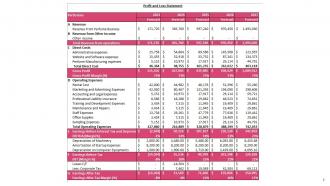
Slide 50: This slide shows Projected profit and loss account statement for perfume start-up.
Slide 51: This is another slide continuing Projected profit and loss account statement for perfume start-up.
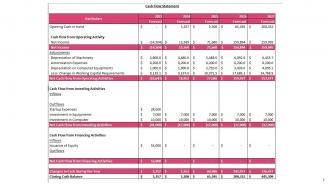
Slide 52: This slide presents Consolidated statements of cash flows for perfume start-up.
Slide 53: This is another slide continuing Consolidated statements of cash flows for perfume start-up.
Slide 54: This slide displays Comparative balance sheet statement for perfume start-up.
Slide 55: This slide represents Comparative balance sheet statement for perfume start-up.
Slide 56: This slide showcases Scenario analysis with optimistic, pessimistic and realistic cases.
Slide 57: This is another slide continuing Scenario analysis with optimistic, pessimistic and realistic cases.
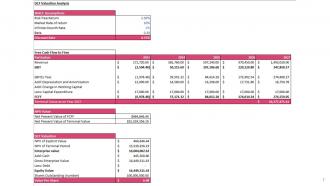
Slide 58: This slide shows Discounted cash flow valuation for perfume start-up.
Slide 59: This slide highlights title for topics that are to be covered next in the template.
Slide 60: This slide presents Organizational structure for smooth business operations.
Slide 61: This slide displays Professional summary of perfume start-up founder.
Slide 62: This slide represents Job roles and responsibilities of perfume business key management.
Slide 63: This slide showcases Job roles and responsibilities of perfume business key management.
Slide 64: This slide highlights title for topics that are to be covered next in the template.
Slide 65: This slide shows Possible exit strategies for perfume industry.
Slide 66: This slide highlights title for topics that are to be covered next in the template.
Slide 67: This slide presents Key abbreviations used in the plan.
Slide 68: This slide contains all the icons used in this presentation.
Slide 69: This slide is titled as Additional Slides for moving forward.
Slide 70: This slide showcases Magnifying Glass to highlight information, specifications etc
Slide 71: This slide depicts Venn diagram with text boxes.
Slide 72: This is Our Goal slide. State your firm's goals here.
Slide 73: This slide contains Puzzle with related icons and text.
Slide 74: This is an Idea Generation slide to state a new idea or highlight information, specifications etc.
Slide 75: This is a Thank You slide with address, contact numbers and email address.
Perfume Business Plan Powerpoint Presentation Slides with all 80 slides:
Use our Perfume Business Plan Powerpoint Presentation Slides to effectively help you save your valuable time. They are readymade to fit into any presentation structure.






FAQs for Perfume Business Plan
Okay so definitely hit the basics - market analysis, customer profiles, product strategy. Financial projections are clutch, investors eat that stuff up. Your ops section needs sourcing and distribution details. Marketing's probably your biggest focus since fragrance is so personal and brand-heavy. The regulatory stuff is a total slog but you can't skip it with FDA rules and shipping internationally. Competitive analysis and what makes you different - obviously important. Oh, and honestly? Most people only read executive summaries thoroughly, so make that part really solid first. Everything else they just skim.
Honestly, market research is gonna make or break your perfume brand. It tells you what scents people actually want (not what you think they want), how much they'll pay, and who you're up against. I've watched brands do a complete 180 after discovering their customers preferred citrus over heavy florals - wild! Do surveys and focus groups before you start mixing anything. Trust me, it's way cheaper than launching something nobody wants. You'll also spot market gaps you can jump into. Oh, and it helps you figure out your positioning too, which sounds boring but it's actually super important.
So the big expenses hit right away - fragrance oils, bottles, packaging, all that stuff. Business registration and licenses too. Honestly I'd just outsource the blending at first, way less headache than buying equipment. Website setup isn't cheap either, plus you need some marketing money and enough cash to survive those slow first months. Product development eats up more than you'd think. Keep your initial line super focused though - don't go crazy with 20 different scents. I'd say plan for at least $10-15K to do it right, but you might squeeze by with less.
Honestly, most fragrance brands just try to smell amazing (which duh, that's the baseline). The real money's in finding your weird niche or story angle. Like maybe you're targeting remote workers who want to feel fancy from their couch? Or using upcycled stuff because sustainability sells. Community building works too - people love feeling part of something. Try partnering with unexpected brands or doing innovative packaging that makes people actually want to post about it. Figure out what gap exists that matches what you're already good at, then build from there.
Perfume is tricky because people literally have to smell it first, you know? I'd start with getting sample stations in department stores and definitely throw sample vials into online orders. Subscription boxes are killing it right now for discovery - that's probably your best bet honestly. Instagram can work but trying to describe a scent in stories is kinda weird lol. Influencer collabs are decent if their vibe actually matches yours. The whole point is giving people tons of chances to try before they drop money on a full bottle. Pick one thing and get really good at it first though.
Dude, you absolutely need to nail down your target audience first. Seriously, skip this step and you'll burn through cash on marketing that goes nowhere. Different groups want totally different things - luxury shoppers vs college students vs the whole clean beauty crowd. Each has their own scent preferences, packaging expectations, price tolerance, the works. Once you know who you're selling to, everything else falls into place way easier. Your branding, where you sell, even your actual fragrance formulas should match what they want. Honestly took me forever to learn this lesson, but it's like the foundation for literally everything else.
Okay so packaging is huge - it's what people notice first when they're browsing. Your bottle and box basically tell customers everything about your brand before they even try the scent. I'm totally guilty of buying perfume just because the bottle looked amazing on my vanity (no shame). Good packaging makes people think it's worth more money too. You want something that'll look good in photos since everyone posts their perfume collections now. Also make sure it pops on store shelves because there's so much competition out there.
Your scent profiles are everything for customer connection. Those top notes? They're doing the heavy lifting for first impressions - citrus screams fresh energy, florals give off romance vibes. But here's the thing - middle and base notes actually determine if people come back since they stick around longest. Younger customers usually go crazy for fruity or dessert-y scents, while older buyers stick with classic florals and woods. The psychology behind all this is honestly fascinating! Get focus groups testing your profiles early and track which notes people react to most.
Honestly, I'd go with a mix of channels. Your own website is key, plus Amazon if you can handle their fees. Instagram and TikTok are killing it right now for beauty brands - especially if you're after Gen Z customers. Department stores and local beauty boutiques are solid too. Skip Sephora for now though, they're crazy picky about who they work with. Build up your online customer base first. Then hit up smaller shops in your area where you can actually tell your brand story without getting lost in the noise.
So you'll need to hit a few regulatory boxes before launching. IFRA standards are the big one for fragrance ingredients, plus FDA rules if you're selling in the US. Labeling is huge too - ingredient lists, allergen warnings, all that fun stuff. Trademark your brand name ASAP because someone will definitely steal it otherwise. The paperwork honestly sucks but beats getting slapped with a recall later. Business licenses are obvious but easy to forget when you're excited about the creative stuff. I'd grab a cosmetic regulatory specialist early on - they'll make you a checklist for whatever markets you're targeting.
Social media is perfect for fragrance marketing! Instagram and TikTok work amazing - post those pretty flat lays, behind-the-scenes creation stuff, and "scent journey" videos describing your notes. Those "get ready with me" posts where people layer fragrances are honestly so satisfying to watch. Find micro-influencers who actually love your scents (not just anyone), make some catchy hashtags, and get people doing unboxing videos. Oh and user-generated content is huge right now. The whole trick is making people feel that luxury vibe even though they obviously can't smell anything through their phone. It's all about the emotion and aesthetics.
Honestly, personalization and sustainability are the big ones right now. People want custom scents that feel unique to them, plus eco-friendly packaging because everyone's more conscious about waste. Clean beauty is everywhere too - natural ingredients aren't just trendy anymore, they're expected. Gender-neutral fragrances are blowing up, which totally makes sense to me since smell is so subjective anyway. Oh, and DTC brands are killing it with social media and subscription models, completely bypassing traditional retail. I'd pick maybe two of these trends for your business plan since they're actually changing what customers expect, not just passing fads.
Yeah, influencer partnerships totally work for perfume! People trust recommendations from creators they follow way more than random ads. Instagram and TikTok are perfect for fragrance content too - all that visual stuff really pops. Here's the thing though - skip the mega celebrities. Micro-influencers in beauty spaces are where it's at. Their audiences actually engage and buy stuff. Higher conversion rates and all that. Just make sure you pick influencers whose whole vibe matches your brand. No point partnering with someone whose aesthetic is totally off, you know? Start small and see what works.
Okay so pricing is tricky but here's what worked for me - first figure out what people will actually pay in your target market. Don't make the mistake of comparing yourself to Chanel if you're going after everyday buyers, that's just setting yourself up to fail. Check out competitor prices in your exact category instead. Then work backwards from retail prices since most places take their cut anyway. You'll need to factor in all your real costs too - ingredients, bottles, getting it to stores, the whole thing. Honestly the math can be depressing at first but start there and adjust.
Track revenue per fragrance and your customer acquisition costs first - that's where the money story lives. Repeat purchase rate matters tons too. Honestly, gross margins will make or break you since ingredients are all over the place (ugh, don't even look at rare oil prices). Inventory turnover's key because perfumes just sit there if they flop. Customer lifetime value shows if your marketing actually works. Oh, and seasonal stuff - holidays are huge for fragrance sales so watch those patterns. Start simple with these basics, then get fancy with analytics once you've got steady data coming in.
-
I am a big fan of their newsletters because that is how I found my perfect requirement at the time of urgency. Thank God, I kept opening those.
-
Delighted to see unique and eye-catching PowerPoint designs that are so easy to customize.