

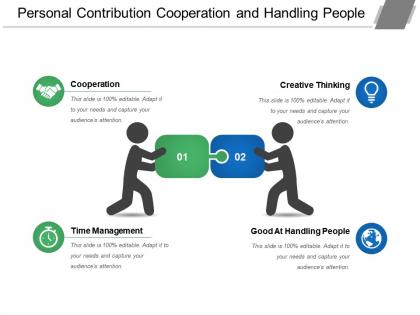
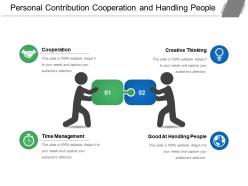
Personal contribution cooperation and handling people




Try Before you Buy Download Free Sample Product
 Impress Your
 Audience
 100%
100% Editable
 Save Hours
 of Time


Discover half truths with our Personal Contribution Cooperation And Handling People. Avoid any errors in the future.
People who downloaded this PowerPoint presentation also viewed the following :
Personal contribution cooperation and handling people with all 5 slides:
Keep disappointments at bay with our Personal Contribution Cooperation And Handling People. They generate enduring enthusiasm.


FAQs for Personal contribution cooperation
**INPUT**: What are the key characteristics of successful teamwork? **OUTPUT**: Successful teamwork characteristics include clear communication, shared accountability, complementary skills, mutual trust, and aligned objectives toward common goals. These elements streamline project execution by minimizing conflicts, enhancing productivity, and accelerating decision-making processes, with many organizations finding that diverse teams ultimately deliver superior innovation and competitive advantage across industries. **Word count: 50 words**
Effective communication enhances team collaboration by establishing clear expectations, facilitating transparent information sharing, and minimizing misunderstandings that can derail projects. Through regular check-ins and structured feedback loops, teams across industries like healthcare, consulting, and manufacturing streamline decision-making processes, reduce duplicated efforts, and ultimately deliver faster project completion with improved quality outcomes.
Diversity strengthens team dynamics by bringing varied perspectives, experiences, cultural insights, problem-solving approaches, and creative thinking styles to collaborative efforts. These different viewpoints enhance decision-making, reduce groupthink, and foster innovation, with many organizations finding that diverse teams deliver superior outcomes, increased adaptability, and stronger competitive advantage in increasingly complex business environments.
Trust within teams develops through consistent communication, transparent decision-making, reliable follow-through on commitments, and creating psychological safety for open dialogue. When organizations implement regular feedback sessions, collaborative problem-solving processes, and accountability frameworks, teams experience enhanced collaboration, faster decision-making, and improved performance outcomes, ultimately delivering stronger results and competitive advantage.
Conflict resolution techniques include active listening, mediation sessions, structured dialogue frameworks, collaborative problem-solving approaches, and establishing clear communication protocols. These methods streamline team dynamics by addressing root causes, fostering mutual understanding, and creating transparent resolution pathways, with many organizations finding that proactive conflict management ultimately enhances productivity and strengthens collaborative relationships.
Leadership style significantly impacts team effectiveness by influencing communication patterns, decision-making processes, and employee motivation levels. Transformational leaders in organizations like tech startups and healthcare systems enhance team performance through clear vision-setting, collaborative problem-solving, and adaptive management approaches, ultimately delivering improved productivity, higher employee engagement, and stronger organizational outcomes.
Strategies for fostering creativity and innovation include encouraging diverse perspectives, creating psychological safety for risk-taking, implementing structured brainstorming sessions, providing dedicated time for experimentation, and establishing cross-functional collaboration opportunities. These approaches streamline idea generation by reducing hierarchical barriers, enhancing knowledge sharing, and enabling rapid prototyping, with many organizations finding that diverse teams ultimately deliver breakthrough solutions and sustained competitive advantage.
Teams can measure performance and progress through key performance indicators, regular milestone reviews, goal completion rates, collaboration metrics, and stakeholder feedback assessments. These measurement approaches enable organizations to track productivity, identify improvement areas, and optimize resource allocation, with many companies finding that systematic performance tracking ultimately delivers enhanced team efficiency and stronger competitive positioning.
Tools supporting remote teamwork include video conferencing platforms, collaborative document editors, project management software, instant messaging applications, and cloud-based file sharing systems. These technologies streamline communication and coordination by enabling real-time collaboration, centralizing project tracking, and maintaining seamless access to shared resources, with many organizations finding that strategic combinations ultimately deliver enhanced productivity and stronger team cohesion.
Cultural differences influence teamwork in globalized environments by shaping communication styles, decision-making approaches, and collaboration expectations across diverse teams. While these variations present coordination challenges, organizations increasingly leverage cultural diversity to enhance creativity, problem-solving capabilities, and market insights, with many multinational companies finding that inclusive team practices ultimately deliver stronger innovation and competitive advantage.
Team size significantly impacts communication patterns, decision-making speed, coordination complexity, and individual accountability within groups. Smaller teams of 3-5 members typically enable faster consensus and stronger personal responsibility, while larger teams of 8-12 can offer diverse expertise but may experience coordination challenges, with many organizations finding that optimal team size depends on project complexity and desired outcomes.
Team members can provide constructive feedback by focusing on specific behaviors rather than personalities, using "I" statements, offering actionable suggestions, and timing conversations appropriately. Successful feedback approaches include regular one-on-ones, structured peer reviews, and creating psychological safety, with many organizations finding that consistent, respectful dialogue ultimately enhances performance and strengthens collaborative relationships.
Common obstacles teams face include communication breakdowns, conflicting priorities, unclear roles, lack of trust, and resource constraints. These challenges can be overcome by establishing clear communication protocols, defining specific responsibilities, conducting regular team alignment meetings, and fostering psychological safety through transparent feedback, ultimately delivering stronger collaboration and improved project outcomes.
Teams can leverage individual strengths through strategic role allocation, cross-functional collaboration, and skills-based task distribution that matches expertise with responsibilities. By implementing strength-mapping assessments and creating complementary partnerships, organizations enhance project outcomes, accelerate problem-solving, and improve overall performance, with many companies finding that diverse skill integration ultimately delivers competitive advantage and innovation.
Setting clear goals and roles within teams significantly enhances operational efficiency by eliminating confusion, reducing task overlap, and ensuring accountability across all team members. This strategic approach enables organizations to streamline project execution, accelerate decision-making processes, and deliver measurable outcomes, with many companies finding that well-defined structures ultimately boost productivity and competitive advantage.
-
Enough space for editing and adding your own content.
-
Excellent design and quick turnaround.