

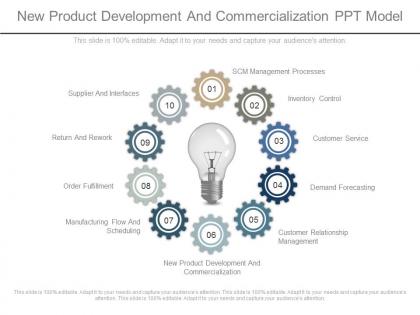
New product development and commercialization ppt model




Try Before you Buy Download Free Sample Product
 Impress Your
 Audience
 100%
100% Editable
 Save Hours
 of Time


Confidently counter challenges with our New Product Development And Commercialization Ppt Model. You will feel fully equipped.
People who downloaded this PowerPoint presentation also viewed the following :
New product development and commercialization ppt model with all 7 slides:
Our New Product Development And Commercialization Ppt Model have choices for every budget. Don't allow costs to bother you.
FAQs for New product development and
The key stages in new product development include idea generation, concept development, market research, prototype creation, testing and validation, and commercialization. These stages streamline innovation by systematically reducing risks, optimizing resource allocation, and ensuring market fit, with many organizations finding that structured development processes accelerate time-to-market while delivering products that meet customer needs and generate sustainable competitive advantage.
Market research informs product design by identifying customer pain points, preferences, feature priorities, usage patterns, and competitive gaps through surveys, focus groups, and behavioral analytics. This data-driven approach enables companies to develop targeted features that resonate with specific market segments, ultimately reducing development costs, accelerating time-to-market, and delivering products with higher adoption rates.
Customer feedback serves as a critical refinement tool, identifying usability issues, feature gaps, performance concerns, and market positioning opportunities throughout development cycles. Through systematic feedback collection, companies enhance product functionality, reduce development costs, and accelerate time-to-market, with many organizations finding that early customer input ultimately delivers stronger market adoption and competitive differentiation.
Determining the right pricing strategy involves analyzing competitor pricing, understanding your target market's willingness to pay, calculating production costs, and considering your brand positioning goals. Through market research and testing approaches like penetration pricing or premium positioning, companies can optimize pricing for customer acquisition while maintaining profitability, ultimately delivering competitive advantage and sustainable revenue growth.
Effective ways include encouraging cross-functional collaboration, implementing regular brainstorming sessions, creating psychological safety for risk-taking, establishing dedicated innovation time, and leveraging diverse perspectives from different departments. These approaches streamline creative processes by breaking down silos, accelerating idea generation, and enhancing problem-solving capabilities, with many organizations finding that structured innovation frameworks ultimately deliver faster product cycles and competitive market advantages.
Technology streamlines new product development through digital prototyping, collaborative platforms, automated testing, and data-driven market analysis. These tools accelerate design iterations, enhance cross-functional team coordination, and minimize time-to-market by enabling real-time feedback loops, with many organizations finding that integrated development platforms deliver faster launches and reduced development costs.
Key metrics for evaluating new product launch success include revenue performance, market penetration rates, customer acquisition costs, user engagement levels, and customer satisfaction scores. These metrics enable organizations to assess both immediate market response and long-term viability, with many companies finding that combining financial indicators with customer behavior data delivers comprehensive insights for strategic optimization and competitive positioning.
Cross-functional collaboration is essential in new product development, enabling diverse expertise from marketing, engineering, design, and operations to align on customer needs, technical feasibility, and market viability. This strategic approach streamlines decision-making, reduces development cycles, and minimizes costly revisions, with many organizations finding that integrated teams deliver more innovative products faster to market.
Common pitfalls include insufficient market research, poor timing, inadequate customer feedback integration, weak competitive analysis, and unrealistic budget planning. These challenges often result from rushing development cycles without proper validation, with many companies finding that thorough testing phases and strategic market positioning ultimately deliver higher success rates and stronger competitive advantage.
Prototyping and iteration improve final products by enabling early problem identification, user feedback integration, and design refinement before costly production phases. Through rapid testing cycles, companies streamline development timelines, minimize expensive revisions, and enhance user experience, with many organizations finding that iterative approaches ultimately deliver more market-ready solutions and competitive advantages.
Best practices for managing project timelines include establishing clear milestones, implementing agile methodologies, conducting regular stakeholder reviews, utilizing project management software, and building buffer time for unexpected challenges. These approaches streamline development cycles by enhancing team coordination, improving resource allocation, and enabling faster pivots when needed, with many organizations finding that structured timeline management ultimately delivers products to market 20-30% faster while maintaining quality standards.
Competitive analysis shapes product differentiation by identifying market gaps, analyzing competitor weaknesses, and revealing unmet customer needs that inform unique value propositions. Through systematic competitor research, companies discover opportunities for superior features, pricing strategies, and positioning approaches, enabling them to create distinctive products that stand out in crowded markets and capture competitive advantage.
Risk mitigation strategies for new product development include thorough market research, prototype testing, phased rollouts, cross-functional collaboration, and contingency planning. These approaches streamline development by validating customer demand early, identifying technical issues before launch, and enabling iterative improvements, with many organizations finding that strategic risk management ultimately delivers faster time-to-market and higher success rates.
Companies leverage social media for product validation through targeted surveys, focus group discussions, beta testing campaigns, influencer partnerships, and direct customer feedback collection across platforms like Instagram, LinkedIn, and Facebook. These approaches enable organizations to gauge market demand, refine features, and identify potential issues early, ultimately reducing launch risks while building pre-launch excitement and ensuring product-market fit.
Sustainability drives modern product development through eco-friendly materials, circular design principles, energy-efficient manufacturing, and lifecycle assessments that minimize environmental impact. Companies across industries, from automotive to consumer goods, increasingly integrate sustainable practices to meet regulatory requirements, reduce operational costs, and appeal to environmentally conscious consumers, ultimately delivering competitive advantage and long-term viability.
-
Understandable and informative presentation.
-
Content of slide is easy to understand and edit.