


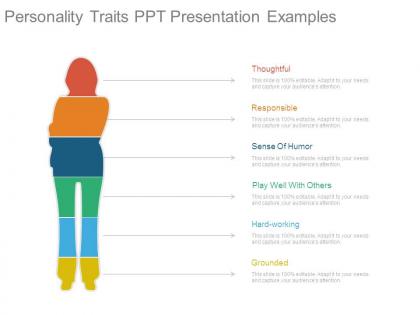
Personality traits ppt presentation examples




Try Before you Buy Download Free Sample Product
 Impress Your
 Audience
 100%
100% Editable
 Save Hours
 of Time


There is something exciting about beautiful colours and beautiful designs. If you intend to make a presentation that will be remembered for more things than one use our PowerPoint Templates and Slides.
People who downloaded this PowerPoint presentation also viewed the following :
Personality traits ppt presentation examples with all 7 slides:
Jeers cease due to our Personality Traits Ppt Presentation Examples. Angry crowds begin to feel appeased.
FAQs for Personality traits
The top five personality traits that influence leadership effectiveness include emotional intelligence, resilience, adaptability, integrity, and strategic thinking. These traits enable leaders by enhancing team communication, navigating organizational challenges, and driving sustainable growth, with many executives finding that combining these characteristics ultimately delivers stronger employee engagement, improved decision-making capabilities, and competitive advantage in increasingly complex business environments.
Personality traits significantly influence teamwork dynamics by affecting communication styles, conflict resolution approaches, decision-making processes, and collaborative preferences within organizations. Different personality combinations can either enhance team synergy or create challenges, with many successful organizations finding that diverse personality teams deliver stronger problem-solving capabilities and innovative solutions when properly managed.
Understanding personality traits enhances workplace communication by enabling tailored messaging, reducing misunderstandings, and fostering stronger team collaboration through personalized approaches. With many organizations finding that personality-aware communication strategies streamline project coordination, minimize conflicts, and improve employee engagement, teams ultimately deliver faster results and create more inclusive environments across departments.
Introversion and extroversion significantly influence conflict resolution approaches, with introverts typically preferring one-on-one discussions, written communication, and thoughtful preparation time before addressing disputes. Extroverts often favor group discussions, verbal processing, and immediate dialogue to resolve issues, with many organizations finding that combining both styles enhances team problem-solving and delivers more comprehensive solutions.
Personality traits significantly influence employee motivation and job satisfaction by affecting how individuals respond to work environments, leadership styles, and task structures. Employees with high conscientiousness typically thrive with clear goals and structured feedback, while those with strong openness prefer creative challenges and autonomy, with organizations increasingly finding that matching personality profiles to roles and management approaches enhances engagement and retention.
Personality assessments can predict career success by identifying traits that align with specific field requirements, such as conscientiousness for management roles, openness for creative industries, and emotional stability for healthcare positions. While these tools provide valuable insights for career planning and hiring decisions, success ultimately depends on skills development, experience, and environmental factors, with many organizations finding that combining personality data with competency assessments delivers more accurate predictions.
Cultural differences significantly affect personality trait interpretation through varying social norms, communication styles, values, and behavioral expectations across societies. What appears as assertiveness in individualistic cultures like the United States may be perceived as aggression in collectivistic cultures like Japan, while traits valued in one culture, such as direct communication, might be considered rude in relationship-focused societies, ultimately requiring cultural competency for accurate assessment.
Common misconceptions include believing personality traits directly predict all behaviors, that traits remain completely fixed throughout life, and that situational factors don't influence actions. While personality provides behavioral tendencies, environmental contexts, cultural influences, and personal development significantly shape how traits manifest, with many organizations finding that understanding this complexity enhances team dynamics and leadership effectiveness.
Managers can leverage personality traits for team assignments by matching complementary strengths, aligning introverted and extroverted communication styles, and balancing analytical thinkers with creative contributors. Through strategic personality mapping, organizations enhance project outcomes, reduce interpersonal conflicts, and accelerate team productivity, with many companies finding that diverse trait combinations ultimately deliver stronger innovation and operational efficiency.
Personality traits commonly associated with creativity and innovation include openness to experience, curiosity, risk-taking propensity, persistence, and cognitive flexibility. These characteristics enable individuals and organizations to challenge conventional thinking, explore unconventional solutions, and adapt to changing market demands, with many companies finding that fostering these traits ultimately delivers competitive advantage and breakthrough innovations.
Personality traits significantly influence decision-making under pressure through risk tolerance, emotional regulation, and cognitive processing styles. Conscientiousness drives systematic analysis while openness enables creative solutions, and extraversion facilitates collaborative decision-making, with many organizations finding that diverse personality combinations ultimately deliver more balanced outcomes and strategic advantages in crisis management.
Personality traits significantly influence remote work effectiveness through communication preferences, self-discipline levels, collaboration styles, and adaptation to digital environments. Introverted employees often thrive with reduced office distractions and flexible scheduling, while extroverts may struggle with isolation, with many organizations finding that understanding these differences enables better team management, targeted support systems, and ultimately higher productivity across distributed workforces.
Personality traits can evolve gradually through life experiences, deliberate practice, therapy, major life transitions, and neuroplasticity. While core temperament remains relatively stable, traits like conscientiousness, emotional stability, and openness often shift through career changes, relationships, education, and personal development efforts, with many individuals finding that consistent behavioral modifications ultimately reshape their personality patterns over years.
Understanding personality traits helps resolve workplace conflicts by identifying communication preferences, stress triggers, and behavioral patterns that contribute to misunderstandings. Through personality assessments and targeted training, managers can facilitate more effective dialogue, adapt their mediation approaches to different personality types, and create collaborative solutions, with many organizations finding that personality-aware conflict resolution reduces team tensions and enhances overall productivity.
Organizations can accommodate diverse personality traits through flexible work arrangements, varied communication channels, customized leadership approaches, team composition diversity, and personalized development programs. These strategies enable companies to leverage introverts' analytical strengths alongside extroverts' collaborative energy, with many businesses finding that personality-inclusive environments enhance employee engagement, reduce turnover, and ultimately deliver improved innovation and organizational performance.
-
Excellent products for quick understanding.
-
Wonderful templates design to use in business meetings.