


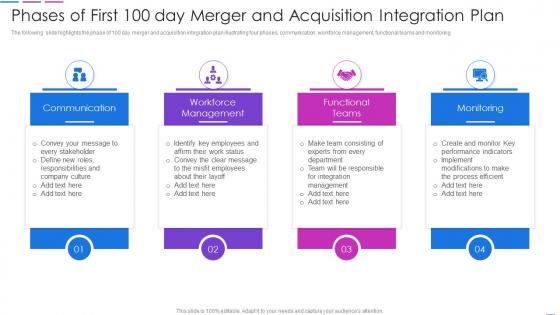
Phases Of First 100 Day Merger And Acquisition Integration Plan




Try Before you Buy Download Free Sample Product
 Impress Your
 Audience
 100%
100% Editable
 Save Hours
 of Time


The following slide highlights the phase of 100 day merger and acquisition integration plan illustrating four phases, communication, workforce management, functional teams and monitoring.
People who downloaded this PowerPoint presentation also viewed the following :
Phases Of First 100 Day Merger And Acquisition Integration Plan with all 6 slides:
Use our Phases Of First 100 Day Merger And Acquisition Integration Plan to effectively help you save your valuable time. They are readymade to fit into any presentation structure.





FAQs for Phases Of First 100 Day Merger And
So there's basically four main chunks to M&A integration. You'll start with pre-close planning - mapping out your strategy and figuring out what's actually critical. Day 1 readiness comes next, which is just making sure things don't completely fall apart when the deal closes (spoiler: it's always messier than planned). Then you've got the heavy lifting phase - actually combining all the systems, processes, and teams. Takes like 12-18 months usually. Last bit is optimization where you polish everything up and try to hit those synergy targets everyone promised the board. Oh, and definitely get your integration team together early - trust me on that one.
Honestly, skip the basic surveys - they're pretty useless. Get into actual focus groups and sit-downs with people from every level to see how things really work day-to-day. Check out their decision-making, communication style, what gets people promoted vs. fired. I've watched so many deals blow up because executives just glanced at org charts and called it good (rookie move). Watch the small stuff too - meeting vibes, how they handle disagreements, whether people actually go home at 5pm. Oh, and start this early in due diligence. Use outside people to run it so you'll get honest answers.
Dude, communication will totally make or break your integration. People are already freaking out about layoffs and culture changes, so you've got to be super transparent about what's happening and when. I learned this the hard way - rumors spread like wildfire when you're not talking enough. Set up regular check-ins through whatever channels work: town halls, team meetings, random coffee chats. Those first 100 days are crucial since everyone's analyzing every little thing you do. Honestly, I'd rather over-communicate and annoy people than leave them guessing. Trust me on this one.
Look at revenue synergies and customer retention first - those are your big ones. Employee turnover in critical roles will tell you a lot too. The operational stuff like system integration? That's honestly where most deals fall apart, so track those milestones religiously. Don't sleep on cultural integration surveys either. I've seen great deals tank because nobody paid attention to that side of things. Focus on leading indicators instead of waiting for the financial results - by then you're already screwed if something's wrong. Start measuring everything from day one and check in weekly for the first 100 days.
Tech will save your sanity during M&A integration, trust me. You can automate the data migration nightmare and get real-time updates on progress. Project management tools track all those crazy workstreams, while collaboration platforms keep teams talking (people are already freaking out enough). Integration software maps system dependencies so nothing explodes later. Pick tools both companies can actually figure out without training everyone for weeks. Oh, and audit what tech each side already uses first - way easier than starting from scratch. The communication piece alone makes it worth it.
Talk to your best people ASAP - like, this week if you haven't already. People absolutely hate not knowing what's happening to their jobs, so even if you don't have all the details figured out yet, at least give them a timeline. Be upfront about their role, pay, and where they fit in the new company. Retention bonuses work, or maybe faster equity vesting. Honestly, I've seen too many good people bail during mergers just because no one bothered to tell them they were wanted. Show them how this actually helps their career - don't just assume they'll stick around.
Stop thinking "should we buy this?" and start asking "how the hell will we actually merge these companies?" The numbers matter, but I've watched deals completely implode because nobody checked if the payroll systems could sync up - such a stupid oversight. Get your integration people talking to due diligence from the start. Cultural fit is huge. So is keeping their best people from bolting. Map out what'll break the deal beyond just price. Don't wait until after you sign to figure out integration. That's backwards.
Ugh, data compatibility is the worst part - nothing talks to each other because everyone's using different formats and systems. Your workflows get completely messed up too. Things that worked fine separately suddenly break when you try to combine them. Don't even get me started on training people - they're already freaking out about the merger and now they have to learn new software overnight. Oh, and you've got duplicate departments doing the same job but you can't just cut one without everything falling apart. Honestly? Figure out which integrations are make-or-break first and assign actual teams to those. The fancy stuff can wait.
Honestly, the key is beating customers to the punch with updates before they start panicking. Keep sending them regular info about what's changing and what's staying the same - people absolutely lose their minds over surprises during mergers. Make sure your support team is still fully staffed (sounds obvious but you'd be shocked how many companies mess this up). Put together an FAQ for the stuff everyone's gonna ask anyway. For your big accounts, assign someone to hold their hand through this. And here's the thing - if you promise something, you better deliver. Your reputation's on the line right now.
Get both leadership teams together constantly for structured sessions - like, before the deal even closes. Map out who decides what, how you'll communicate, shared metrics, all that stuff. Don't let anyone guess their role because I've literally watched deals implode when leaders kept stepping on each other for months. Set up joint working groups too so teams actually work together instead of just tolerating each other. Document whatever you agree on and share it with everyone. Honestly, the companies that nail this early are the ones that don't hate each other six months later.
Look, you absolutely need people in the loop on this - I've seen too many mergers crash because leadership thought they could just announce changes from the top. People hate having stuff forced on them without explanation. Get them involved early by creating mixed teams from both companies. They'll give you the real scoop on what'll actually work day-to-day, plus they won't feel like victims of some corporate takeover. Trust me, the rumor mill gets vicious when employees feel left out. But when they're part of planning? Total game changer. You'll keep your good people and get way better results.
Ugh, the cultural stuff is always brutal - teams get super territorial and communication just falls apart. Honestly, most companies try to rush the whole thing way too fast. Get your leadership on the same page first, then talk to everyone constantly about timelines. I mean constantly. Your integration will take like twice as long as you think (learned that one the hard way). Set up dedicated teams with clear owners for different pieces. Quick wins early on help build trust before you dive into the messy complicated stuff. Oh, and key people will definitely try to jump ship if they feel left out.
Set your timelines upfront for both short and long-term stuff. Short-term focus should be keeping customers happy and hitting your numbers - basic operational stuff. But here's where most people screw up: they let every crisis eat up all their bandwidth. You've got to ring-fence resources for strategic work, even when everything's on fire (which it will be). Create separate workstreams for long-term goals that won't get killed when urgent issues pop up. Map out your trade-offs explicitly so you're making real decisions, not just reacting to whatever's loudest. Trust me, protecting that strategic bandwidth is everything.
Yeah, regulatory stuff will totally kill your M&A deal if you ignore it early on. Antitrust folks, industry regulators, foreign investment boards - they all want their piece of the review process. We're talking 6-18 months minimum, and honestly that's being optimistic. I've seen deals where they had to sell off whole business units just to get approval. The worst part? Sometimes you agree to operational restrictions that mess with your whole integration strategy. My advice - start mapping out the regulatory landscape during due diligence, not after you've already shaken hands.
Start by auditing both brand portfolios right away - figure out which ones to keep, merge, or just ditch completely. Sometimes it actually makes sense to keep brands separate instead of cramming everything together (learned that one the hard way). Map out how each brand hits different customer segments. Don't rush this part or you'll totally confuse people! Make sure your marketing, sales, and support teams all get the strategy so they're not saying different things. Test changes with your best customers first, then roll things out slowly. Way better than doing some massive rebrand overnight. Oh, and be intentional about every decision - don't just wing it.
-
Excellent products for quick understanding.
-
Keep doing the good work guys. Surpass the needs and expectations always!!