

Pitch deck slide market gap opportunity template 1 presentation examples




Try Before you Buy Download Free Sample Product
 Impress Your
 Audience
 100%
100% Editable
 Save Hours
 of Time


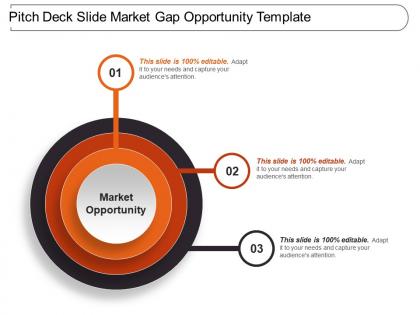
To identify the growth prospects for your organization, then use our pitch deck slide market gap opportunity PPT slide. It will help in analyzing the business market so that to identify all types of factors (positive or negative). Explain the steps which help in analyzing the market opportunities for your industry with this market opportunity analysis PowerPoint design. The steps starts from identifying the business environment force them to the stage of analyzing the market and the key competitor. Then you can describe the target profile of your market with this opportunity analysis PPT image. Use this PPT image template for describing the concepts related to market gap opportunity. Such as consumer segmentation, purchase situation analysis, direct competition analysis, indirect competition analysis, and more. Just click and start initializing with this market segmentation PowerPoint design. It will help in bringing an exquisite Presentation in front of your potential and associated business audiences. Dial our Pitch Deck Slide Market Gap Opportunity Template 1 Presentation Examples for help. They will reach you in record time.
People who downloaded this PowerPoint presentation also viewed the following :
Pitch deck slide market gap opportunity template 1 presentation examples with all 5 slides:
Build big on the firm foundation of our Pitch Deck Slide Market Gap Opportunity Template 1 Presentation Examples. They will help cement your growth.



FAQs for Pitch deck slide market gap opportunity template
Effective techniques include competitor analysis, customer feedback surveys, trend monitoring, patent research, and social media sentiment analysis. Through these methods, businesses can uncover unmet needs, underserved segments, and emerging opportunities across industries like healthcare, fintech, and retail, ultimately delivering strategic advantages and competitive positioning in increasingly crowded markets.
Consumer behavior analysis reveals unmet needs by examining purchasing patterns, feedback data, demographic preferences, and interaction touchpoints across customer journeys. Through advanced analytics and survey methodologies, businesses identify service gaps, product deficiencies, and emerging demands, with retail companies and financial services finding that behavioral insights ultimately deliver targeted innovation opportunities and competitive positioning advantages.
Competitive analysis reveals market opportunities by identifying underserved customer segments, pricing inefficiencies, product gaps, and emerging trends competitors haven't addressed. Through systematic evaluation of competitor strategies, businesses can pinpoint areas where rivals struggle with service delivery or innovation, ultimately discovering lucrative niches and developing differentiated offerings that capture market share.
Emerging trends influence market gap discovery by revealing shifting consumer behaviors, technological capabilities, and regulatory changes that create unmet needs. These evolving patterns help businesses identify opportunities where current solutions fall short, with companies in healthcare, fintech, and retail finding that trend analysis enables faster innovation, better product-market fit, and competitive advantage in rapidly changing markets.
Startups can leverage customer surveys, competitor analysis platforms, social media listening tools, industry reports, and market research databases to identify market gaps. These resources enable entrepreneurs to uncover unmet customer needs, analyze competitive weaknesses, and spot emerging trends, with many successful startups finding that combining multiple research methods delivers the most comprehensive market insights.
Businesses can leverage customer feedback through social listening tools, survey analysis, complaint pattern recognition, and direct customer interviews to uncover unmet needs and service gaps. By systematically analyzing feedback across touchpoints, companies often discover niche opportunities in product features, service delivery, or customer experience improvements that competitors miss, ultimately enabling strategic differentiation and market positioning advantages.
Businesses can validate market gaps through customer surveys, competitor analysis, focus groups, pilot testing, and market research data analysis. These validation strategies help organizations assess demand, identify unmet needs, and minimize investment risks, with many companies finding that systematic validation through multiple channels delivers more accurate insights, ultimately enabling strategic resource allocation and competitive positioning in increasingly dynamic markets.
Cultural shifts create market gaps by changing consumer behaviors, values, and expectations, often leaving existing products or services misaligned with emerging needs. These transformations drive innovation opportunities across sectors like sustainable fashion responding to environmental consciousness, remote work technologies addressing workplace flexibility demands, and personalized wellness solutions meeting individualized health trends, with many companies finding that early adaptation to cultural changes delivers significant competitive advantages and market positioning.
Technology opens new market avenues through advanced analytics, artificial intelligence, IoT connectivity, blockchain solutions, and cloud platforms. These innovations enable organizations to identify untapped customer segments, streamline market entry processes, and deliver personalized experiences at scale, with many companies finding that strategic technology adoption significantly reduces exploration costs while accelerating competitive positioning.
Market gap risks include overestimating demand, underestimating competition, insufficient resources for execution, regulatory hurdles, and timing misalignment with market readiness. While promising gaps present significant opportunities, many organizations find that thorough market validation, competitive analysis, and phased implementation strategies help minimize these risks, ultimately delivering sustainable competitive advantage and reduced investment exposure.
Industry experts bring deep sector knowledge, established networks, and market intelligence that reveal hidden gaps through specialized insights, trend analysis, and customer feedback channels. Through strategic partnerships with consultants, researchers, and thought leaders, organizations access proprietary data, emerging market signals, and competitive blind spots, while leveraging experts' credibility to validate opportunities, ultimately delivering first-mover advantages and accelerated market entry.
Businesses should track market size, growth rate, competitive density, customer acquisition costs, and profit margins to assess market gap potential. These metrics enable organizations to evaluate demand strength, revenue opportunities, and resource requirements, with companies in emerging sectors like fintech and healthtech finding that combining quantitative data with customer feedback delivers more accurate opportunity assessments.
Visual data presentations enhance understanding of market gaps by transforming complex datasets into accessible charts, graphs, heatmaps, and comparative dashboards that highlight underserved segments and revenue opportunities. These visualizations enable stakeholders to quickly identify patterns, geographic disparities, and customer needs across industries like retail, healthcare, and financial services, ultimately delivering faster strategic decisions and competitive positioning advantages.
Netflix's pivot from DVD rentals to streaming identified the gap between physical media and digital convenience, revolutionizing entertainment delivery and achieving global dominance. Similarly, Uber recognized the inefficiency in traditional taxi services, creating on-demand transportation that streamlined urban mobility, while Airbnb transformed unused residential spaces into hospitality assets, ultimately delivering enhanced customer experiences and significant market disruption across multiple industries.
Seasonal trends create predictable market gaps by shifting consumer demand, supply chains, and operational priorities across industries like retail, hospitality, and agriculture. These cyclical patterns enable strategic businesses to capitalize through inventory optimization, targeted product launches, and resource reallocation, with many organizations finding that anticipating seasonal fluctuations delivers competitive advantage and enhanced profitability.
-
Visually stunning presentation, love the content.
-
Helpful product design for delivering presentation.