


Pitch deck slide business model example slide powerpoint guide




Try Before you Buy Download Free Sample Product
 Impress Your
 Audience
 100%
100% Editable
 Save Hours
 of Time


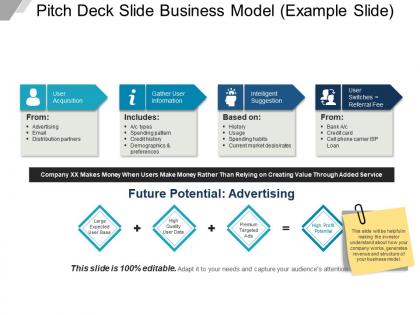
Use this Pitch Deck Slide Business Model template to give a precise summary of your business model. Such a pitch deck slide will be beneficial for making your investors understand the structure of your business model and how your company generates revenue. Provide information about the workings of your organization through this business model. Get this pitch deck template to describe the business model in 4 steps depicting how to acquire users at first, by advertising, emailing, or through distribution patterns. Gather information related to your audience through these business model slides which may include their spending patterns, their credit history, their demographics and their tastes and preferences. Intelligent suggestions, based on users buying behavior, their usage rate and spending habits can be provided which will give an accurate estimate to the audience. Information related to the monitoring part can be presented through this template making it more clear for your audience to understand your business model in one go. Just one click, and your presentations on business models can be given within a few minutes.
People who downloaded this PowerPoint presentation also viewed the following :
Pitch deck slide business model example slide powerpoint guide with all 5 slides:
Make your gesture convincing with our Pitch Deck Slide Business Model Example Slide Powerpoint Guide. They emphasise the critical details.
FAQs for Pitch deck slide business model example
Alright, so for your business model slide you need to nail the basics: revenue streams, who's buying from you, what it costs to run things, and why you're better than competitors. Show how money flows in and what you spend to deliver your stuff. Pricing is where most people mess up - honestly, just be real about what customers will actually fork over. Unit economics matter too because investors want to see you get the math behind each sale. Oh, and don't overcomplicate it! Focus on proving this thing can grow without falling apart.
Honestly, it's all about knowing what gets each type excited. Angels usually bet on founders they like - so talk up your team's background and why you're obsessed with solving this problem. VCs though? They want that massive growth story, so hit them with TAM numbers and how you'll scale fast. Strategic investors are kinda obvious - they're looking for ways this helps their main business. Before each pitch, I'd flip your deck around so their pet interests come first. Oh and definitely stalk their recent deals beforehand - you'll spot patterns in what they actually fund vs what they say they want.
Look, your pitch deck needs a story or investors will just zone out on all the boring business stuff. Don't just dump your business model on them - show them the actual problem people have, then walk them through how you fix it. It's like when you're trying to get someone to watch a new show... you don't recite the cast list, you tell them why they'll be obsessed with it. Make them picture your customers' lives getting better. Honestly, half of fundraising is just making VCs feel smart for "getting" your vision. Connect the dots for them emotionally, then they'll care about your numbers.
Show them your unit economics first - how much each customer brings in vs what it costs to get them. Charts work great here, especially the classic hockey stick for user growth. Customer lifetime value and retention rates are gold. I hate when people just throw around huge market numbers without explaining how they'll actually grab that share, so be specific about your capture strategy. Demonstrate how your fixed costs spread thinner as you grow more users. Then hit them with expansion plans - new markets or products that won't require proportionally bigger costs to execute.
Focus on stuff that shows people actually want your product and will pay for it. CAC, LTV, monthly recurring revenue if you have it, engagement rates. Conversion from trial to paid is huge - investors hate vanity metrics that look impressive but mean nothing. Show your retention numbers and any early revenue you've got. Honestly, even small numbers are fine as long as you're tracking the right things and can show growth trends. I'd stick to maybe 4-5 key metrics max, and make sure you can explain why each one proves your business model works. That's what they really care about.
Honestly, diagrams are a game-changer for pitch decks. Investors get lost in walls of text but they'll instantly understand your revenue flow when it's mapped out visually. I'd start with simple charts for market size, then use icons for different customer segments. The napkin test is real though - if you can't sketch your model in 30 seconds, it's too messy. Process flows are clutch for showing product journey too. Oh and don't jam everything onto one slide, that's rookie stuff. Sketch it out first before going digital.
Honestly, the worst thing you can do is be super vague about how you actually make money. I've seen so many people claim some "trillion dollar market" without showing how they'll realistically get customers - instant credibility killer. Don't hide your revenue model on slide 12 either. Put that stuff upfront. People get way too caught up explaining fancy features instead of the basic value exchange, which just makes investors zone out completely. Your unit economics need to be simple but believable. Oh, and definitely have backup slides ready for when they ask about competitors - because they always will.
Look, investors want proof there's actually money to be made here. Calculate your TAM first - that's if you magically owned the entire market. Then get real with your SAM and SOM numbers. But here's the thing - don't just wave around massive figures like "it's a trillion dollar market!" That makes you look clueless. Back up everything with actual research from legit sources. Show them why the timing's perfect and how you'll realistically grab your slice. Growth trends matter too. Basically, prove you're not just dreaming but you've actually thought this through.
Honestly, just nail the basics - revenue model, customer acquisition costs, and lifetime value if you've got decent data. Growth trajectory matters way more than fancy charts. I'd keep projections to 3-5 years tops and be realistic about it. Investors have seen a million hockey stick projections that crashed and burned, so don't oversell. Show how much funding you need and where it's going. The whole point is proving you actually get your numbers and aren't just throwing darts at a board. Oh, and if you have real traction already, lead with that over future projections every single time.
Pick 2-3 main competitors and make a quick comparison chart showing where you crush them. Don't spend forever hyping up how amazing they are - I've seen way too many founders do that and it's painful to watch. Hit the key differences fast. Like "Company X targets enterprise, but we're laser-focused on SMBs" or whatever your angle is. Could be pricing, features, UX - whatever makes you obviously different. The whole point is positioning yourself in your own lane, then wrapping up with why your specific approach actually makes sense for the market you're going after. Keep it snappy.
Dude, your value prop is everything - it's what makes investors actually give a damn. You've got like 30 seconds max before they zone out, so nail what problem you're solving and why you're better than everyone else. I swear, half the decks I see just list features without ever saying why anyone should care. Big mistake. Honestly, if you can't explain your value in one clean sentence, you're not ready to pitch yet. Investors are drowning in these things, so make yours stick from the first slide.
Start with one clear sentence about how you make money - that's your foundation. Then add just enough detail to prove you're not winging it, but don't turn it into a spreadsheet nightmare (been there, it's painful). Charts work way better than walls of text. Focus on the metrics investors actually care about - CAC, LTV, the usual suspects. Leave out the fluff for now. You can always get into the weeds later, but honestly? Your deck should pass the mom test first - if she gets it, you're golden.
Honestly, customer feedback is your best friend when it comes to pitch decks. Test everything - your pain points, pricing, value prop - with real customers first. Their responses will either validate your slides or show you what needs fixing. The cool thing is investors usually ask the same stuff customers worry about anyway. I'd do focused interviews around your main deck claims. Grab their exact quotes and use real data points to back up your story. Makes everything way more believable than just throwing around generic market stats. Plus you'll feel way more confident when you're actually presenting it.
Get inside their heads and figure out what's gonna keep them up at night about your startup. Market size, competition, whether you can actually pull this off - hit those concerns straight up with real data. Don't sugarcoat everything either. Honestly, investors smell BS from a mile away, so throw in a slide about potential risks and how you'd deal with them. Your financial projections better add up too (I've seen so many founders wing this part and it shows). Oh, and be super clear about what you're asking for and when you need an answer.
Dude, seriously look at Airbnb's original pitch deck - they absolutely crushed the problem-solution thing and made their commission model crystal clear. Uber's is legendary too. Simple "tap for ride" concept but they showed how massive the market could be. Oh and Buffer! Their whole transparent freemium approach was honestly pretty brilliant. Here's what all these decks did right though - they kept the business model stupid simple. No weird charts or confusing revenue breakdowns that make investors' eyes glaze over. Just one clear path to making money and how it grows. That's literally it. Start with that and you're already ahead of most people.
-
Great quality product.
-
Very unique and reliable designs.