

Policy Management Work Plan By Review Schedule





Try Before you Buy Download Free Sample Product
 Impress Your
Audience
 100%
Editable
 Save Hours
of Time


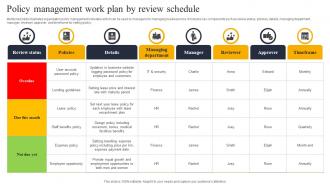
Mentioned slide illustrates organisation policy management schedule which can be used by managers for managing business risks. It includes key components such as review status, policies, details, managing department, manager, reviewer, approver, and timeframe for setting policy.
People who downloaded this PowerPoint presentation also viewed the following :
Policy Management Work Plan By Review Schedule with all 6 slides:
Use our Policy Management Work Plan By Review Schedule to effectively help you save your valuable time. They are readymade to fit into any presentation structure.





FAQs for Policy Management Work Plan
Look, you'll need four main things: clear processes for making policies, one central spot for storage with version control, regular reviews, and decent training plans. Most teams totally blow it on the storage part though - can't just throw everything in a shared folder and hope for the best! Start by figuring out what policies you already have and where they're hiding. Then assign owners for different areas, set up approval workflows, and build in some way to track if people are actually following them. It's kind of like organizing your closet - messy to start but so much better once it's done.
Honestly, start with just one high-risk area - don't try to tackle everything at once or you'll burn out. Set up some kind of tracking system (trust me, the paperwork gets insane fast) to monitor who's done their training and when policies got their last update. Document literally everything - policy sign-offs, incidents, the works. Each policy needs someone who actually owns it, not just some vague "team responsibility" thing. Oh, and actually check if people are following procedures in real life, not just on paper. Regular audits sound boring but they'll save your butt when something goes wrong.
Honestly, tech just handles all the boring stuff that used to drain your time. Set up workflows so policy approvals happen automatically. AI can catch compliance issues early - way better than dealing with problems later. Real-time dashboards beat digging through email chains any day. Version control is huge though - you'll never wonder if you're reading the current policy or some random old draft again. The analytics piece is pretty cool too since you can see which policies people actually use and find the gaps. I'd digitize what you have first, then add the fancy automation stuff.
Don't wait around for regulations to blindside you - been there, done that when GDPR hit and we were totally unprepared! Set up alerts from the regulatory bodies that matter to your industry. Assign someone (or a few people) to actually watch for changes. When updates come out, you need a quick process: figure out how it affects you, update your policies fast, tell your team what's different, and document it all. Honestly, the documentation part is boring but you'll thank yourself later during audits. Make it part of your regular routine instead of scrambling every time.
Honestly, break those policies into smaller chunks first - nobody's reading a 20-page document. Plain language beats legal speak every time. Add some visuals like flowcharts because people are visual learners (shocking, I know). Interactive training sessions actually work way better than just emailing PDFs that'll sit in someone's downloads folder forever. Make everything searchable on mobile too. The real trick? Use actual workplace scenarios so people get how this stuff applies to their day-to-day work. Oh, and don't try fixing every policy at once - just tackle your most important ones first or you'll burn out.
Honestly, start with the basics - are people actually following your policies? Check compliance rates first. Then see how fast employees can find what they need when they're scrambling for answers. Training completion rates tell you a lot too. If incidents keep happening despite having policies, something's broken. Also track how long policy updates take - nobody wants to deal with a system that's a nightmare to change. I'd throw in some quick team surveys about whether things make sense. You don't need fancy metrics right away though. Grab whatever data's easy to get now and build from there.
Ugh, the volume is insane - regulations never stop changing and you're constantly behind. My team gets scattered across different priorities, so policy stuff gets pushed down until there's some crisis. Getting people to actually care about revisions? Good luck with that mess. Then you've got the nightmare of making sure updates actually reach everyone in different departments. I swear, half the time people don't even know new policies exist. Honestly though, quarterly review cycles save your sanity. Assign someone to own it instead of doing everything reactively - way less stressful.
Honestly, visual templates are a game changer for policy training. Nobody wants to read through pages of dense text - I mean, who has time for that? Flowcharts and infographics actually make sense to people. Your brain retains visual stuff way better anyway. You can build standardized templates for different policy types, which keeps everything consistent across departments. Complex procedures become these simple step-by-step visuals that people actually follow. The biggest win? Employees will genuinely pay attention instead of just pretending to read through boring documents. I'd start with your most critical policies first and convert those.
Policy management and risk management go hand in hand - you can't really do one without the other. Your policies exist to handle the risks your company faces. When developing new policies, you're basically writing down how to deal with specific risk scenarios. Honestly, most regulatory policies exist because someone somewhere screwed up badly and lost a ton of money. Your risk assessments should tell you which policies need updates, and when people violate policies, that's a red flag for new risks. I'd start by figuring out which policies connect to your biggest risks.
Honestly, start by figuring out what's broken in your current setup first. Get your remote people involved - they know what actually sucks about the policies right now. Focus on results instead of micromanaging hours, but be clear about when everyone needs to be online for meetings. Cover the boring but necessary stuff like data security and equipment rules since people are literally working from coffee shops these days. Oh, and nail down your hybrid schedule expectations early - like which days teams should actually be in the office together. The whole "everyone must be present" thing is pretty much dead at this point.
Okay so first thing - set up folders by year and policy type. When you roll out new versions, immediately dump the old ones in there with all the approval dates and revision history intact. Auditors are gonna want that stuff later, I promise you. Use the same naming system for everything so people can actually find things. I'd start with your newest outdated policies since they're way easier to sort through. Set up quarterly reminders to go through your archive - you can probably toss anything that's legally safe to delete. Honestly the whole system falls apart if you don't stay on top of it regularly.
Okay so first thing - always start with your purpose and scope, then get into the actual requirements. Break everything up with bullet points because nobody wants to read massive paragraphs of policy stuff. Simple language is key here, don't get all technical unless you have to. I'd definitely add real examples too - like actual scenarios people might face. That way it's not just some abstract rule floating around. Oh and use descriptive headings so people can skip to whatever section they actually need. Trust me, your team will thank you for not making them hunt through walls of text to find one simple answer.
You definitely want stakeholder feedback - like, way more than you probably think. The people actually doing the work will catch problems you'd never see coming. I've watched policies crash and burn because leadership never bothered asking anyone on the ground floor what made sense. Get their input early though, not after everything's already written in stone. Trust me, front-line staff know where the real obstacles are. Also grab feedback throughout the whole process - you'll save yourself major headaches later when implementation rolls around.
Honestly, leadership has to walk the walk first - if your CEO's breaking rules, forget about everyone else following them. Make consequences real and actually follow through (I've seen too many companies with policies that are basically suggestions). People need to get WHY the policy exists, not just what it says. Check in regularly instead of waiting for problems. Here's the thing though - celebrate people who do it right, don't just hammer the ones who mess up. Makes it feel less like you're being watched all the time, you know?
Honestly, the biggest thing right now is AI handling policy automation - like, actually useful stuff, not just buzzword nonsense. Real-time compliance monitoring is huge too. Most places are ditching those old static policy docs for systems that actually adapt when regulations change. If you're still stuck with Word docs and SharePoint... yikes, that's rough. Cloud-based management is pretty much standard now. Oh, and since everyone's still working remotely, mobile policy access and self-service portals are everywhere. I'd start by looking at what tech you've got and figure out where automation could save you the most headaches.
-
Great quality product.
-
My presentations were a bit amateur before I found SlideTeam’s designs. I’ve been able to find slides for nearly every topic I’ve had to present. Thanks, Slideteam!