

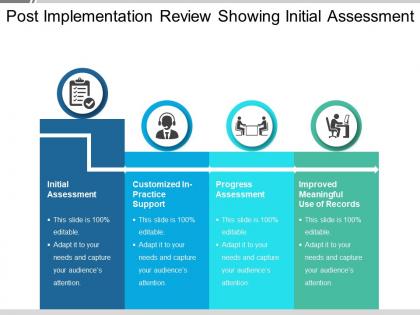
Post implementation review showing initial assessment




Try Before you Buy Download Free Sample Product
 Impress Your
 Audience
 100%
100% Editable
 Save Hours
 of Time


Sign the contract with our Post Implementation Review Showing Initial Assessment. They will deliver wherever and whenever you want.
People who downloaded this PowerPoint presentation also viewed the following :
Post implementation review showing initial assessment with all 5 slides:
Presentations that thrill are only a click away. Our Post Implementation Review Showing Initial Assessment are ready to use in seconds.




FAQs for Post implementation review
The primary objectives of conducting a Post Implementation Review include evaluating project success against original goals, identifying lessons learned, assessing resource utilization, measuring stakeholder satisfaction, and documenting best practices for future initiatives. These comprehensive assessments enable organizations to streamline future project delivery, enhance operational efficiency, and build institutional knowledge, with many companies finding that systematic PIRs significantly improve subsequent project outcomes and strategic decision-making.
Organizations ensure stakeholder participation in PIR processes by establishing clear communication protocols, scheduling sessions at convenient times, defining specific roles and responsibilities, and demonstrating the direct value to each participant's objectives. Through structured interviews, collaborative workshops, and digital feedback platforms, teams capture comprehensive insights from project managers, end-users, and executives, while emphasizing how their input drives future project success and organizational learning.
Post Implementation Review metrics should include schedule adherence, budget variance, scope completion, quality deliverables, stakeholder satisfaction, and business objective achievement. These assessments enable organizations to measure ROI, identify process improvements, and enhance future project outcomes, with many companies finding that comprehensive metric evaluation ultimately delivers better resource allocation, operational efficiency, and strategic competitive advantage.
A PIR evaluates actual project outcomes against planned objectives after completion, while initial project evaluations assess feasibility, risks, and potential benefits before implementation begins. Through post-completion analysis, organizations can measure real performance metrics, identify gaps between expectations and results, and capture lessons learned, ultimately enabling better project planning and resource allocation for future initiatives.
Common challenges during Post Implementation Review include insufficient data collection, stakeholder resistance to feedback, inadequate baseline metrics, timeline pressures, and biased reporting. These obstacles can compromise review effectiveness by limiting honest assessment, reducing learning opportunities, and hindering future project improvements, with many organizations finding that structured frameworks and independent facilitators help overcome resistance while ensuring comprehensive evaluation.
Lessons learned during PIR can be effectively documented through structured templates, detailed case studies, visual dashboards, and standardized reports that capture both successes and challenges. These documentation methods enable organizations to create centralized knowledge repositories, conduct cross-departmental training sessions, and develop best practice guidelines, ultimately delivering improved project outcomes and enhanced organizational learning across future initiatives.
Feedback serves as the foundation of Post Implementation Reviews, providing critical insights from stakeholders, end-users, and project teams about system performance, user experience challenges, and operational impacts. Through structured feedback collection from departments like IT, finance, and operations, organizations identify improvement opportunities, validate successful implementations, and inform future project strategies, ultimately enhancing organizational learning and competitive advantage.
A PIR contributes to continuous improvement by identifying lessons learned, documenting best practices, analyzing performance gaps, and creating actionable recommendations for future projects. These insights enable organizations to refine methodologies, enhance resource allocation, and streamline processes, with many project management offices finding that systematic PIR implementation ultimately delivers higher success rates and improved stakeholder satisfaction.
Tools for streamlining PIR processes include project management software like Microsoft Project, documentation templates, stakeholder feedback surveys, performance dashboards, and automated reporting systems. These technologies enhance efficiency by centralizing data collection, standardizing evaluation criteria, and facilitating collaborative review sessions, with many organizations finding that integrated platforms ultimately deliver faster assessments and more actionable insights.
PIR findings should be communicated to senior management through executive summaries highlighting key achievements, lessons learned, budget variances, and strategic recommendations for future projects. These reports enable leadership to assess project ROI, identify process improvements, and make informed decisions about resource allocation, while many organizations find that structured PIR presentations enhance project governance and organizational learning.
Post Implementation Reviews should typically be conducted 3-6 months after project completion, allowing sufficient time for systems to stabilize and initial results to emerge. This timeline enables organizations to capture meaningful performance data, identify operational efficiencies or challenges, and assess whether strategic objectives are being met, ultimately delivering actionable insights for future project optimization.
Organizations balance thoroughness with efficiency by establishing clear PIR scope boundaries, using standardized templates and checklists, and focusing on high-impact areas rather than exhaustive coverage. Many companies streamline the process through automated data collection, structured stakeholder interviews, and time-boxed review sessions, ultimately delivering comprehensive insights while minimizing resource drain and accelerating future project cycles.
Effective PIR meetings require structured agendas focusing on objectives, outcomes, and lessons learned, while encouraging open dialogue through neutral facilitation and blame-free environments. Organizations should invite diverse stakeholders, use data-driven insights to guide discussions, and document actionable recommendations, with many teams finding that dedicated follow-up sessions enhance accountability and ensure continuous improvement across future projects.
PIR scope varies significantly, with IT projects focusing on system performance, user adoption, data migration accuracy, and integration effectiveness, while construction projects emphasize safety compliance, structural integrity, environmental impact, and regulatory adherence. These different approaches reflect each sector's unique risk profiles and success metrics, with IT reviews prioritizing functionality and scalability, and construction reviews emphasizing durability and safety standards.
A well-executed PIR significantly enhances future project planning by identifying successful methodologies, resource allocation strategies, and risk mitigation approaches that can be replicated across initiatives. These insights streamline project execution by enabling organizations to avoid repeated mistakes, optimize timelines, and improve stakeholder communication, with many companies finding that systematic PIR processes ultimately deliver faster project cycles and higher success rates.
-
Good research work and creative work done on every template.
-
Innovative and Colorful designs.