

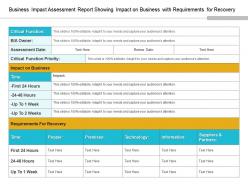
Business impact assessment report showing impact on business with requirements for recovery





Try Before you Buy Download Free Sample Product
 Impress Your
 Audience
 100%
100% Editable
 Save Hours
 of Time


Earn instantaneous appreciation with our Business Impact Assessment Report Showing Impact On Business With Requirements For Recovery. It generates immediate applause.
People who downloaded this PowerPoint presentation also viewed the following :
Business impact assessment report showing impact on business with requirements for recovery with all 5 slides:
Brand your thoughts with our Business Impact Assessment Report Showing Impact On Business With Requirements For Recovery. Make a mark in the minds of your audience.




FAQs for Business impact assessment report showing impact on business with
A thorough business impact assessment includes risk identification, dependency mapping, recovery time objectives, resource requirements, and financial impact analysis. These components work together by evaluating critical processes, quantifying potential losses, and establishing recovery priorities, with many organizations finding that comprehensive assessments ultimately streamline continuity planning and minimize operational disruptions.
Organizations can prioritize risks by evaluating probability and potential impact severity, considering recovery time objectives, regulatory requirements, and financial exposure. Through risk matrices and stakeholder input, companies systematically rank threats by business criticality, with many finding that customer-facing operations and revenue-generating processes require immediate attention, ultimately enabling strategic resource allocation for maximum operational resilience.
Stakeholder engagement ensures comprehensive data collection, identifies hidden risks and dependencies, and validates assessment accuracy through diverse perspectives across departments, customers, and partners. Through structured interviews, surveys, and workshops, organizations capture critical insights that internal teams might overlook, while building buy-in for continuity strategies, ultimately delivering more robust assessments and smoother implementation during actual disruptions.
Business impact assessments should be conducted annually as a baseline, with additional reviews triggered by significant organizational changes, new regulations, technology implementations, or market shifts. Many organizations find that quarterly lightweight reviews complement comprehensive annual assessments, ensuring risk profiles remain current while maintaining operational efficiency, ultimately delivering better preparedness and strategic decision-making capabilities.
Common pitfalls include inadequate stakeholder engagement, underestimating recovery timeframes, overlooking interdependencies between systems, insufficient data collection, and focusing solely on IT rather than broader business processes. These oversights can compromise assessment accuracy, with many organizations finding that involving cross-functional teams and conducting regular updates ultimately delivers more comprehensive risk mitigation and strategic resilience planning.
Technology and data analytics enhance business impact assessment accuracy by providing real-time data collection, predictive modeling capabilities, automated risk analysis, and comprehensive scenario planning tools. Through advanced analytics platforms, organizations streamline assessment processes, minimize human error, and generate more precise impact forecasts, with many financial institutions and healthcare systems finding that these technologies ultimately deliver faster decision-making and improved strategic planning.
Business impact assessment frameworks include ISO 22301, NIST Guidelines, COBIT, COSO Enterprise Risk Management, and industry-specific standards like FFIEC for financial services. These frameworks streamline assessment processes by providing structured methodologies, standardized risk categories, and compliance alignment, with many organizations finding that combining multiple frameworks delivers comprehensive risk visibility and enhanced regulatory adherence.
Business impact assessments influence strategic decision-making by quantifying potential risks, identifying critical dependencies, and prioritizing resource allocation based on operational importance. Through comprehensive analysis, organizations can make informed decisions about investments, contingency planning, and business continuity measures, while ensuring resources are directed toward protecting the most vital functions, ultimately enhancing operational resilience and strategic competitive advantage.
Business impact assessments contribute to compliance by identifying critical processes, data protection requirements, regulatory dependencies, and operational vulnerabilities that must meet specific standards. Through systematic evaluation, organizations can demonstrate due diligence, establish recovery priorities aligned with regulatory timeframes, and maintain detailed documentation, with many financial services and healthcare institutions finding that comprehensive assessments streamline audit processes while ensuring continuous regulatory adherence.
Effectiveness metrics include recovery time objectives, maximum tolerable downtime, financial loss calculations, operational disruption measurements, and compliance adherence rates. These assessments enable organizations to quantify potential impacts across departments, prioritize critical functions, and allocate resources strategically, with many enterprises finding that comprehensive metrics ultimately streamline continuity planning and enhance organizational resilience.
Small businesses can streamline their business impact assessment processes by focusing on core operations, using simplified risk matrices, and leveraging cost-effective digital tools rather than complex enterprise software. While larger enterprises require comprehensive multi-departmental frameworks, small businesses benefit from agile, owner-driven assessments that prioritize critical functions, enabling faster decision-making and resource allocation with significantly lower overhead costs.
**INPUT**: What specific methodologies are recommended for evaluating operational disruptions in a business impact assessment? **OUTPUT**: Recommended methodologies include quantitative risk analysis, dependency mapping, scenario modeling, recovery time objectives assessment, and financial impact calculations. These approaches streamline evaluation by identifying critical processes, measuring downtime costs, and prioritizing recovery strategies, with many organizations finding that structured assessments ultimately deliver enhanced resilience and competitive advantage.
A business impact assessment identifies critical processes, recovery time objectives, and potential financial losses during disruptions, providing essential data for prioritizing disaster recovery investments. Through systematic analysis of operational dependencies, resource requirements, and customer impact scenarios, organizations can develop targeted recovery strategies, allocate resources effectively, and establish realistic timelines, ultimately ensuring business continuity while minimizing downtime costs.
Training and awareness ensure stakeholders understand BIA objectives, methodologies, and their specific roles in data collection and process evaluation. Through comprehensive education programs, organizations enhance assessment accuracy, improve cross-departmental collaboration, and accelerate recovery planning development, with many finding that well-trained teams deliver more thorough impact analyses and ultimately stronger business continuity strategies.
Lessons learned from previous incidents can be incorporated by analyzing past vulnerabilities, updating risk scenarios based on actual impact data, and refining recovery time objectives through documented response experiences. Organizations integrate these insights by revising assessment methodologies, enhancing threat modeling with real-world examples, and strengthening contingency planning, ultimately delivering more accurate risk profiles and robust business continuity strategies.
-
Great experience, I would definitely use your services further.
-
Excellent Designs.