

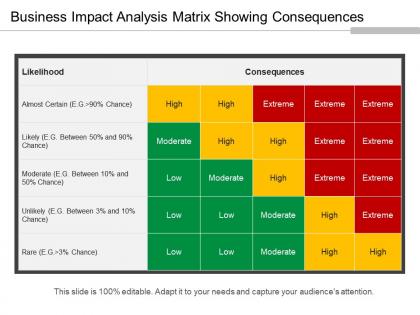
Business impact analysis matrix showing consequences




Try Before you Buy Download Free Sample Product
 Impress Your
 Audience
 100%
100% Editable
 Save Hours
 of Time


Build greater ability to absorb with our Business Impact Analysis Matrix Showing Consequences. Your capacity will get enlarged.
People who downloaded this PowerPoint presentation also viewed the following :
Business impact analysis matrix showing consequences with all 5 slides:
Introduce interesting fun and games with our Business Impact Analysis Matrix Showing Consequences. Enable children to feel joy.




FAQs for Business impact analysis
So you'll want to start by figuring out which business functions are actually critical - like what would make everyone panic if it went down. Map out how your systems depend on each other (this part's honestly kind of a pain but worth it). Calculate the money you'd lose over time and figure out how long each function can realistically stay down. Don't get too crazy with the financial stuff at first - just focus on lost revenue, fines, and reputation hits. Interview your department heads about what they absolutely can't function without for hours vs days. Also think through what you'd need for recovery: people, tech, space.
A BIA looks at what happens *after* things go sideways - like how much money you'd lose or which customers get screwed over. Risk assessment is the opposite. It tries to figure out what might cause problems before they hit. So one's about consequences, the other's about causes. Honestly, I'd start with the BIA because it shows you what actually matters to your business. Then you can focus your risk assessment on protecting those critical areas instead of trying to guard against everything under the sun. They work together really well once you get the hang of it.
Look, the BIA is where you start everything - it shows what actually breaks your business when disaster hits. You'll map out which systems are critical and how long each one can stay down before you're screwed. Also tells you how outages cascade through different departments. Without doing this first, you're flying blind on recovery priorities. Trust me, you don't want to be the guy who restored email before the payment processor because it "seemed important." I've seen that happen and it's painful to watch. Do your BIA homework before writing any actual recovery procedures.
So basically you map out every business process, then figure out which ones would screw you over most if they crashed. Interview your department heads, check revenue streams, see how everything connects. It's like getting an X-ray of your whole company - honestly pretty shocking what you find. You might discover payroll is way more time-sensitive than expected, or that crappy old system everyone hates is secretly keeping everything running. Oh, and you'll definitely separate what's actually critical from stuff that just feels important. Start with listing everything out, then imagine your nightmare scenarios and work backwards from there.
Most companies go with three main approaches for BIA - quantitative, qualitative, or mixing both. Hard numbers work great when you can actually calculate revenue loss or recovery costs. But reputation damage? Good luck putting a dollar sign on that mess. That's where qualitative methods shine. Honestly, I'd start simple with a qualitative framework first. You can always layer in the quantitative stuff later once you've got decent data. Hybrid approaches are pretty popular since some impacts are just impossible to measure precisely. Way less headache than trying to force numbers on everything upfront.
Update it yearly at minimum, but that's honestly not enough. Big changes like new systems, staff turnover, or process shifts? Those need immediate updates. I've watched companies get completely screwed because they treated their BIA like some dusty binder on a shelf - terrible idea. Near-misses are actually great wake-up calls to check if your assumptions still hold up. Oh, and don't wait for your annual review if something major shifts in how you operate. Your BIA should reflect reality, not what your business looked like two years ago.
Look, skipping a BIA is honestly a recipe for disaster. When something bad happens, you'll have zero clue which systems actually matter for keeping the lights on. Picture this: you're frantically trying to fix everything at once while your business bleeds money. Recovery times? Total guesswork. Resource planning? Good luck with that. The regulatory headaches alone will make you wish you'd done this upfront. Plus - and this bit always gets overlooked - insurance companies get real picky about payouts when you can't prove what was critical. Trust me, spending time on a BIA now beats the alternative of scrambling later when everything's on fire.
Dude, ditch those manual surveys - they're such a pain. Get automated tools that just pull data straight from your systems instead. Those risk assessment platforms are actually pretty solid for mapping out dependencies and calculating impact scores. Way better than wrestling with spreadsheets all day. Cloud-based BIA software makes collaborating with stakeholders way less of a headache too. Everything updates in real-time which is nice. Oh, and visualization tools are clutch - executives love charts they can actually make sense of. I'd start by figuring out what's eating up most of your time manually, then find tools to automate those specific things first.
Definitely start with business process owners - they actually know what breaks. Then grab IT teams, operations managers, and someone from senior leadership. Finance is crucial since they get the revenue impact piece. HR matters if you're dealing with processes that depend on staffing levels. Customer service reps are honestly gold for this stuff because they're the first ones customers complain to when things go sideways. Legal and compliance can't be optional if you're in a regulated space. The trick is finding people who really understand day-to-day operations, not just the ones who sit in meetings about it. I'd work outward from process owners first.
Honestly, getting people to actually show up and give you real data is the worst part - suddenly everyone's swamped until something breaks. Departments will either act like they're the most critical thing ever or downplay their recovery times because politics, you know? Then you're stuck with zero documentation and everyone tells you different things about what connects to what. Oh, and good luck keeping it updated when processes change every other week. My advice? Get the executives on board first, then be super clear about how much time you need from people upfront. Trust me on that last part.
Regulators eat this stuff up - a solid BIA shows you've mapped out your critical processes and actually have recovery plans ready. SOX, GDPR, most industry standards require you to identify key business functions and assess operational risks anyway. Your BIA covers exactly that. Two birds, one stone. Board meetings get way easier too since you can prove you understand your dependencies and have real numbers on your risks. Honestly, I've seen companies struggle through audits without one. Keep yours updated and compliance reviews become almost boring. The auditors basically check the box and move on.
Start with Revenue Per Hour - that's how much cash you're hemorrhaging every hour when systems are down. Trust me, once executives see that number they suddenly care a lot more about disaster planning. Then look at your Recovery Time Objective (how long you can be offline before things get really ugly) and Recovery Point Objective (how much data loss is acceptable). RPH is honestly the easiest one to calculate and it grabs attention fast. I always lead with that metric since it gets people moving. The other two are super important but RPH speaks their language, you know?
A BIA shows you exactly which business functions cost the most when they go down. That way you're not just throwing money everywhere hoping it sticks. Look at the revenue impact data - that tells you where to invest in backup systems and faster recovery. Honestly, most companies waste so much budget protecting stuff that doesn't even matter. Short downtimes? Maybe you don't need the expensive solutions there. But if something kills your cash flow, that's where you spend. Use those impact rankings to prioritize what actually deserves your continuity budget.
Look, BIAs actually work when done right. Target bounced back way faster from that massive 2013 breach because they'd already mapped out their critical stuff and had plans ready to go. Southwest figured out which systems need backup power first during outages - makes sense when you're bleeding money every minute you're down. This smaller manufacturer I know about? Their BIA showed them how crazy dependent they were on certain suppliers, so they spread things out before it bit them. Honestly, most people think BIAs are just boring paperwork, but they're basically your cheat sheet for recovering faster than everyone else when everything hits the fan.
Ditch the PowerPoint death trap - nobody's paying attention anyway. Instead, do hands-on workshops where you actually show people what BIA means for *their* specific job. Tabletop exercises work great because teams can walk through real scenarios together and figure out their critical processes. I'd give department leads ownership of their own sections - makes it way less like something being forced on them. Oh, and create simple templates they'll actually use later. The whole thing should feel collaborative, not like some corporate mandate. People need to ask questions and see where they fit in, otherwise you're just wasting everyone's time.
-
Professional and unique presentations.
-
Amazing product with appealing content and design.