

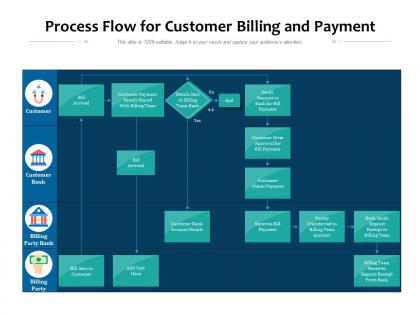
Process flow for customer billing and payment




Try Before you Buy Download Free Sample Product
 Impress Your
 Audience
 100%
100% Editable
 Save Hours
 of Time


Our Process Flow For Customer Billing And Payment are topically designed to provide an attractive backdrop to any subject. Use them to look like a presentation pro.
People who downloaded this PowerPoint presentation also viewed the following :
Process flow for customer billing and payment with all 2 slides:
Use our Process Flow For Customer Billing And Payment to effectively help you save your valuable time. They are readymade to fit into any presentation structure.

FAQs for Process flow for customer
Honestly, start with your invoicing - make those line items super detailed so there's no confusion later. Give people options to pay you (cards, ACH, whatever works). Set up recurring billing if you've got regular clients because manually creating invoices every month is just annoying. Payment terms need to be clear from day one - can't stress this enough. Get some kind of system to track everything instead of using random spreadsheets. Oh, and definitely have a plan for chasing down late payments because people will drag their feet. The whole point is making it dead simple for customers to actually pay you while you stay on top of your cash flow.
Honestly, automation is a lifesaver for billing mistakes. No more typos from manual entry or those awkward duplicate invoices that make you look unprofessional. The system just pulls straight from your data, so there's way less room for human error. What I love most? It catches weird amounts or missing info before anything goes out the door. Your team stops doing mindless data entry and actually handles the tricky stuff that needs a human brain. Oh, and validation rules are clutch - they'll flag anything suspicious automatically. Start with whatever billing tasks make you want to bang your head against the wall first.
Oh man, where do I start? Late payments are the worst - you'll be chasing people constantly and it's honestly draining. Manual invoice mistakes happen way too often. Then there's clients who magically forget your payment terms (sure, right). Your cash flow gets all wonky when accounts are overdue. Payment processing can be slow as hell, plus you get disputed charges and people still writing checks in 2024. Don't even get me started on when your billing software doesn't play nice with your accounting system. My advice? Automate everything you can and be super clear about payment rules from day one.
Dude, seriously - picking the wrong payment gateway is such a pain. You want one that actually plays nice with your current setup. Good ones will process stuff faster, cut down on failed payments, and save your finance people from doing tons of manual work. I learned this the hard way at my last job lol. Make sure it has automated retry for declined cards and real-time reporting. Bulk processing is huge too if you're dealing with lots of transactions. Trust me, your team will be way happier when they're not stuck reconciling payments for hours every month.
Dude, PCI DSS compliance is your starting point - can't skip that one. Tokenization replaces card numbers with random tokens, which is honestly brilliant. Encrypt everything in transit and at rest. Anyone touching payment systems needs multi-factor auth, no exceptions. Never store full card numbers or CVV codes though - let your payment processor deal with that headache. I learned that the hard way at my last job. Log all transactions and watch for weird activity. Breaches will bankrupt you faster than you think, so don't mess around with this stuff.
Honestly, automated workflows are a game changer here. Set thresholds so smaller invoices (maybe under $500?) go straight through while bigger ones need manager approval. Digital systems beat email chains every time - way less back and forth. Make sure invoices have complete info upfront so they don't bounce back. Missing purchase order numbers are the worst for this. Set deadlines for each step and automate reminders when approvers are slow. First thing though? Map your current process. Find where stuff gets stuck - that's where you'll save the most time.
Dude, you'll save so much time with invoicing software. Takes all that manual stuff - creating invoices, chasing payments, updating records - and does it automatically. I used to waste hours on spreadsheets before switching. Way fewer mistakes too since you're not copying numbers around constantly. Most of them sync with QuickBooks or whatever accounting thing you use, which is nice. FreshBooks is solid if you want something simple. Honestly even the cheap plans are worth it - I probably get back like 5+ hours a month now that I'm not doing everything by hand.
Analytics can totally help you spot patterns in your payment data - it's actually pretty powerful stuff. Check which customers are always late and what payment methods work best. Also timing matters way more than people think! Some companies cut overdue payments by 30% just by sending reminders at the right time. Your aging reports will show you risky accounts before they blow up. Honestly, predictive models are worth setting up to catch potential defaulters early. The real magic happens when you automate alerts based on all this data so you're not scrambling to fix problems after they happen.
Dude, you absolutely need multiple payment options. Cart abandonment drops like crazy when people can actually pay how they want to. Some folks won't touch their credit cards online, others live by PayPal or Apple Pay. I learned this the hard way with my first store - lost so many sales because I only did Stripe. Bank transfers work great for B2B stuff too. Start with whatever your customers use most, then add more based on what they're asking for. Trust me, having just one option is basically turning money away at the door.
Dude, transparent billing is huge for building trust. People hate surprise charges - like, who doesn't panic a little when opening bills? Break everything down clearly and explain fees upfront. Your customers will actually relax instead of constantly wondering what you're hiding. When people can see exactly where their money goes, they stick around longer. Honestly, I think most companies overcomplicate their invoices on purpose. Don't be that guy. Make yours so simple your mom could read it without calling you three times asking what something means.
Honestly, just be super upfront about money stuff from day one. Write down your payment terms before starting any work - trust me on this one. Your invoices should be stupid simple to understand, and send them on the same day every time. I can't tell you how many people I know who've gotten burned because they were lazy about invoicing. Oh, and respond fast when clients have billing questions. Sounds obvious but you'd be surprised how many people drag their feet. Better to overcommunicate than deal with angry customers later.
Ugh, regulatory stuff is such a pain but you can't ignore it. PCI DSS controls how you process credit cards, GDPR handles data privacy, plus there's tons of financial regs depending on your sector. Short version: you'll need solid security measures, detailed audit trails, and super transparent billing statements with all the required disclosures. I learned this the hard way at my last job - we had to basically rebuild our whole system because compliance wasn't involved from day one. Definitely loop in your compliance people before making any billing changes. Trust me on this one.
First thing - check your cash flow situation because that's what really matters. Industry norms are worth knowing so you don't look weird to clients or price yourself out. I'd definitely look at how reliable each customer is with payments. Companies get screwed all the time by being too nice with terms upfront, honestly. Project size plays a role too. With clients you've worked with forever? Maybe longer terms are fine. New people though - nah, keep it tight. Oh and start stricter than you think you need to. You can always loosen up later once you see how they actually pay.
Look, customer feedback is like having a cheat sheet for fixing billing problems you didn't even know were there. Survey people after they pay or track where they bail out of your payment process. Angry complaints? Those are actually gold - they tell you exactly what's busted. Maybe your mobile checkout crashes constantly, or invoices don't make sense, or that extra verification step pisses everyone off. Just set up a quick feedback form and check it monthly for patterns. Then actually do something about what you find (this part's key).
Honestly, smooth billing is a game-changer. Your cash flow becomes predictable, customers stop freaking out about surprise charges, and you'll spend way less time putting out fires. People really do appreciate knowing when their bill's coming - money stuff makes everyone nervous. Short bursts work better than long sentences sometimes. It's boring admin work but it quietly fixes so many other problems down the line. Better retention, easier planning, fewer angry emails. I'd start by writing down your current process and spotting where things usually break. Trust me, it's worth the upfront effort even though it feels tedious.
-
Great designs, Easily Editable.
-
Understandable and informative presentation.
-
Very well designed and informative templates.