

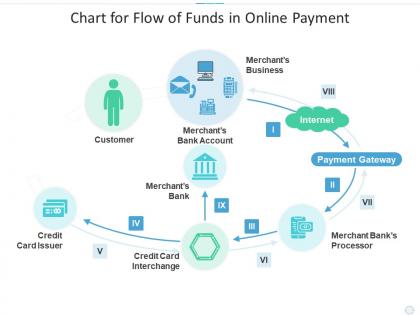
Chart for flow of funds in online payment




Try Before you Buy Download Free Sample Product
 Impress Your
 Audience
 100%
100% Editable
 Save Hours
 of Time


Our Chart For Flow Of Funds In Online Payment are topically designed to provide an attractive backdrop to any subject. Use them to look like a presentation pro.
People who downloaded this PowerPoint presentation also viewed the following :
Chart for flow of funds in online payment with all 2 slides:
Use our Chart For Flow Of Funds In Online Payment to effectively help you save your valuable time. They are readymade to fit into any presentation structure.

FAQs for Chart for flow of funds
So basically there's three main steps: authorization, capture, settlement. Authorization happens first - that's when the customer's bank puts a hold on their money after they click pay. Capture comes next (usually automatic, but sometimes you'll do it manually for stuff like pre-orders). Settlement is when the actual money moves through all the payment networks to your account. Takes about 1-3 business days total. Oh and don't forget - those authorizations expire after a few days if you don't capture them, which is honestly kind of annoying but whatever.
So here's the deal with payments - authorization happens super fast, like within seconds. Your processor basically asks the customer's bank "hey, do they have money and is this legit?" Bank says yes or no. If it's approved, the money gets frozen in their account but doesn't actually move to you yet. That part (called settlement) takes 1-2 days usually. Don't ship anything until you get that final settlement though - I learned that one the hard way! Authorization just holds the cash, it's not yours until later.
So basically, payment gateways are like the middleman between your site and the banks. They encrypt customer card info, send it to processors, then bounce the approval back to you. It's kind of like those old swipe machines but actually secure lol. They also do fraud checks and handle PCI compliance stuff (which is honestly a nightmare to deal with yourself). Plus they convert different payment types so your system can read them. Just pick one that plays nice with whatever you're already using and supports the payment methods people actually want - nobody wants to abandon their cart because you only take one random payment app.
So basically, your money takes different paths depending on how you pay. Credit cards bounce through like 3-4 middlemen (your bank, Visa/Mastercard, the merchant's processor) which is why it takes 2-3 days to actually settle. PayPal and Apple Pay just layer on top of that mess, though they feel instant. Bank transfers skip the card networks but are weirdly slower somehow. Crypto's totally different - it's just peer-to-peer with no banks involved, which honestly still blows my mind. The annoying part? All these routes affect when you actually get your money and how much you'll pay in fees.
So basically you've got encryption (TLS/SSL stuff) protecting data as it moves around, plus tokenization that swaps out actual card numbers with fake tokens. Multi-factor authentication is huge too. The fraud detection algorithms are honestly kind of creepy - they'll flag stuff before you even realize something's wrong. PCI compliance is required if you're touching card data at all, which is a pain but necessary. Secure APIs and network segmentation help isolate everything. Don't put all your eggs in one basket though - layer multiple protections since hackers are constantly evolving their tactics.
So basically international payments are a pain because there's way more middlemen involved. Your money has to go through correspondent banks and all these networks, and each one takes their fee. Currency conversion is honestly the worst part - you're getting hit with FX spreads AND conversion fees that can easily cost you 2-4%. Settlement takes forever too, like 1-5 days instead of same-day. I'd definitely ask your processor to show you the exact routing they use. That way you'll know where all these fees are coming from and you can push for better rates if you're doing decent volume.
Oh man, payment regulations are such a maze. PCI DSS controls how you handle card info, plus if you're touching Europe there's PSD2 with all its authentication requirements. AML rules mean you're constantly verifying identities and flagging weird transactions - honestly feels like you're playing detective half the time. Some countries won't even let payment data leave their borders, which is fun to discover later. My advice? Map out exactly which rules hit your payment flows before you get too deep into building anything.
Ugh, chargebacks are the worst. So basically what happens is the payment processor yanks the money right back out of your merchant account - you lose the original sale AND they hit you with a fee too. Super fun, right? The money just flows backwards through the whole chain: your account → processor → customer's bank. Set up chargeback alerts ASAP so you can fight the bogus ones fast. Oh and definitely keep some extra cash sitting in your account because these reversals happen crazy quick. Like, faster than you'd expect.
Oh man, payment tech is moving crazy fast right now. FedNow and RTP let you transfer money instantly - no more waiting 2-3 days like a caveman. Blockchain stuff is interesting too, stablecoins can skip banks entirely, but it's mostly just crypto companies using that right now. API-first processors are pretty slick, they'll route your payments through different channels automatically. Speed, cost, whatever you prioritize. When you're shopping around for payment providers, definitely grill them about real-time options. Settlement speeds can make or break your cash flow - learned that the hard way at my last job.
So payment processors are like your middleman for all the money stuff. They jump in when someone buys from you and handle the messy parts - verifying cards, checking for sketchy fraud, talking to banks to actually move the cash. Honestly, it's way more complicated than it should be in 2024. You don't have to learn banking regulations or figure out why someone's card got declined. They batch everything together and settle it so you just get paid without the headache. Pretty much lets you focus on your actual business instead of becoming a finance expert overnight.
Look, crypto basically lets you skip all the bank BS - payments go straight wallet to wallet instead of through like 5 different middlemen. You're talking minutes instead of days for settlements, plus way cheaper fees. The blockchain thing gives you crazy transparency too. Honestly though, most companies still cash out to regular money super fast because crypto prices are all over the place. Where it really shines is international stuff - no more dealing with currency swaps or waiting forever for correspondent banks. I'd say just try it with some of your overseas payments first, see how it goes.
Honestly, start with settlement times - that's your biggest quick win. Find processors doing next-day or same-day payouts instead of waiting 2-3 days. Your cash flow will thank you. Also clean up that checkout process because abandoned carts are killing you. Accept digital wallets too - they fail way less than cards for some reason. Oh, and set up retry logic for failed payments. You'd be shocked how many work on the second try. I probably should've mentioned that first actually, but the faster settlements are still what I'd tackle right away.
Fraud checks are the worst culprit usually. Banks take forever running their risk stuff during authorization, plus network timeouts between processors happen way more than they should. Settlement delays are another pain - that's when money actually moves between accounts. API rate limits will slow you down too if you're doing high volume transactions. Oh and cross-border payments? Total nightmare with all the currency conversion and compliance hoops. I'd definitely watch your gateway's status pages and build in good timeout handling so you catch problems early.
So basically, how people pay affects how fast money actually moves around. Digital wallets and one-click stuff? Way smoother than regular card processing. But when people bail on their carts or have to retry payments, it creates these weird bottlenecks - honestly feels like rush hour for your cash flow. Different payment types take different routes too, like ACH versus cards versus those instant payments. Oh, and abandoned carts are the worst. Bottom line: build your checkout around what actually gets people to finish buying, and pick payment partners who support whatever methods your customers are already using anyway.
Track your payment success rates and transaction volumes first - those are your bread and butter metrics. Processing times matter too, obviously. But here's what really gets overlooked: dig into why payments are failing. That's where you'll find the actual money leaks. Settlement times and chargeback rates give you the full picture of how your funds move. Oh, and make sure your payment processor data matches your accounting system - trust me, those mismatches will drive you insane later. Set up some automated dashboards so you can catch problems early instead of scrambling when cash flow gets weird.
-
Awesomely designed templates, Easy to understand.