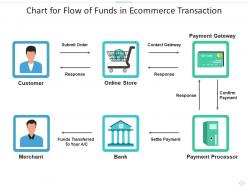
Chart for flow of funds in ecommerce transaction

Rating:
95%
Chart for flow of funds in ecommerce transaction
Slide 1 of 2
Favourites Favourites

Try Before you Buy Download Free Sample Product

Audience Impress Your
Audience
Editable 100%
Editable
Time Save Hours
of Time
The Biggest Sale is ending soon in
0
0
:
0
0
:
0
0
Rating:
95%
Introducing our Chart For Flow Of Funds In Ecommerce Transaction set of slides. The topics discussed in these slides are Payment Processor, Customer, Funds. This is an immediately available PowerPoint presentation that can be conveniently customized. Download it and convince your audience.

People who downloaded this PowerPoint presentation also viewed the following :

FAQs for Chart for flow of funds

Key ecommerce transaction flow chart stages include product browsing, cart management, user authentication, payment processing, order confirmation, inventory updates, and fulfillment tracking. These stages streamline customer experiences by automating checkout processes, securing payment gateways, and integrating inventory systems, with many retailers finding that optimized flows reduce cart abandonment while enhancing operational efficiency.

A well-designed transaction flow chart improves user experience by streamlining checkout processes, reducing cart abandonment rates, identifying pain points, and optimizing payment workflows. These visual mapping tools enable retailers to enhance navigation clarity, minimize transaction steps, and accelerate completion times, with many ecommerce platforms finding that optimized flows increase conversion rates and customer satisfaction significantly.

Common pitfalls include overcomplicating the visual flow, neglecting mobile user experiences, failing to map error handling scenarios, ignoring payment security requirements, and overlooking post-transaction processes like confirmations and receipts. These oversights often result in confused development teams, frustrated customers, and incomplete system implementations, with many ecommerce businesses finding that clear, comprehensive flow charts ultimately streamline development cycles and enhance user experiences.

Payment gateways serve as secure intermediaries between customers, merchants, and financial institutions, processing card details, authenticating transactions, and facilitating fund transfers within the ecommerce flow. They encrypt sensitive payment data, communicate with banks for authorization, and route approved payments back to merchants, ultimately enabling seamless checkout experiences while ensuring PCI compliance and fraud protection.

Inventory management serves as the backbone of ecommerce transactions, ensuring product availability, preventing overselling, updating stock levels in real-time, and coordinating fulfillment workflows. Through automated inventory systems, retailers streamline order processing, reduce cancellations, and enhance customer satisfaction, while maintaining accurate stock visibility across multiple channels, ultimately delivering seamless shopping experiences and operational efficiency.

Analyzing transaction flow charts reveals bottlenecks by mapping each step's duration, identifying where customers abandon purchases, and highlighting system delays or redundant processes. Through visual process mapping, ecommerce businesses can streamline checkout sequences, reduce cart abandonment rates, and optimize payment gateway integrations, ultimately delivering faster transaction times and improved customer experiences across their platforms.

Key metrics include conversion rates, cart abandonment rates, payment success rates, order fulfillment times, and customer acquisition costs at respective stages. These measurements enable businesses to identify bottlenecks, optimize checkout processes, and enhance customer experiences, with many ecommerce platforms finding that systematic tracking delivers improved operational efficiency and significantly higher revenue conversion.

B2B ecommerce transactions typically involve complex approval workflows, bulk pricing negotiations, credit terms, and multi-stakeholder decision-making processes, while B2C platforms streamline direct purchases with instant payment processing. B2B flows accommodate quote requests, purchase orders, and extended payment cycles, whereas B2C emphasizes rapid checkout experiences, ultimately delivering tailored commercial solutions for different business models.

Automation enhances ecommerce transaction efficiency by streamlining payment processing, automating inventory updates, enabling real-time order tracking, reducing manual data entry, and accelerating fulfillment workflows. These technologies deliver faster checkout experiences, minimize human errors, and optimize resource allocation, with many retailers finding that automated systems significantly reduce processing times while improving customer satisfaction and operational scalability.

Mobile transaction flow considerations include simplified navigation, touch-friendly interfaces, mobile payment integration, reduced form fields, and optimized loading speeds. These design elements streamline the purchasing process by minimizing cart abandonment, enhancing user experience, and accommodating smaller screens, with many ecommerce businesses finding that mobile-optimized flows significantly increase conversion rates and customer satisfaction.

Return and refund processes integrate effectively through automated reverse logistics workflows, real-time inventory updates, flexible payment reversals, customer self-service portals, and streamlined approval systems. These mechanisms enable retailers to process returns seamlessly while maintaining inventory accuracy, with many ecommerce businesses finding that efficient return integration ultimately enhances customer trust and reduces operational overhead.

Best practices for visualizing ecommerce transaction flow charts include using clear icons and labels, maintaining consistent color coding, organizing steps chronologically, highlighting decision points prominently, and ensuring mobile-responsive design. These visualization techniques streamline customer understanding by reducing confusion, accelerating checkout processes, and minimizing cart abandonment, with many online retailers finding that well-designed flow charts ultimately enhance user experience and increase conversion rates.

Third-party software integration impacts transaction flow by introducing additional processing steps, authentication layers, and data exchange points between systems. While this can create potential delays or failure points, it significantly enhances functionality through payment gateways, fraud detection, and inventory management, with many ecommerce platforms finding that strategic integrations ultimately deliver improved security and customer experiences.

Essential security measures include SSL encryption, payment gateway tokenization, multi-factor authentication, fraud detection algorithms, and PCI DSS compliance protocols. These safeguards work together by protecting customer data during transmission, securing payment processing, and minimizing fraud risks, with many retailers finding that transparent security visualization builds customer trust and reduces cart abandonment rates.

Customer feedback refines ecommerce transaction flows by identifying friction points, highlighting confusing navigation steps, and revealing abandoned cart triggers through surveys, reviews, and behavioral analytics. This data enables retailers to streamline checkout processes, optimize payment options, and enhance user interfaces, with many ecommerce platforms finding that feedback-driven refinements significantly reduce cart abandonment rates and increase conversion efficiency.

Ratings and Reviews

95% of 100
Write a review
Most Relevant Reviews
  1. 100%

    by Derrick Rice

    Top Quality presentations that are easily editable.
  2. 100%

    by James Lewis

    Attractive design and informative presentation.
  3. 80%

    by Cristopher Cole

    Best Representation of topics, really appreciable.
  4. 100%

    by Dillon Payne

    Great quality slides in rapid time.

4 Item(s)

per page: