

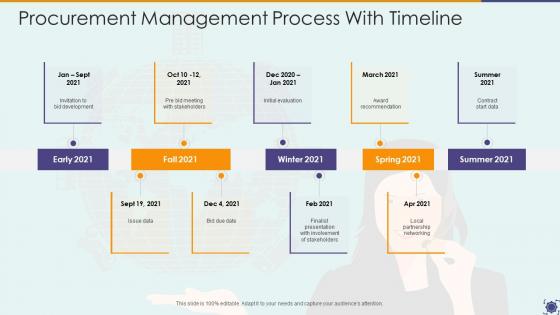
Procurement Management Process With Timeline




Try Before you Buy Download Free Sample Product
 Impress Your
 Audience
 100%
100% Editable
 Save Hours
 of Time


Our Procurement Management Process With Timeline are topically designed to provide an attractive backdrop to any subject. Use them to look like a presentation pro.
People who downloaded this PowerPoint presentation also viewed the following :
Procurement Management Process With Timeline with all 6 slides:
Use our Procurement Management Process With Timeline to effectively help you save your valuable time. They are readymade to fit into any presentation structure.





FAQs for Procurement Management
So there are basically 5 stages to track: planning/requirements, finding vendors, the whole RFP thing, picking someone, then hammering out contracts. Honestly, timelines are all over the place - some stuff takes weeks, others drag on forever (especially if you're dealing with government red tape). Don't rush the planning part though, trust me on that one. I'd add buffer time everywhere, but especially for evaluating vendors since that always takes longer than you think. Oh, and get everyone on board with your timeline upfront or you'll be constantly explaining delays later.
Honestly, procurement timelines are all over the place depending on your industry. Healthcare and aerospace? You're looking at 12-18 months easy - the regulatory stuff is absolutely insane. Tech moves way faster though, usually 2-6 months since they actually care about speed. Government contracts are the worst - 18+ months sometimes because, well, bureaucracy. Oh, and manufacturing usually falls somewhere in the middle around 6-12 months. Whatever timeline you think you need, just add extra time. I've literally never seen a procurement process finish early.
SAP Ariba and Coupa are solid for automating the whole requisition mess - they handle approvals and vendor stuff automatically. Honestly though, sometimes the simple fixes work best. Try Asana or Monday first to see where things are actually getting stuck. ContractWorks speeds up those painful legal reviews if that's your main bottleneck. Zapier's great for connecting whatever random systems you're already using without breaking the bank. Oh, and don't try to fix everything at once - just pick your biggest pain point and start there. Way less overwhelming.
Ugh, vendor selection is where everything falls apart if you're not careful. Most people think 2-4 weeks is plenty but then get blindsided by how long due diligence actually takes. I've seen it mess up entire timelines - contract negotiations get delayed, implementation gets pushed back, go-live dates become a joke. Start your vendor outreach way earlier than feels necessary. Buffer time is your friend here. Things always take longer than you expect, and honestly? That's probably still optimistic.
Look, stakeholders can totally make or break your procurement timeline. Get their input early for requirements and approvals, but don't let too many people jump in - that's where things get messy. Figure out who's actually essential upfront and tell them exactly when you need decisions. I always map out who reviews what at each stage, then add extra buffer time because people are slow. Oh, and whatever timeline they give you? Double it. They'll promise quick turnaround then disappear for two weeks.
Start tracking milestones right away - just throw together a basic spreadsheet with all your key dates (RFP release, proposal deadlines, evaluation stuff, contract signing). Monday.com works if you're fancy, but honestly Excel is fine as long as people actually update the damn thing. Give someone ownership of each milestone and do regular check-ins. Build in extra time because vendors will beg for extensions and your internal approvals are going to take forever anyway. Oh, and set up reminders a few days before deadlines - trust me on this one, things slip through the cracks way too easily.
Dude, unclear requirements will absolutely wreck your timeline every time. Then you've got endless vendor questions and internal approvals that just sit there forever. Stakeholders changing their minds halfway through? Ugh, tale as old as time. Budget issues slow everything down too - suddenly you need three more signatures or have to start over completely. Oh and legal reviews? Always take twice as long as they promise. Contract stuff gets messy fast, especially with new vendors. Honestly, just assume everything will take longer. Lock down your requirements before you even think about starting the RFP. Buffer time is your best friend here.
Honestly, you're looking at 2-4 weeks just for planning and figuring out what you actually need. Then vendor outreach and collecting proposals eats up another 3-6 weeks. Evaluation takes 2-4 weeks if you're lucky. Contract negotiation? Budget 1-3 weeks, but I've seen legal drag that part out forever over tiny details. Anything over 50K will easily hit 2-3 months total. My advice? Build in extra time from the start and don't let people pressure you to skip the evaluation phase - that's where things go sideways later.
Yeah, risk management absolutely adds time to procurement - we're talking weeks or even months sometimes. New vendors especially need thorough vetting, plus all the security checks and compliance stuff. I watched one "quick" software buy drag on for three months because IT kept finding new security concerns to obsess over! Build this time into your original timeline instead of scrambling later. Start your risk assessments early and try running them alongside other procurement steps. That way you're not sitting around waiting for approvals while everything else is ready to go.
Ugh, regulatory stuff is the worst - it'll easily double your timeline, sometimes more. Healthcare and finance are absolutely brutal about this. You need buffer time for all their compliance reviews and documentation nonsense. My advice? Map out every regulatory checkpoint upfront because you can't speed through any of them. Build in like 30-50% extra time minimum. Get your compliance people involved from the start too - they're actually good at spotting problems before they blow up your whole schedule. Trust me, better to overestimate than scramble later.
First thing - get your vendor requirements standardized and pre-approve the good suppliers you already know. Run approvals at the same time instead of making everyone wait in line (legal can review contracts while procurement handles tech specs). Set different approval levels so your CEO isn't signing off on printer paper orders, which honestly happens more than it should. Map out your current mess first to see where things get stuck. Deadlines help too - automate the boring stuff like sending out RFPs. Don't lower your standards, just cut the paperwork bloat.
Oh totally - demand changes mess with your whole timeline. When demand spikes, you're stuck rushing everything: faster sourcing, maybe splitting orders between suppliers, way shorter eval periods. I've watched teams completely skip their background checks when they panic, which... yeah, bad idea. Demand drops though? Perfect time to slow down and actually negotiate decent terms or check out new suppliers without the stress. Honestly the smartest thing is just padding your original timeline from the start because demand's gonna shift - that's just how it goes.
Dude, prepare your standard terms and non-negotiables before you even start talking. Seriously, most delays happen because people wing it and then scramble later. Template contracts are your best friend here - don't reinvent the wheel every time. Focus on the big stuff, not tiny word changes that don't matter. Run parallel negotiations too, creates some urgency (vendors hate losing deals to competitors lol). Oh and assign one person from each side as the main contact. Nothing kills momentum like "let me check with my manager" every five minutes. Schedule regular check-ins so things don't just... die.
Dude, clear communication is huge - cuts your procurement timeline by like 30-40%. Be super upfront about requirements and deadlines from the start. That way vendors actually submit complete proposals instead of you having to chase missing docs (which is honestly the worst). Regular check-ins with stakeholders are key too, otherwise approvals just sit there forever. Create a shared timeline so everyone knows what they're supposed to do and when. Oh, and here's something that really works - send out template responses for those same questions vendors always ask. Saves tons of time.
Look, start with cycle time - track from when someone submits a req all the way to contract signing. Response rates from suppliers matter too, plus how long each stage actually takes. Cost per transaction is massive because that's where you'll spot the money drains. Don't skip stakeholder satisfaction either - angry internal customers mean your process sucks, period. Oh and definitely benchmark against industry standards so you know if you're being slow. But honestly? Pick maybe 3-4 metrics tops and actually review them monthly. Nobody needs another forgotten dashboard collecting digital dust.
-
Visually stunning presentation, love the content.
-
Illustrative design with editable content. Exceptional value for money. Highly pleased with the product.