


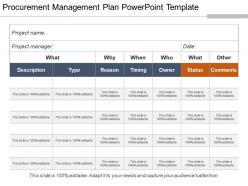
Procurement management plan powerpoint template





Try Before you Buy Download Free Sample Product
 Impress Your
 Audience
 100%
100% Editable
 Save Hours
 of Time


Color up the event with our Procurement Management Plan Powerpoint Template. They will create a brighter environment.
People who downloaded this PowerPoint presentation also viewed the following :
Procurement management plan powerpoint template with all 5 slides:
Focus forward with our Procurement Management Plan Powerpoint Template. The future will appear bright and clear.


FAQs for Procurement management
Start with your procurement timeline - that's your foundation. Then figure out roles, responsibilities, and what contract types make sense. Budget constraints and approval processes are next (ugh, approvals take forever but you can't skip them). Vendor selection criteria matters a lot. Don't forget performance metrics for tracking once contracts are live. Risk management strategies should cover your ass when things go sideways. Legal and compliance stuff is huge if you're in a regulated space. Oh, and map out how you'll actually manage these contracts day-to-day - that part gets overlooked way too often but it'll save you headaches later.
So basically, a Procurement Management Plan is just one piece of your bigger project plan. Your main project plan covers everything - timelines, budgets, all that stuff. But procurement gets specific about buying things from vendors. Like, how you'll pick them, what contracts to use, the whole purchasing process. I always think of it like this: if your project plan is the house blueprint, procurement is just the detailed specs for redoing the kitchen (probably the most expensive part anyway). You just gotta make sure they work together so your vendor stuff doesn't mess up your schedule or budget.
Dude, you absolutely need to get stakeholders involved early or you're setting yourself up to fail. Talk to end users, finance, legal, suppliers - basically anyone who'll be touched by this. I learned this the hard way on a project where we didn't loop in IT until way too late. Their input helps you figure out the right approach, spot potential issues, and set timelines that actually make sense. Don't wait until you've already decided on something. Have these conversations during planning when you can still pivot if needed.
So there's basically four main ways to buy stuff. Competitive bidding when you know exactly what you want and just need the cheapest option. RFPs work better for complicated projects where you're judging more than just price - like how they'll actually do the work. Then there's sole source, which is when only one company can handle it (good luck convincing procurement of that though, they hate it). Direct purchase orders are for boring everyday stuff that doesn't cost much. Just match the method to how complex and expensive your purchase is.
Honestly, the trick is baking risk stuff right into your procurement plan from day one. Start by flagging the obvious threats - supplier goes belly up, shipments get delayed, quality tanks. Build backup vendors into your selection process and make sure contracts actually spell out who's responsible when things go sideways. I always set up regular check-ins to monitor how things are tracking because problems love to sneak up on you. The whole point is getting ahead of the mess instead of scrambling later. Document your "oh shit" scenarios now while you're thinking clearly - trust me, you don't want to figure this out mid-crisis.
Focus on cost variance first - that's the one that'll get you in hot water if it goes wrong. Track delivery times and quality scores too. Contract compliance matters more than people think. I always check supplier relationship health because honestly, angry vendors will screw you over later. On-time delivery rates are pretty obvious but worth measuring. Risk mitigation is good to have on there. Quality scores from your internal stakeholders tell you if stuff's actually working. Set up a monthly dashboard review so you can catch problems early. Nothing worse than finding out everything's broken when it's too late to fix it.
Think of your Procurement Management Plan as the bridge connecting what your company wants to do with actually buying the stuff to make it happen. So if you're going green, you'd focus on eco-friendly suppliers and sustainable materials - makes sense, right? The whole point is spending money on the right things at the right time to hit those bigger goals. Honestly, I'd start by looking at your organization's strategic plan first, then just build your procurement approach around whatever priorities they've set. It's pretty logical once you break it down like that.
Honestly, if you've got budget, SAP Ariba or Coupa are pretty solid - they handle vendor stuff, contracts, all that. Oracle's good too but can be overkill. For smaller teams? Monday.com works great if you set it up right. Microsoft Project's decent for timelines. Actually, I've seen teams do surprisingly well with just a well-organized SharePoint site for docs and approvals. Sounds basic but it works. The real trick is picking whatever your team will actually stick with - doesn't matter how fancy it is if nobody uses it consistently.
Build compliance into your procurement workflow right from day one. Make a checklist covering SOX, GDPR, whatever regulations hit your industry. Your team should run through this before any big purchasing decisions. Keep detailed records of everything - seriously, future you will be grateful when audit season rolls around. For complex purchases, loop in legal or compliance folks. Your vendor contracts need specific compliance language too. The trick is making this routine, not scrambling to check boxes later. Oh, and schedule regular audits so nothing slips through the cracks.
Quarterly reviews are the baseline, but honestly? Update it whenever something big shifts in your project. Scope changes, budget cuts, new regulations - all that stuff messes with procurement. I learned this the hard way on a project last year when we didn't adjust after a major scope change. Major organizational shake-ups or supply chain issues are also red flags for updates. Short version: block out those quarterly reviews on your calendar right now, but don't be rigid about it. When real changes happen, your plan needs to reflect that or you'll be scrambling later.
Okay so first thing - set your evaluation criteria before you even post the RFP. Get multiple bids obviously, and create a scoring matrix with weights for cost, technical skills, past work, timelines etc. Honestly the reference checking part is huge - I can't tell you how many disasters I've seen because people got lazy here. Document everything as you go. Make sure your RFP is detailed enough that you're actually comparing similar proposals. Oh and write down why you picked who you picked. Trust me, someone will ask later and you'll want that paper trail.
So basically, your procurement plan sets the budget upfront and maps out how you'll track spending. You get cost thresholds, approval processes, regular budget check-ins - all that stuff to catch problems early. Don't just go with the cheapest vendor though, that usually backfires. Track your purchase orders and verify invoices as they come in. The big thing? Define who can approve what amounts. Trust me, you don't want random team members making expensive purchases without oversight. I've seen projects get wrecked by surprise costs at the end.
Honestly, tech is a total game-changer for procurement stuff. You can automate all those annoying approval workflows and actually see your spending in real-time instead of guessing. AI helps with supplier risk assessment too, which is pretty neat. Cloud systems are clutch because your whole team can access the same updated info from anywhere - no more "which version is this?" confusion. The analytics help you catch problems before they turn into disasters. My advice? Figure out what's driving you crazy in your current process first, then find tools that fix those specific headaches. Way better than trying to overhaul everything at once.
Start by setting green requirements right from the beginning - environmental certs, carbon limits, ethical sourcing stuff. Don't let vendors treat it like optional. Weight these pretty heavily in your scoring matrix next to cost and quality. Honestly, I've watched so many teams mention sustainability once then completely ignore it later. Set up KPIs to actually track this throughout the whole process too. The trick is making sustainability part of your standard eval from day one. That way vendors know you're not just checking boxes, you actually mean it.
Honestly, rushing vendor selection is what kills most projects - I've watched this happen way too many times. Document everything that went sideways in your post-project reviews: vague requirements, skipped research, crazy deadlines, terrible contracts. Then look for patterns across your org's failed procurements. Nine times out of ten, it's crappy planning or waiting too long to loop in stakeholders. Build a database of these lessons (even though nobody thinks they'll actually use it). Trust me, you'll thank yourself later when you're not making the same costly mistakes again.
-
Best way of representation of the topic.
-
Excellent template with unique design.