

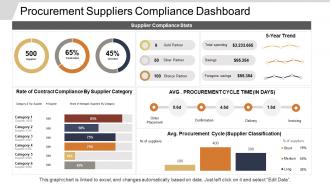
Procurement suppliers compliance dashboard






Try Before you Buy Download Free Sample Product
 Impress Your
Audience
 100%
Editable
 Save Hours
of Time


Build a firm base for your ascent with our Procurement Suppliers Compliance Dashboard. Be able to commence from the grassroots.
People who downloaded this PowerPoint presentation also viewed the following :
Procurement suppliers compliance dashboard with all 6 slides:
Spruce up your act with our Procurement Suppliers Compliance Dashboard. Keep your listeners glued to their seats with your exciting ideas.


FAQs for Procurement
Honestly, just focus on what hits your industry first. FAR if you're doing government work, SOX for public companies, GDPR when you've got EU customers. Healthcare means HIPAA headaches, finance gets Dodd-Frank, and don't even get me started on ITAR for defense - that export control stuff is a nightmare. Each sector has its own special brand of torture on top of basic procurement rules. My advice? Figure out which ones actually apply to you and build a simple checklist. Way better than drowning in regulations that don't even matter for your business.
Honestly, start with regular internal audits and get some decent procurement software that tracks compliance stuff automatically. Random spot checks are where it's at though - I swear they catch way more problems than the scheduled ones. Document everything at each stage: vendor selection, contract approvals, payments, all of it. Run reports on vendor diversity, spending limits, approval workflows - the usual suspects. Mix automated monitoring with manual reviews from your team. Oh, and figure out your biggest compliance risks first, then build everything around those. That way you're not wasting time on minor stuff that doesn't really matter.
Honestly, automation is a lifesaver for procurement stuff. Set up workflows that auto-enforce your approval chains and flag sketchy contracts before they become problems. AI can actually scan vendor agreements for compliance issues now (which blew my mind when I first saw it). The beauty is you're not depending on Sarah from purchasing to remember every single policy - because let's be real, that never works out. Don't try to automate everything at once though. Pick your messiest, most error-heavy processes first. That's where you'll actually notice the difference right away.
Honestly, supply chain compliance is like trying to hit a moving target. Trade wars pop up, pandemics mess everything up, and suddenly your "compliant" supplier isn't anymore. Your procurement folks need to build in flexibility from day one - can't just set rules and walk away. Diversifying across regions helps a ton, but you've also got to stay current on regulations in every market you're sourcing from. I learned this the hard way when a client got burned by new EU rules they missed. Bottom line: treat compliance like it's constantly evolving and regularly test your strategies.
Oh man, the worst part is definitely when different departments have totally different rules - drives everyone crazy. Documentation is usually a mess too. Half the time people just ignore the whole process because it's way too complicated or takes forever. Keeping up with regulations is brutal, especially government stuff. And don't get me started on tracking supplier certifications manually - what a pain. Honestly though, if you can automate those approval workflows first, that'll solve like 80% of your headaches. Just make the guidelines simple enough that people actually want to follow them.
Honestly, the best training happens when people can actually practice what they'll be doing. Skip the boring PowerPoint slides - nobody remembers those anyway. Instead, create scenarios based on real procurement situations your team deals with. Make it interactive with case studies they can work through. Role-specific modules work way better than one-size-fits-all training. And don't forget refresher sessions because rules change and, let's face it, people forget stuff. The game-changer is connecting the training to actual consequences and rewards. When your staff sees how following procurement rules directly impacts their work and the organization, they'll actually care about learning it.
Dude, non-compliance in procurement is a nightmare you don't want. Legal penalties and regulatory fines add up quick, plus your reputation gets trashed when suppliers can't trust you anymore. I've watched companies lose government contracts entirely over this - talk about a revenue killer. Then there's all the internal mess: redoing processes, surprise audits, awkward meetings with leadership asking what the hell happened. Your team needs to know compliance rules from day one and actually build them into decisions. Short version: it's way easier to do it right the first time than clean up the disaster later.
Yeah, procurement's gotten way more complicated lately. You can't just focus on price and delivery times anymore - now you're stuck verifying that suppliers actually follow environmental rules, treat workers decently, and hit all these ESG requirements. Honestly, it's kind of a pain but makes sense. Due diligence means auditing their practices and tracking supply chain stuff you probably never thought about before. I'd start by looking at your current suppliers and figuring out which ones might be sketchy. Documentation's huge too - you'll need all those sustainability metrics ready.
Honestly, just pick 3-4 metrics that actually matter to your company - don't go overboard trying to track everything. Compliance rate is the obvious one (what percentage of purchases follow your processes). Contract adherence and supplier certification rates are solid picks too. Exception frequency is annoying but super telling - those "just this once" situations pile up faster than you'd think. Audit findings tell you if you're improving over time. Cost savings between compliant vs non-compliant purchases can be eye-opening for leadership. Time-to-resolution matters if you're drowning in compliance issues. Oh, and training completion rates if your team keeps forgetting the rules. Check them monthly and you'll spot problems before they blow up.
Honestly, just start simple with clear purchasing policies and actually follow them. A basic spreadsheet tracking vendors and approvals beats fancy software any day - I've watched huge companies totally bomb this by overcomplicating everything from day one. Document your vendor selection process and train whoever's doing the buying. Consistency matters way more than being perfect right out the gate. Competitive bidding, approval workflows, all that stuff needs to be written down somewhere. You can always upgrade to automated tools later once you've got the boring foundation stuff nailed down first.
First thing - get your leadership on board or you're dead in the water. Training is huge but make it actually interesting, not some boring slideshow that'll put everyone to sleep. Document everything and set up clear approval processes. Honestly, the carrot works better than the stick here - reward people for doing things right instead of just punishing mistakes. Oh, and don't make this just procurement's problem. Everyone needs skin in the game. Regular audits help you spot trouble before it becomes a real headache.
Yeah so when laws change, your compliance stuff usually needs updating too. Could be small tweaks or a total redo - depends how big the changes are. Most of the time you'll get a transition period to fix your processes and retrain people. The annoying part? Some changes apply backwards to old contracts (seriously, who thought that was fair?). Others only hit new deals going forward. Your legal team should be watching for this stuff and doing gap analyses. Honestly, I'd just do quarterly reviews so you're not scrambling later when something breaks.
First thing you'll want to do is compare your current procurement stuff against ISO 20400 or UN Global Compact standards - gives you a solid starting point. Look for gaps in supplier diversity, environmental impact, ethical sourcing. Honestly, this part can be a real wake-up call! Update your framework to include these standards after that. Train your team on the new requirements (they'll probably have questions). Set up regular check-ins to monitor everything. Oh, and create actual measurable KPIs - otherwise you're just going through the motions. The whole point is tracking real progress, not just ticking boxes.
Look, getting stakeholders involved early saves you so much headache later. Map out who needs to be in the loop - legal, finance, users, suppliers - and build those check-ins right into your process. People actually follow rules when they had a say in making them, which honestly makes total sense. You'll spot compliance gaps before they blow up into expensive disasters. The best part? Those same people become your allies instead of fighting you every step. I learned this the hard way on a project last year. Start identifying key players for each procurement decision and you're golden.
Look, there's a bunch of ways to tackle this. GRC platforms are pretty solid for automating the boring stuff like policy tracking. Industry associations have tons of free templates and guides - seriously, people sleep on these resources. Government sites like GSA are decent for staying on top of regulatory changes too. If you're drowning in complex regs, maybe bring in a consultant. Oh, and don't overlook the simple stuff first. Start with a basic compliance checklist for what you're already doing, then expand from there. Way easier than trying to boil the ocean right away.
No Reviews