

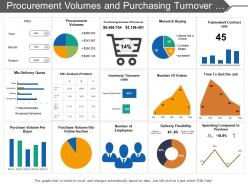
Procurement volumes and purchasing turnover dashboard






Try Before you Buy Download Free Sample Product
 Impress Your
Audience
 100%
Editable
 Save Hours
of Time


Ideas will function with our Procurement Volumes And Purchasing Turnover Dashboard. They will acquire the energy for activation.
People who downloaded this PowerPoint presentation also viewed the following :
Procurement volumes and purchasing turnover dashboard with all 6 slides:
Get full benefit from our Procurement Volumes And Purchasing Turnover Dashboard. You will deserve every bit of credit.


FAQs for Procurement volumes and
Focus on cost savings and cycle time first - those are your bread and butter. Supplier performance scores matter too, plus contract compliance rates. Oh, and don't sleep on spend under management like I did at my last job. That bit us hard. Purchase order accuracy is pretty straightforward to track. You might want supplier risk metrics depending on your industry. Diversity spend too if leadership cares about it. Honestly though? Pick maybe 5-6 things max. Otherwise you'll drown in spreadsheets and never actually use the data to make decisions.
Dude, procurement analytics is way better than just guessing about your suppliers. Real-time dashboards show you everything - delivery rates, quality scores, costs, compliance stuff. Way less painful than those endless spreadsheets we all hate! You can actually spot which suppliers suck before they screw you over. Plus it predicts supply chain problems ahead of time, which is pretty cool. Benchmarking different suppliers against each other becomes super easy too. Honestly, just start with automated scorecards for your main suppliers first - you'll wonder why you didn't do this sooner.
Honestly, data visualization is a total game-changer for procurement stuff. You know how you'd normally be drowning in spreadsheets? Charts and dashboards make everything way clearer - like you can actually see spend patterns, which suppliers suck, and where you're bleeding money. I've seen people waste hours trying to find trends in raw data when a simple visual would show it instantly. Start with basic spend analysis dashboards first (trust me on this one). Contract renewals, overspending, underperforming vendors - it all jumps out at you. Makes your whole procurement strategy so much more obvious when the patterns are right there visually.
Dig into your past procurement data - it's gold for spotting spending patterns and figuring out which suppliers actually deliver vs. the ones that constantly let you down. Pull reports from your biggest spend categories over the last 2-3 years. You'll see trends in purchase volumes, delivery times, quality issues, all that stuff. Honestly, some suppliers look great on paper but their track record tells a different story. Use this intel to negotiate better deals and predict when demand's gonna spike so you're not panicking later. I bet you'll find some eye-opening insights that'll save real money.
Honestly, the data mess is gonna be your biggest pain. You've got procurement info everywhere - ERPs, random spreadsheets, platforms that barely sync up. It's a nightmare to clean and standardize all that stuff. Getting buy-in from finance and procurement teams? Good luck with that one - they hate changing how they work. Oh, and finding someone who actually gets both procurement AND analytics is like finding a unicorn. Seriously rare skill combo. My advice? Pick one supplier category first. Prove it works there before you try to tackle everything at once.
Dude, procurement analytics is a game changer for cutting costs. First time I saw one of these dashboards, I couldn't believe we were paying three different prices for the same pens - so embarrassing! It spots spending patterns you'd miss otherwise. You can figure out which suppliers actually deliver value and use real data when negotiating better rates. No more duplicate purchases across departments either. Smart timing helps too, like buying before prices spike seasonally. Focus on your biggest spending categories first though - that's where the real savings are hiding. Way more effective than trying to analyze everything at once.
Get your data platform sorted out first - pull from ERP, suppliers, all that spend data. Tableau or Power BI are basically required now for dashboards. Machine learning's pretty huge for classifying spend and scoring supplier risk. API integrations are what make everything actually work together (learned this the hard way). Everyone obsesses over the flashy AI features, but clean data governance is still everything. Oh, and audit your current systems first - figure out where the biggest gaps are in your procurement process before you go buying new tech.
So procurement analytics is basically your heads-up system for supply chain disasters waiting to happen. You can track supplier performance trends and catch red flags before they blow up in your face. The data shows you where you're too dependent on single suppliers (which honestly happens more than people admit) and helps predict bottlenecks. Financial health monitoring is huge too - you'll spot vendors circling the drain before they take you with them. Start by mapping what risks you're already sitting on. That's usually where the oh-shit moments reveal themselves, and you can actually do something about it.
Dude, real-time data is a total game changer for procurement. Instead of waiting around for monthly reports, you're seeing price changes instantly. Supply chain issues? You'll catch them as they happen and pivot fast. I used to hate those quarterly reviews - such a waste of time. Now you can negotiate way better deals because you've got current market data right there. Spotting cost savings happens so much faster too. Honestly, just start by hooking up your main supplier feeds first. That'll give you live updates on delivery times and pricing trends, which is where most of the action happens anyway.
Honestly, predictive analytics is like having a crystal ball for your supply chain. You can spot supplier risks and price swings weeks ahead instead of getting blindsided when everything goes sideways. The accuracy on some of these models is getting pretty insane - though I still don't totally trust the hype around AI fixing everything. Your team stops playing whack-a-mole with problems and actually gets ahead of them. They'll optimize contracts, cut costs, build stronger supplier relationships. Just don't go crazy at first. Pick something simple like demand forecasting, show it works, then expand from there.
First thing - map out your current ERP data flows before throwing any analytics on top. You need to see what you're actually dealing with. Go for API integrations over batch uploads if you can. Real-time data crushes yesterday's reports every single time. Get your procurement folks involved early (seriously, they'll spot data weirdness that IT totally misses). Standardize how you classify vendors and spending across both systems. Run everything in parallel for at least a month - I learned this the hard way on a project last year. Start small though. Pick one thing like spend analysis, nail it, then expand from there.
So ML basically finds spending patterns you'd never catch on your own - we're talking huge datasets here. You can predict when prices might spike, flag suppliers who always run late, even spot sketchy invoices. Honestly, the fraud detection stuff is wild. It'll also crunch historical data to suggest your best supplier options for different buys. My advice? Don't go crazy at first. Pick your biggest spending areas where small wins actually move the needle. Even a 2% improvement on your top categories adds up fast.
Dude, supplier privacy and data security are huge red flags here. You're dealing with their financials, contracts, performance data - basically everything that could tank them if it gets out. Your analytics models might also be biased against smaller suppliers without you realizing it. Honestly feels like everyone underestimates how messy this gets. Get clear consent for how you'll use their data and audit your algorithms regularly. Oh, and definitely run a privacy impact assessment first - that'll show you where the biggest risks are hiding.
So basically, procurement analytics lets you see which suppliers are actually doing good environmental stuff vs just talking about it. You can track carbon footprints, find vendors with solid green practices, and measure how your purchasing choices affect sustainability. Honestly, it's pretty powerful once you get into it. The data helps you consolidate shipments, pick local suppliers to cut down transport emissions, and bake environmental requirements right into your contracts. I'd start by mapping out what your current suppliers are doing sustainability-wise, then use that as your baseline to improve from.
Honestly, three big things are dominating procurement analytics right now. Supply chain resilience is huge - everyone's paranoid about disruptions after the past few years of chaos. ESG tracking is the second one because companies need to prove their sustainability numbers to investors. AI optimization is getting crazy sophisticated too. Most businesses are going nuts over supplier risk monitoring (can't blame them). Predictive analytics for demand forecasting is pretty much expected now, and automated contract analysis is becoming the norm. I'd focus on supply chain risk indicators first if you're building dashboards - that stuff directly hits business continuity. ESG scorecards are next priority since compliance headaches aren't worth it.
No Reviews