


Professional skill development workshop proposal powerpoint presentation slides




Try Before you Buy Download Free Sample Product
 Impress Your
 Audience
 100%
100% Editable
 Save Hours
 of Time


Our Professional Skill Development Workshop Proposal Powerpoint Presentation Slides are topically designed to provide an attractive backdrop to any subject. Use them to look like a presentation pro.
People who downloaded this PowerPoint presentation also viewed the following :
Content of this Powerpoint Presentation
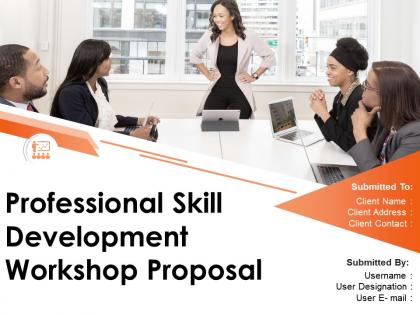
Slide 1: This slide introduces Professional Skill Development Workshop Proposal. State Client details and User details.
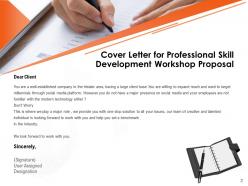
Slide 2: This slide displays Cover Letter for Professional Skill Development Workshop Proposal.
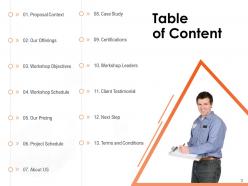
Slide 3: This slide showcases Table of Content.
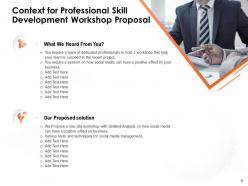
Slide 4: This slide displays Context for Professional Skill Development Workshop Proposal. You require a team of dedicated professionals to hold a workshop that help your team to succeed in the recent project.
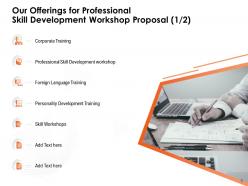
Slide 5: This slide displays Our Offerings containing- Corporate Training, Professional Skill Development workshop, Foreign Language Training, Personality Development Training, Skill Workshops.
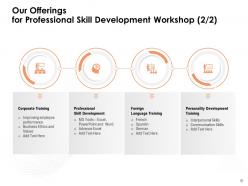
Slide 6: This slide showcases Our Offerings for Professional Skill Development Workshop such as- Professional, Skill Development, MS Tools – Excel , PowerPoint and Word, Advance Excel, wtc.
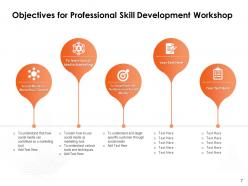
Slide 7: This slide showcases Objectives for Professional Skill Development Workshop.
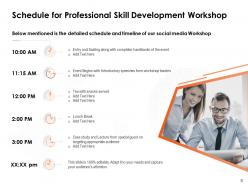
Slide 8: This slide displays Schedule for Professional Skill Development Workshop. Below mentioned is the detailed schedule and timeline of our social media Workshop
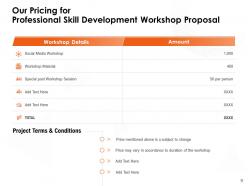
Slide 9: This slide showcases Our Pricing for Professional Skill Development Workshop Proposal.
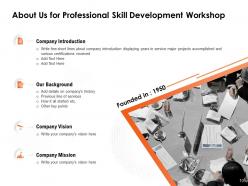
Slide 10: This is About Us slide to showcase Company specifications.
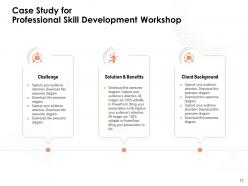
Slide 11: This slide depicts Case Study. Capture your audience attention. Download this awesome diagram
Slide 12: This slide presents Certifications.
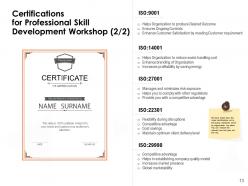
Slide 13: This slide depicts Certifications for Professional Skill Development Workshop. We have listed down the major certifications wrt to the quality standards which an organization can attain. You can choose the relevant one and grey out the rest.
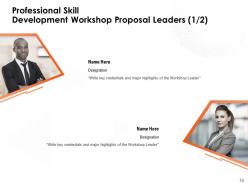
Slide 14: This slide displays Professional Skill Development Workshop Proposal Leaders.
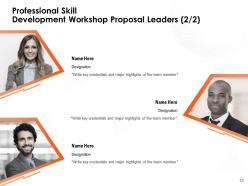
Slide 15: This slide shows Professional Skill Development Workshop Proposal Leaders. Write key credentials and major highlights of the team member”
Slide 16: This slide depicts Client Testimonial.
Slide 17: This slide displays Next Step for Professional Skill Development Workshop Proposal.
Slide 18: This slide showcases Terms and Conditions for Professional Skill Development Workshop Proposal
Slide 19: This is Contact Us slide with Company logo, Company address and Contact number and Email address.
Slide 20: This is Icons Slide for Professional Skill Development Workshop Proposal.
Slide 21: This slide is titled as Additional Slides for moving forward.
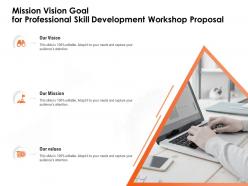
Slide 22: This slide displays Mission, Vision and Goal.
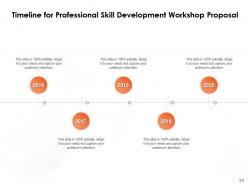
Slide 23: This slide showcases Timeline process.
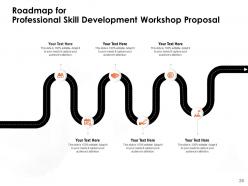
Slide 24: This slide shows Roadmap process.
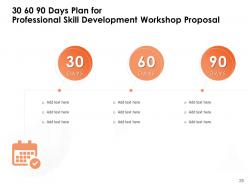
Slide 25: This is 30 60 90 Days Plan slide.
Professional skill development workshop proposal powerpoint presentation slides with all 25 slides:
Use our Professional Skill Development Workshop Proposal Powerpoint Presentation Slides to effectively help you save your valuable time. They are readymade to fit into any presentation structure.
FAQs for Professional skill development workshop proposal
Honestly? Emotional intelligence is huge - like, way more than people realize. You've gotta read the room and actually listen instead of just waiting to jump in with your brilliant ideas. Adaptability too, because everything changes constantly these days. Clear communication obviously matters, but I mean *really* listening to your team, not just nodding along. Oh, and giving feedback without destroying someone's confidence - that's an art form. Decision-making when you don't have all the info is pretty crucial too. Maybe start small this week? Just pay attention to how you're actually communicating in meetings. Are you hearing people or already planning what you'll say next?
Honestly, just stalk some job postings for roles you want - they literally tell you what matters. LinkedIn's weirdly helpful too for seeing what people in those positions actually highlight on their profiles. I'd also peek at what your top-performing coworkers are doing that you're not. Your manager probably has thoughts on where you could grow, so just ask them straight up. Here's the thing though - don't go crazy with random certifications just because they sound cool. Pick like 2-3 things max and actually get good at them instead of being mediocre at everything.
Dude, emotional intelligence is seriously underrated for career stuff. Like, you can be brilliant technically but if you can't read people or handle stress well, you're gonna hit a wall. The developers who actually advance? They're not just good at coding - they explain things without being condescending and don't create team drama. Your EQ basically makes everything else you're good at work better. Leadership, collaboration, even solving technical problems gets easier when you understand people. Honestly, just start noticing your reactions in meetings. What sets you off? How do you come across when you're frustrated? That awareness alone will help tons.
Honestly, networking is like having insider access to opportunities you'd never stumble across otherwise. People will tell you about courses they actually took (so much better than sketchy online reviews), new tools their companies are using, or skills that are suddenly in demand. You'll hear how others solve problems and realize gaps in your own knowledge - sometimes in a good way, sometimes... well, humbling lol. The conversations just happen naturally too, which is nice. I'd say pick one person this week and ask what they're working on lately or what skills they're trying to build.
Honestly? Start with just one skill and track it weekly - way less overwhelming. I swear by keeping a learning journal, plus asking colleagues for feedback since they'll catch stuff you're totally blind to. Recording yourself doing presentations is awkward as hell but you'll learn so much. Skills matrices are great for rating yourself against different competencies too. The trick is being real about where you actually are vs. where you think you are - that gap is usually bigger than we want to admit. Oh, and find a mentor if you can. Regular check-ins with someone who's been there make a huge difference.
Oh man, technology has totally changed the game for learning work stuff. Like, you can literally pick up coding or leadership skills through online courses now - LinkedIn Learning, Coursera, all that. The crazy part is how it adapts to however you learn best. Virtual practice environments are clutch too because you can mess up without actual consequences, you know? Though honestly, sometimes there's almost too many options and I get decision paralysis. My advice? Just pick one skill you actually want and dive into a platform that doesn't make you want to fall asleep.
Honestly, mentoring programs are game-changers because you get someone who's already been through what you're dealing with. They'll give you real feedback on your work and show you shortcuts that would take forever to figure out on your own. The networking part is huge too - you tap into their connections. What I love most is how they catch things you can't see about yourself, like blind spots or skills you should focus on. Way better than those cookie-cutter training things companies do. I'd look for someone who's basically where you want to be in a few years.
Honestly, you should totally stay on top of learning new stuff - it's what keeps you from getting left behind. I mean, half the things I learned in college are basically useless now lol. But here's the thing: when you're always picking up skills, you become that person bosses actually remember for cool projects and promotions. Things move so ridiculously fast these days. My advice? Pick one thing you suck at that's actually hurting your career. Then just commit to like 30 minutes a week on it. Doesn't sound like much, but it adds up way faster than you'd think.
Honestly, start by stalking job postings and LinkedIn profiles of people who have the roles you want - see what skills keep popping up. Then hit up Coursera or Udemy, but prioritize courses taught by actual industry people, not just professors (trust me on this one). Look for stuff with real projects and certs that employers actually care about. Don't just hoard random certificates though - that's pointless. Pick one skill that'll make a big impact. Finish the whole course, do the projects, then use what you learned at your current job right away. That's how it actually sticks.
Honestly, timing is everything with this stuff. I'd start small - like 15-20 minutes during lunch or whenever you can squeeze it in. Way more realistic than pretending you'll find huge blocks of time. Pick something that'll help your current job first so your boss actually notices. Podcasts are a game-changer for commutes or the gym - feels less like "studying" and more like just listening to something interesting. Oh, and definitely check if your company has training money sitting around. Mine had this whole budget I didn't even know about for like two years. Focus on one thing at first though, otherwise you'll spread yourself too thin.
Honestly, working with diverse teams is like having built-in mentors everywhere. Someone shows you a coding trick, you teach them how to nail presentations - constant skill swapping. The soft skills you pick up are probably even more valuable though? Like learning to communicate across different work styles and cultural backgrounds. That stuff's career gold. You get exposed to problem-solving approaches you'd never think of in a homogeneous group. Main thing is actually engaging with people instead of just sticking to your usual work buddies. Stay curious and you'll absorb so much.
Honestly, I'd start with basic self-assessments and 360 feedback - tools like BambooHR work well for this. Skills matrices are super helpful too since they map what people actually know against what they need to know. Your performance review data is probably already sitting there waiting to be useful. Pluralsight and LinkedIn Learning have decent built-in assessments if you want something fancier. Oh, and don't overthink it at first. Just do a simple skills inventory survey to figure out where you're at, then you can get more sophisticated later once you know what gaps you're actually dealing with.
Honestly, companies are totally fixated on communication, adaptability, and emotional intelligence right now. Being able to explain stuff clearly matters way more than people think. Plus you've gotta handle constant change without losing your mind - which, let's be real, is exhausting but whatever. Reading the room is clutch too. Problem-solving and teamwork are massive since everyone's basically connected to everyone else's work now. Critical thinking's the other big one because bosses want you making good calls on your own. Don't try mastering all of these at once though. Pick one or two and actually get good at them first.
Look, first figure out exactly what you're missing skill-wise compared to where you want to be. Job postings are honestly your best friend here - they'll show you what's actually needed, not just what sounds cool. Don't lie to yourself about your gaps either, that just wastes time. Break everything down into 3-6 month chunks with real deadlines. Mix it up too - courses, hands-on projects, maybe find someone to mentor you. I learned this the hard way, but vague goals like "get better at coding" never work. You need specifics and dates. Check in every few months to see if you're on track or need to pivot.
Honestly, certifications are basically proof you know your stuff without employers having to take your word for it. Think of it like having someone credible vouch for you instead of just saying "trust me, I'm good at this." Tech fields especially love them - sometimes you literally can't get the job without specific ones. Companies use them as shortcuts to figure out if you're qualified, which saves everyone time I guess. My advice? Look at job postings in your field and see which certs keep popping up. Don't just grab random ones though - make sure they actually matter for where you want to go career-wise.
-
Great quality product.
-
Great designs, really helpful.
-
Unique research projects to present in meeting.
-
Very well designed and informative templates.
-
Great quality product.