Project brief objectives ppt summary example introduction
Try Before you Buy Download Free Sample Product
Audience
Editable
of Time
Elaborate on the growth of civilization with our Project Brief Objectives Ppt Summary Example Introduction. Acquaint folks with their human heritage.
People who downloaded this PowerPoint presentation also viewed the following :
Content of this Powerpoint Presentation
Description:
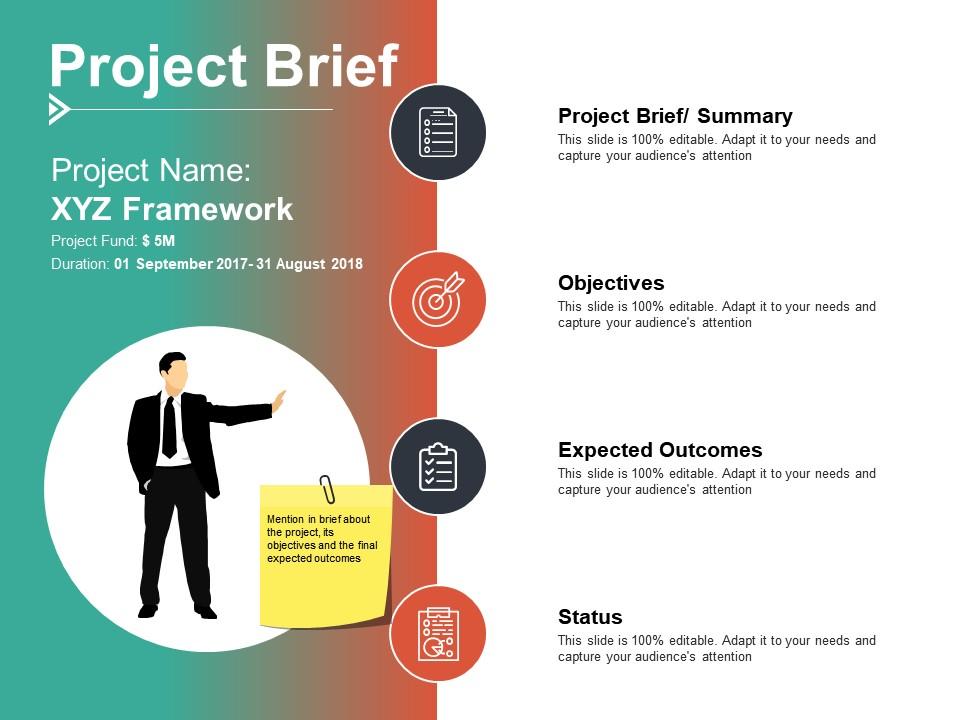
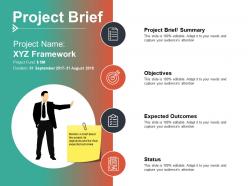
The image is a PowerPoint slide titled "Project Brief," designed to summarize a project named "XYZ Framework." It is structured into several sections, each detailing a critical aspect of the project:
1. Project Name: XYZ Framework
2. Project Fund: $5M
3. Duration: 01 September 2017 - 31 August 2018
4. Project Brief/Summary: An editable section for a summary of the project
5. Objectives: Another editable section to outline the project goals
6. Expected Outcomes: Space provided to describe what the project aims to achieve upon completion
7. Status: To indicate the current progress of the project
Use Cases:
This type of project brief slide can be utilized across a variety of industries for project planning and status reporting:
1. Technology and Software Development:
Use: Introducing new software frameworks or updates
Presenter: Project Lead
Audience: Development Team, Stakeholders
2. Construction and Engineering:
Use: Outlining new infrastructure projects
Presenter: Engineering Manager
Audience: Construction Teams, Investors
3. Healthcare:
Use: Presenting healthcare initiatives or research projects
Presenter: Program Director
Audience: Medical Staff, Research Teams
4. Education:
Use: Describing educational programs or curriculum developments
Presenter: Academic Coordinator
Audience: Educators, Institutional Leadership
5. Marketing and Advertising:
Use: Planning marketing campaigns or product launches
Presenter: Marketing Strategist
Audience: Marketing Department, Partners
6. Environmental Services:
Use: Detailing sustainability projects or environmental studies
Presenter: Environmental Analyst
Audience: Policy Makers, Environmentalists
7. Finance and Banking:
Use: Initiating new financial products or services
Presenter: Financial Planner
Audience: Bank Executives, Regulatory Bodies
Project brief objectives ppt summary example introduction with all 5 slides:
Build greater ability to absorb with our Project Brief Objectives Ppt Summary Example Introduction. Your capacity will get enlarged.
FAQs for Project brief objectives ppt
So you need clear objectives first - what are you actually trying to do? Then nail down your audience and what they want. Scope is huge (seriously, this saves your sanity later when people start asking for random additions). Timeline with real milestones, not wishful thinking. Budget limits too. Oh and define what success looks like upfront! I learned this the hard way on a project that just... never ended because we couldn't agree if it was done. Get everyone to sign off on these pieces before you start or you'll hate yourself later.
Look, when your team has super clear objectives, nobody's wandering around confused about what they're supposed to be doing. People can actually make smart decisions on their own because they get how their work connects to everything else. Those soul-crushing "wait, what's our goal again?" meetings basically disappear - thank god. Your teammates start collaborating way better too since they can see how their stuff fits with everyone else's. Just write objectives concrete enough that people can picture what winning looks like and track progress without guessing.
Dude, stakeholder feedback is everything. Without it you're just guessing what people actually want. Get their input super early because they'll catch stuff you totally missed and tell you what success looks like from their angle. I've watched projects crash and burn because teams assumed they knew what stakeholders needed - spoiler alert, they didn't. The feedback helps you nail down realistic scope and get everyone on board from day one. Oh, and ask specific questions about their constraints and needs. Don't just go "thoughts?" because you'll get useless answers.
SMART criteria will totally fix your fuzzy project objectives. Break each one down: Specific (what exactly are you doing), Measurable (actual numbers), Achievable (don't be delusional about resources), Relevant (connects to business goals), Time-bound (real deadlines). So instead of "improve customer satisfaction" you'd say "boost customer satisfaction scores from 3.2 to 4.0 in 6 months by cutting support response times." Feels like overkill at first but trust me, it prevents so many headaches later. Just grab your current objectives and run them through that checklist - you'll instantly spot the weak ones.
Don't make your goals super vague like "improve user experience" - that tells you nothing. Also avoid being crazy ambitious when you don't have the time or budget for it. The worst thing though? Setting goals you can't even measure. Like how do you know if "better brand awareness" actually happened? Make them specific with real deadlines instead. Anyone should be able to read your objective and immediately get what success looks like. Honestly, I'd rather have 3 solid goals than 10 fuzzy ones that don't mean anything. Quick test: can you explain each goal in one sentence without rambling?
Okay so here's what I'd do - make one of those impact vs effort grids. Plot everything based on value vs resources needed. Obviously hit the high-impact, low-effort stuff first. Then if you've got time left, maybe tackle the bigger projects that still pack a punch. This is honestly where things usually fall apart because everyone's convinced their thing is super critical. But you can't nail everything with limited resources, so you gotta be pretty ruthless about what actually matters. Oh and definitely write down why you made these choices - stakeholders will thank you later when they're wondering about trade-offs.
Honestly, I'd hit them with multiple touchpoints - kickoff meeting first where you walk through everything verbally. Then send a written follow-up via email or whatever project tool you're using. One-pagers work great too since people can reference them quickly without digging through long docs. Check in regularly because let's be real, objectives shift as things move along. Different people absorb info differently, so mixing formats helps. Oh and definitely keep a shared doc somewhere accessible - you'll thank yourself later when someone inevitably asks "wait, what were we supposed to be doing again?"
Track whatever metrics you actually wrote down in your project brief - completion rates, cost savings, user adoption, the usual stuff. Compare those against your original targets (if you remembered to set them lol, we've all been there). I'd start measuring within the first week so you can spot problems early. Numbers are great but don't ignore what people are actually saying about it. Honestly, the qualitative feedback from stakeholders can be just as telling. Set up check-ins at 30, 60, and 90 days to see how things are really going.
Okay so here's what I do - set up checkpoint reviews throughout the project to see if your original goals still make sense. Change control processes are your friend for documenting any tweaks (trust me, this saves you from scope creep nightmares later). Get feedback from stakeholders regularly since they'll spot when things need adjusting. Before making changes though, always run impact assessments to see how it'll mess with your timeline and budget. Oh and build review points into each phase - way better to catch issues early than scramble when everything's falling apart. Learned that one the hard way!
Look, cultural stuff will totally mess with your project goals if you're not careful. Western teams are all about hitting deadlines and who's responsible for what. But in a lot of Asian cultures? They'd rather spend time building consensus first - which honestly makes sense when you think about it. What feels "urgent" to you might come across as super rushed to them. I've watched projects blow up because nobody thought to check these things beforehand. Definitely run your objectives by someone local before you lock everything in. Trust me on this one.
Here's what I'd do - set up regular check-ins every few weeks to see if your goals still make sense. Your big "must-haves" should stay locked in, but how you get there? Stay flexible on that part. Time-box everything so you're not stuck chasing outdated targets for months (learned this the hard way). Honestly, scope creep is sneaky and loves hiding behind "being adaptable." Write down any changes you make though. When the data's telling you to switch directions, just do it. Think of it like GPS - same destination, but it'll reroute you around traffic.
So project objectives are like the smaller steps that help you hit your company's big goals. Your company wants 15% more market share? Your project might be launching that new feature by Q3. They're connected, just different levels. You should always be able to trace what you're doing back to how it actually helps the company - honestly, this is where a lot of projects go wrong. Can't make that connection? Then maybe question if it's worth doing at all. Different altitudes, same destination if that makes sense.
Honestly, risk assessments are a game changer for setting goals that don't completely crash and burn. You spot the big problems upfront - tight budgets, missing people, tech nightmares - then build your objectives around them instead of ignoring reality. Makes way more sense than crossing your fingers and hoping for the best. Your stakeholders actually trust you when they see you've thought about what could tank the project. I always start by writing down 3-5 major risks first, then shape my goals from there. Sounds backwards but it works.
Honestly? Just pick something simple that everyone will actually use. Asana and Monday are solid, but even a basic Google Sheet works if that's what your team prefers. Break your big goals into smaller chunks with actual deadlines and assign them to people. The magic happens when everyone can see how their random Tuesday tasks connect to the bigger picture. Set up some automated reminders too - trust me, stuff will slip through the cracks otherwise. I've seen too many teams go for the fancy tool that ends up ignored after two weeks.
Think of project objectives as your GPS for spending money and assigning people. Honestly, without them you're just randomly throwing cash at stuff and crossing your fingers it works out. I've seen teams waste months this way. Your objectives show you which tasks deserve the big bucks and help you figure out staffing needs. Plus later on, you'll actually have something solid to measure success against - did we hit what we aimed for or not? Get those objectives crystal clear first, then use them to guide every budget call you make.
No Reviews