

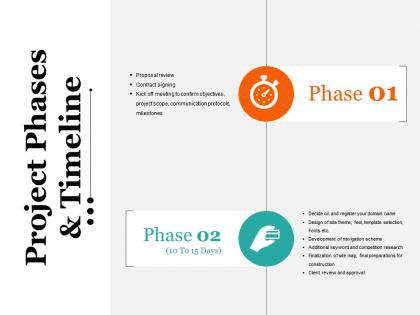
Project phases and timeline ppt examples




Try Before you Buy Download Free Sample Product
 Impress Your
 Audience
 100%
100% Editable
 Save Hours
 of Time


Answer all questions directed to you. Hold yourown with our Project Phases And Timeline Ppt Examples.
People who downloaded this PowerPoint presentation also viewed the following :
Project phases and timeline ppt examples with all 5 slides:
Convince folks that conditions are better than expected with our Project Phases And Timeline Ppt Examples. It will drastically alter impressions.




FAQs for Project phases and
The key phases in a typical project lifecycle include initiation, planning, execution, monitoring and controlling, and closure. These phases enable organizations to streamline resource allocation, manage risks systematically, and deliver consistent outcomes across industries, with many companies finding that structured project management ultimately reduces costs, accelerates delivery timelines, and enhances stakeholder satisfaction.
Defining objectives and deliverables involves establishing clear, measurable goals for each phase, identifying specific outcomes, timelines, and success criteria. This strategic approach streamlines resource allocation, enhances team accountability, and ensures stakeholder alignment, with many organizations finding that well-defined phase parameters ultimately deliver improved project visibility, reduced scope creep, and significantly higher completion rates.
Creating project timelines requires careful consideration of task dependencies, resource availability, team capacity, potential risks, and stakeholder requirements. These factors work together to establish realistic milestones and deadlines, with many project managers finding that incorporating buffer time for unexpected challenges ultimately delivers more accurate schedules and enhanced stakeholder confidence.
Effective stakeholder communication significantly enhances project phases by ensuring clear expectations, reducing scope changes, and maintaining alignment throughout development cycles. Through regular updates and feedback loops, organizations streamline decision-making, minimize delays, and accelerate project delivery, with many finding that proactive communication ultimately reduces costs and improves outcomes.
Project management tools include Gantt charts, Kanban boards, milestone tracking systems, resource allocation dashboards, and automated reporting platforms. These technologies streamline progress monitoring by providing real-time visibility, enabling cross-team collaboration, and delivering predictive analytics, with many organizations finding that integrated platforms ultimately enhance project delivery timelines and resource efficiency.
Managing scope changes requires structured change control processes, impact assessment protocols, stakeholder approval workflows, and timeline adjustment mechanisms throughout project phases. Early phases allow more flexibility with strategic pivots, while later phases demand rigorous evaluation of cost and schedule implications, with many project managers finding that proactive communication and documented change procedures ultimately deliver better outcomes and stakeholder alignment.
Resource allocation best practices include conducting thorough capacity planning, establishing clear role definitions, implementing flexible resource pools, monitoring utilization rates regularly, and maintaining contingency reserves for critical phases. These strategies streamline project execution by preventing bottlenecks, optimizing team productivity, and ensuring adequate coverage during peak demand periods, with many organizations finding that strategic resource planning ultimately delivers faster project completion and enhanced operational efficiency.
Risk assessment integrates into each project phase through continuous evaluation, stakeholder consultation, milestone reviews, and adaptive planning strategies. During initiation, teams identify potential obstacles, while planning phases involve detailed risk matrices, and execution requires real-time monitoring, with many organizations finding that proactive risk integration reduces delays and enhances project success rates.
Team collaboration ensures project timelines through streamlined communication, coordinated task execution, and proactive issue resolution, enabling teams to identify dependencies, share resources efficiently, and maintain momentum across project phases. Strong collaborative practices help organizations reduce delays by 30-40%, with many finding that integrated team workflows accelerate delivery while maintaining quality standards.
Task prioritization within project phases involves assessing impact, urgency, dependencies, and resource availability, while establishing clear deadlines and milestone checkpoints. Successful project managers use frameworks like MoSCoW method or critical path analysis to sequence deliverables, with many organizations finding that regular sprint reviews and stakeholder alignment sessions enable teams to adapt priorities dynamically, ultimately delivering projects on schedule while maintaining quality standards.
Effective milestone achievement strategies include detailed planning with buffer time, regular progress monitoring, proactive risk management, clear accountability assignments, and stakeholder communication protocols. These approaches streamline project execution by identifying potential delays early, maintaining team alignment, and enabling swift corrective actions, with many organizations finding that structured milestone tracking ultimately delivers improved project success rates and enhanced operational efficiency.
Success and quality measurement involves establishing clear acceptance criteria, conducting regular stakeholder reviews, tracking key performance indicators, and implementing quality assurance checkpoints throughout each phase. These assessment methods streamline project governance by ensuring deliverable standards, minimizing rework risks, and maintaining timeline adherence, with many organizations finding that structured evaluation processes ultimately deliver enhanced client satisfaction and competitive project outcomes.
Accurate project completion forecasting techniques include earned value management, Monte Carlo simulation, critical path method analysis, historical data extrapolation, and three-point estimation. These methodologies enhance timeline precision by incorporating risk variables, resource constraints, and performance metrics, with many project managers finding that combining multiple forecasting approaches ultimately delivers more reliable delivery dates and improved stakeholder confidence.
Lessons learned from past projects inform future phases by identifying common bottlenecks, resource allocation patterns, and timeline risks that enable more accurate planning and scheduling. Through systematic analysis of previous project data, organizations can refine estimation methodologies, optimize phase transitions, and implement proactive risk mitigation strategies, ultimately delivering more predictable timelines and enhanced project success rates.
Common pitfalls include underestimating task durations, failing to account for dependencies, neglecting buffer time for unexpected delays, and inadequate stakeholder consultation during planning phases. These oversights often result in missed deadlines, budget overruns, and resource conflicts, with many organizations finding that realistic timeline development ultimately delivers better client satisfaction and operational efficiency.
-
It saves your time and decrease your efforts in half.
-
Professional and unique presentations.