


Proposal for food providing services powerpoint presentation slides




Try Before you Buy Download Free Sample Product
 Impress Your
 Audience
 100%
100% Editable
 Save Hours
 of Time


Catering companies provide food and beverages for a range of events. The size of a catering company can vary from one chef to a full kitchen team staff. Some companies provide customize menu while others provide packages. Generally, these companies have a lot of flexibility in terms of variation in the packages. Start your own catering company and attract clients with the help of our Proposal For Food Providing Services PowerPoint Presentation Slides. Before sending the proposal to your client every company must create a timeline, research the catering industry, make a business plan, establish goals, review tax laws, develop a website, business card, determine your budget, choose suppliers and then market using this food proposal PPT theme. Increase your clients by using the attractive cover letter given in this proposal by promoting your highly skilled and professionally trained culinary team. Establish faith and transparency with the client by providing general information, catering plan timeline, catering menu, and catering themes which your company aces at. Other than this, establish awareness with the client by sharing the overall pricing structure related to food, staff, services, and equipment. Using this PPT proposal you can elaborate on the catering plan of action with steps like the creation of the menu, scouting the location where the event is going to happen, preparation of the tasks that are required before the actual event date, set up of arrangements related to decoration, food and other setup services, and finally prepare and manage the checklist of the tasks to be performed on the final event. Build trust with your client and an edge over the competitors by elucidating about your private and corporate food services, various food events showcased by the company, and the information of staff. In the end layout, the terms and conditions of the purchase order covering general validity, jurisdiction and venue terms, payment terms, resolution of disputes, and cancellation terms with this catering event PowerPoint presentation proposal. Download our ready-to-use food proposal template focusing your target market and potential customers.
People who downloaded this PowerPoint presentation also viewed the following :
Content of this Powerpoint Presentation
Slide 1: This slide introduces Proposal for Food Providing Services. State Client name, Employee asssigned and Firm name.
Slide 2: This slide displays Cover Letter for Food Providing Services Proposal
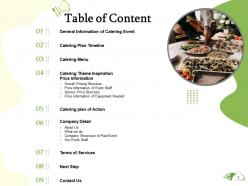
Slide 3: This slide depicts Table of Content.
Slide 4: This slide presents General Information on Food Providing Services Event.
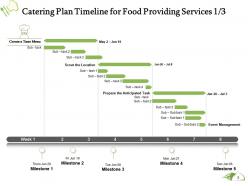
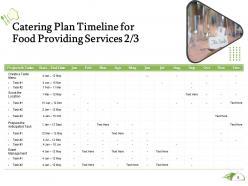
Slide 5: This slide showcases Catering Plan Timeline for Food Providing Services.
Slide 6: This slide represents Catering Plan Timeline for Food Providing Services.
Slide 7: This slide also shows Catering Plan Timeline for Food Providing Services with related information.
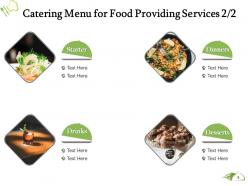
Slide 8: This slide shows Catering Menu for Food Providing Services.
Slide 9: This slide shows Catering Menu for Food Providing Services.
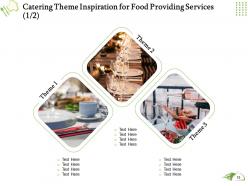
Slide 10: This slide showcases Catering Theme Inspiration for Food Providing Services.
Slide 11: This slide showcases Catering Theme Inspiration for Food Providing Services.
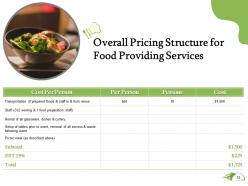
Slide 12: This slide shows Overall Pricing Structure for Food Providing Services.
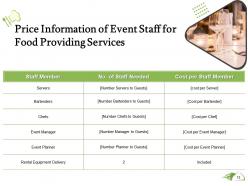
Slide 13: This slide showcases Price Information of Event Staff for Food Providing Services
Slide 14: This slide presents Service Price Structure for Food Providing Services.
Slide 15: This slide shows Price Information of Equipment Needed for Food Providing Services
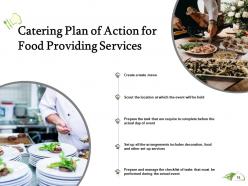
Slide 16: This slide depicts Catering Plan of Action for Food Providing Services.
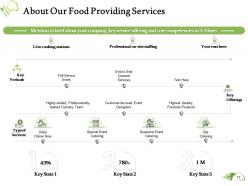
Slide 17: This is About Our Food Providing Services slide. Mention in brief about your company, key service offering and core competencies in 3-4 lines
Slide 18: This slide describes What We Do for Food Providing Services.
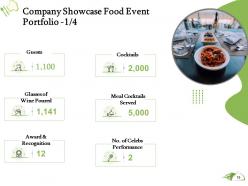
Slide 19: This slide depicts Company Showcase of Past Food Providing Services Event.
Slide 20: This slide represents Company Showcase of Past Food Providing Services Proposal Event -2/4
Slide 21: This slide depicts Company Showcase of Past Food Providing Services Proposal Event -3/4
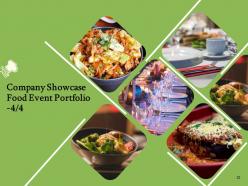
Slide 22: This slide showcases Company Showcase of Past Food Providing Services Proposal Event -4/4
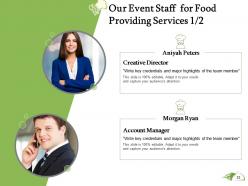
Slide 23: This slide displays Our Event Staff for Food Providing Services. Write key credentials and major highlights of the team member.
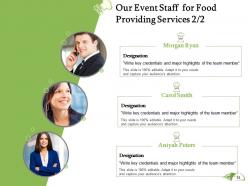
Slide 24: This slide displays Our Event Staff for Food Providing Services. Write key credentials and major highlights of the team member.
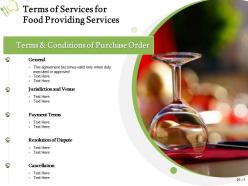
Slide 25: This slide depicts Terms & Conditions of Purchase Order.
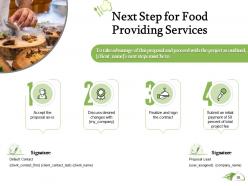
Slide 26: This slide displays Next Step for Food Providing Services
Slide 27: This is Contact Us slide with Address, Email address and Contact number.
Slide 28: This slide is titled as Additional Slides for moving forward.
Slide 29: This is Food Providing Services Proposal Icons Slide
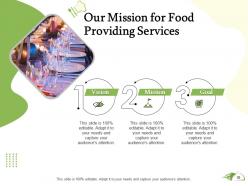
Slide 30: This is Our Mission slide with Vision, Mission and Goal.
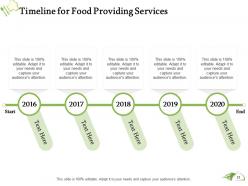
Slide 31: This slide depicts Timeline for Food Providing Services.
Slide 32: This slide displays Roadmap process.
Slide 33: This slide displays Roadmap process.
Slide 34: This slide shows 5 step Roadmap process.
Slide 35: This slide depicts 6 step Roadmap process.
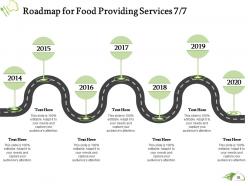
Slide 36: This slide depicts 7 step Roadmap process.
Slide 37: This is 30 60 90 Days Plan slide.
Proposal for food providing services powerpoint presentation slides with all 37 slides:













FAQs for Proposal for food providing services
So for your food service proposal, start with a solid executive summary - that's what hooks them. Menu options with pricing are obvious, but also throw in your timeline, logistics, and staff qualifications. Food safety certs are non-negotiable. The boring stuff like insurance and references? Yeah, they actually check that. Equipment needs, dietary accommodations, fee breakdowns - all gotta be there. Honestly, I'd spend extra time making it look clean and scannable since these people are drowning in paperwork. Oh, and put your contact info everywhere - you'd be shocked how often that gets buried at the end.
Dude, you gotta do market research before writing anything else. It shows you what people actually want to eat and spend money on - not just what sounds cool to you. Like, don't be the guy selling fancy $15 toast in a neighborhood where everyone wants cheap burgers, you know? Research helps with everything: your prices, menu, how fancy or casual to be, even where to set up shop. Plus it shows you what your competition is screwing up that you could do better. I always tell people to check out local demographics and spending habits first - makes your whole proposal sound way less like you're just winging it.
Honestly, your budget is what makes or breaks the whole proposal. Map out everything - food costs, labor, equipment, overhead. I once totally forgot delivery fees and it was a mess lol. It helps you price things realistically and shows clients you actually know what you're doing financially. Plus you can negotiate without panicking about going under. Always start with detailed cost breakdowns. Then add like 10-15% extra because something always goes wrong. Trust me on that buffer - it's saved me more times than I can count.
Don't just throw all your selling points in one boring section - spread them throughout the whole thing. Start strong in your executive summary with whatever makes you special, like farm-to-table sourcing or round-the-clock service. Back everything up with real proof too - testimonials, actual cost savings, certifications. Honestly, I've seen too many proposals that just say "fresh ingredients" without showing any evidence. Connect each point directly to their specific problems. Instead of generic "we're different" statements, show exactly how your differences fix what's bugging them and add real value they can measure.
So for catering, you're basically dealing with transport headaches and keeping food safe while hauling it around. Plus all the venue setup stuff. On-site dining is way less stressful honestly - you control everything but need bigger kitchen space and more staff. Equipment's totally different too. Catering means warming trays and those big transport containers, while on-site needs full kitchen setup and tables/chairs. Oh and definitely look at how often your client does events and guest counts. Make sure your proposal covers delivery times, who's setting up, and cleanup responsibilities. Trust me, catering can feel like organized chaos some days!
Dude, visuals are everything - get some killer food photos, maybe even those 360-degree shots if you can swing it. Way better than just describing stuff. Make it interactive too! Clickable menus, videos of your kitchen in action, virtual tours of the space. Real-time dashboards showing your metrics and customer scores will blow their minds compared to boring PDFs everyone else sends. I swear, most people just skim through static documents anyway. Oh, and sustainability tracking data looks super professional right now. Just make them actually want to click around and explore your proposal instead of zoning out.
Here's what I'd do - grab survey data and testimonials from potential customers first. Ask about food preferences, dietary stuff, what they're willing to spend. Honestly, this feedback is way more convincing than just guessing what people want. Use those insights to back up your menu choices and pricing throughout the whole proposal. Throw in actual quotes from focus groups too. Your staffing plan should reflect what customers said about service expectations. Instead of treating feedback like something you tack on at the end, make it the foundation that supports every decision you're proposing.
Menu mockups with actual food photos are a must. Show them floor plans with kitchen layout and customer flow too. For the numbers part, make cost breakdown charts super digestible - nobody wants to squint at tiny spreadsheets. Revenue projections work great, especially those charts that go up and to the right (executives eat that stuff up). If you're changing an existing place, before/after comparisons are gold. Honestly, competitor analysis visuals help show where you stand. Keep slides clean, not text-heavy or people tune out. Oh, and lead with your best visual to grab attention immediately.
Honestly, clients eat up the sustainability stuff if you do it right. Talk about partnering with local farms and getting rid of single-use plastics - that always hits. Composting programs are huge too. I'd definitely mention any certifications you're going for, like organic partnerships or whatever. The trick is being super specific instead of just saying generic green stuff. Like, throw in actual numbers - "we'll cut food waste by 30%" sounds way better than vague promises. Oh, and don't forget energy-efficient equipment! I've literally seen proposals win just because they had a decent recycling plan.
Start with the basics - breakfast, lunch, dinner sections. Then break those down into proteins, sides, and dietary stuff. Price everything per serving so they know what they're getting into. Honestly, skip the flowery food descriptions - clients just want to know what it is and how much it costs. Definitely call out your vegan, gluten-free options upfront since that's always someone's first question. Throw in portion sizes too. Oh, and maybe add 2-3 seasonal menu swaps to show you're flexible. A sample weekly rotation at the end really helps them picture what their team's actually eating.
Okay so for your food service proposal, break down staffing for each shift - cooks, servers, cashiers, managers, all that. Training programs are huge here. Cover food safety, equipment stuff, customer service. Oh and get everyone ServSafe certified obviously. You gotta plan for ongoing training and performance reviews too. Labor costs need estimates, plus how you'll deal with turnover (because honestly, people quit food service jobs like crazy). The whole point is proving you understand it's not just about having good food - the human element makes or breaks these places. Include schedules for everything.
Honestly, start simple with like 3-4 metrics you can actually track without going crazy. Revenue per customer and food cost percentage are obviously crucial - gotta know if you're making money, right? Customer satisfaction and wait times matter too though, since nobody's coming back if the service sucks. I'd throw in repeat customer rate because that's basically your report card on whether people actually enjoy eating there. Oh, and food waste percentage if you can swing it - that stuff adds up fast. Once you get comfortable tracking those, you can always add more operational stuff later.
Look, competitive analysis proves you actually know what you're doing. Research 3-4 local food service companies - check their pricing, menus, how they operate, what clients say about them. This helps you show what makes you different and better. Clients eat this stuff up because it shows you get the market. Justify your prices with real data and point out gaps your competitors are missing. Oh, and definitely throw in a comparison chart - makes everything look way more legit. Decision-makers love having concrete reasons to pick you over everyone else.
Dude, definitely bring samples if you can swing it - food investors want to taste what they're betting on. Start with your numbers though, they care about ROI before anything else. The market's super saturated so you've gotta stand out somehow. Tell them why YOU can pull this off when so many restaurants fail. Have your supplier stuff figured out, staffing plans, all that operational nitty-gritty ready to go. Practice but don't sound robotic about it. Oh and your projections better be realistic - those margins are brutal and if you're pretending otherwise, they'll know you don't get the industry.
Create a solid risk management section covering food safety protocols, supply chain issues, and staffing problems. List your HACCP plans, backup suppliers, and cross-training stuff. Liability insurance and emergency procedures are must-haves too. Equipment failures deserve a mention - that crap always dies during your busiest week, I swear. Each risk needs its matching solution right there. Oh, and don't just list problems - show how you'll actually fix them. Clients want to see you've already thought this through instead of scrambling when things go sideways.
No Reviews